SEO
What Is SEO? How Does Search Engine Optimization Work?
SEO helps search engines discover, understand and evaluate a website for relevant searches. In this guide, we explain how search engine optimization works, from crawling and indexing to technical SEO, content, authority and performance measurement.
By Mehmet ÇalışırPublished Updated 12 min read
Contents
SEO, or Search Engine Optimization, is the process of improving a website so that Google and other search engines can discover it more easily, understand its content correctly and show it for relevant user searches. SEO is not simply about adding certain keywords to a page or trying to reach the first position on Google. It requires several areas to work together, including technical infrastructure, content quality, user experience, website architecture and brand authority.
The main purpose of a strong SEO strategy is not simply to attract more visitors. The real objective is to help users who are genuinely interested in a company's products or services reach the right pages. For this reason, SEO requires an understanding not only of how search engines work, but also of what users are searching for, why they are searching for it and what kind of answer they expect.
Short answer: SEO is the process of improving a website's technical infrastructure, content, on-page optimization, website architecture and external authority signals so that it can achieve stronger organic visibility in search engines.
At Doruva, our SEO service focuses on improving the website's overall organic visibility rather than concentrating on individual keywords in isolation.
What Is SEO?
SEO stands for Search Engine Optimization. Its fundamental purpose is to make a website more compatible with the way search engines discover, process and evaluate web pages while helping the site become more visible for relevant user searches.
However, viewing SEO only as a matter of Google rankings is incomplete. For a website to perform sustainably in organic search, it first needs to be technically accessible, its pages need to communicate clearly what they are about, and its content should respond to the real needs of users.
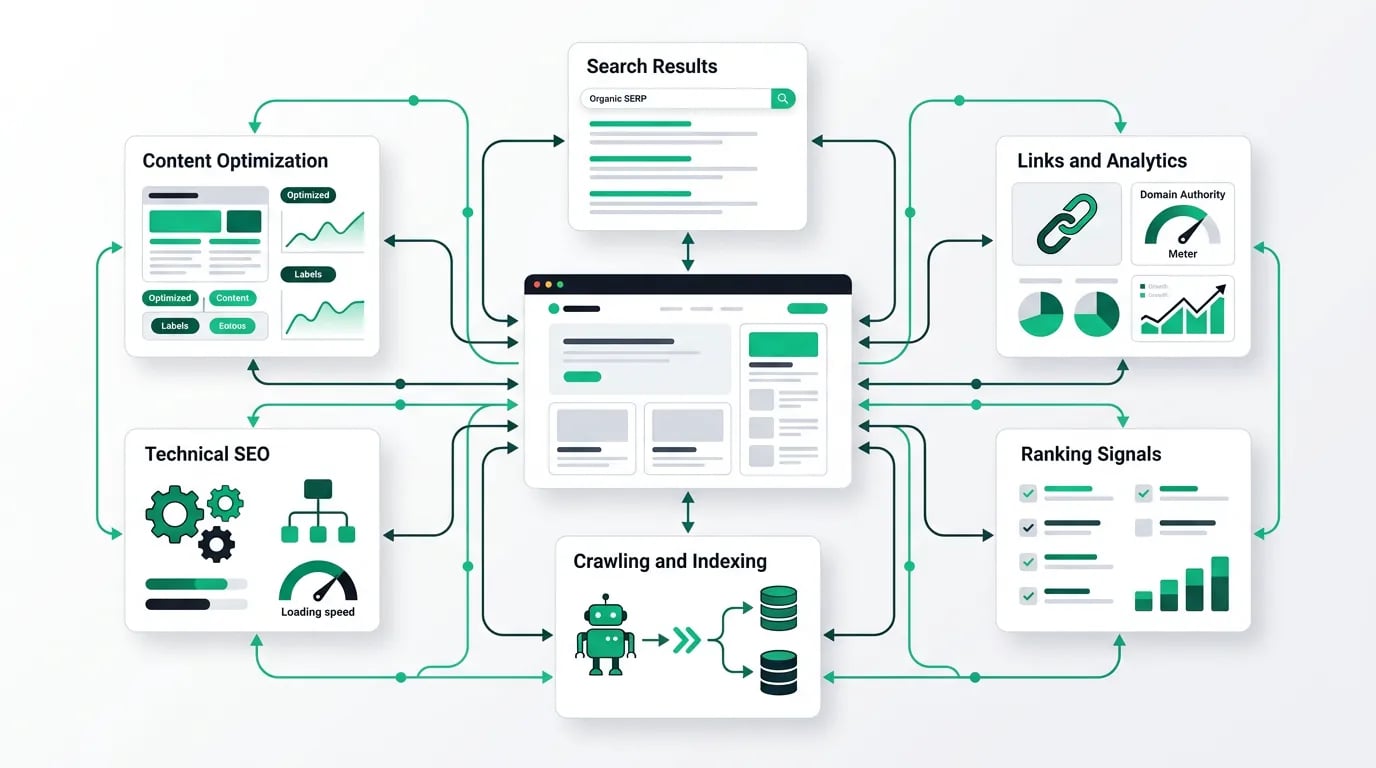
SEO generally involves improving several areas at the same time. The content and structure of an individual page fall under on-page SEO, infrastructure elements such as servers and crawlability fall under technical SEO, while links and brand signals from other websites are generally considered part of off-page SEO.
Content strategy, website architecture, internal linking, user experience and performance measurement are also important parts of a successful SEO process.
One of the defining characteristics of SEO is its focus on organic visibility. In paid advertising models such as Google Ads, visibility is directly connected to advertising spend. In organic search results, the goal is to make the website a relevant and valuable resource for the searches that matter to its audience.
SEO is therefore not a short-term trick. It is a long-term digital growth process focused on improving technical quality, content and authority over time.
How Are Google Search Results Created?
When a user performs a Google search, Google does not crawl the entire internet from scratch at that moment. Search engines organize web pages they have previously discovered and evaluated within a large search index. When a query is submitted, pages that may be relevant to that query are evaluated and used to generate the search results.
For a website to appear in search results, Google first needs to discover and access the page. The page's content, links, technical structure and other signals can then be evaluated.

The systems Google uses to determine which pages should appear and in what order are complex. There is no single "SEO score" or one ranking factor used for every query. The meaning of the search, the relevance of the page, content quality, usability and many other signals may all be considered.
The same page does not necessarily perform equally well for every search query. A piece of content may provide an excellent answer to one specific user question while being only indirectly relevant to another query.
For this reason, the purpose of SEO should not be to manipulate the search engine. The objective is to make the subject and value of a page as clear as possible while providing a genuinely useful experience for the user.
A well-planned website architecture, clear headings, useful content and appropriate internal links can also help Google understand the relationships between different pages.
What Are Crawling, Indexing and Ranking?
To understand SEO properly, it is important to distinguish between crawling, indexing and ranking. A page that does not appear on Google does not necessarily have a ranking problem. Google may not have discovered or indexed the page yet.
What is crawling?
Crawling is the process through which search engine bots access URLs and examine web pages. Crawlers can discover new pages by following existing links and can also obtain information about URLs through technical resources such as sitemaps.
A page blocked through robots.txt, server errors or incorrectly configured technical systems can affect the crawling process.
What is indexing?
Indexing is the process in which the search engine analyzes a crawled page and processes it for inclusion in its search index. A URL being crawled does not necessarily mean that it will be indexed.
A noindex directive, canonical preferences, content quality and different technical conditions may influence whether a page is indexed.
What is ranking?
Ranking is the process of evaluating eligible pages within the search index for a particular search query and determining where they should appear in the search results.
For this reason, an SEO analysis should not begin only with the question "What position are we ranking in?" A healthier sequence is to ask: Can Google find the page, can it crawl it, is it indexing it, and which queries does it associate the page with?
What Is On-Page SEO?
On-page SEO refers to optimization work carried out directly on a web page. The goal is to make the content easier for users to understand while also providing search engines with clearer signals about the page's subject and structure.
On-page SEO is not simply about inserting the target keyword into specific locations. The entire page should be structured around the topic and the user's search intent.

What does on-page SEO include?
Important on-page SEO elements can include:
- Page title and title tag
- H1, H2 and H3 heading structure
- Content that satisfies search intent
- URL structure
- Meta description
- Image alt text
- Internal links
- Content readability
- Natural use of relevant concepts
- Connections to other relevant pages
For example, simply repeating the name of a service several times on a service page is not enough. The user should be able to understand what the service is, which problems it solves, how the process works and whether it is suitable for their needs.
Strong on-page SEO aims to create content for real users while organizing that content in a way that machines can also understand easily.
For this reason, SEO, content strategy and website design should complement one another.
What Is Technical SEO?
Technical SEO covers the infrastructure work required to make a website properly accessible, crawlable and processable by search engines.
Even a website with excellent content can experience search visibility problems because of serious technical issues. For example, important pages may accidentally be marked noindex, or crawler access may be blocked, preventing Google from properly using the content.

What areas are checked in technical SEO?
A technical SEO review commonly examines areas such as:
robots.txtsitemap.xml- Indexing directives
- Canonical tags
- HTTP status codes
- 301 redirects
- 404 errors
- HTTPS usage
- Page speed
- Core Web Vitals
- Mobile usability
- JavaScript-generated content
- Structured data
- URL architecture
- Internal links
The purpose of technical SEO is not to make a website unnecessarily complicated. Quite the opposite: its purpose is to create a clean infrastructure that allows both users and search engines to access the website more reliably.
At Doruva, our technical SEO evaluations focus not only on producing a list of errors but on understanding how each issue actually affects organic visibility and user experience.
You can perform an initial review of your website's fundamental SEO condition using the SEO Test Tool.
What Is Off-Page SEO?
Off-page SEO covers signals that are created outside the website itself and may contribute to the website's digital credibility or authority.
The first concept commonly associated with off-page SEO is a backlink, which is a link from another website to your own. However, off-page SEO is not simply about collecting as many backlinks as possible.

The quality of the source, its relevance to the topic and the natural context of the link all matter. Irrelevant links or networks created purely for manipulation should not form the foundation of a long-term SEO strategy.
Off-page SEO activities may include:
- Natural and high-quality backlinks
- Brand mentions
- Digital PR
- Coverage in industry publications
- References from trusted sources
- Strengthening the brand's online authority
A better question in off-page SEO is not simply "How many backlinks do we have?" but rather: In what context do trustworthy and relevant sources across the web reference our brand?
Before focusing heavily on backlink acquisition, it can also be more effective to improve technical infrastructure and content quality if the website itself has major weaknesses.
You can review more of Doruva's work and completed projects in our references section.
What Is Content SEO?
Content SEO is the process of identifying the right topics based on what users are searching for and creating high-quality content that satisfies the search intent behind those queries.
Keyword research is only one starting point in this process. Producing content based purely on search volume without understanding why a user performs a particular search may not be sufficient.
How does content SEO work?
A strong content strategy should answer questions such as:
- What is the user searching for?
- Why are they searching for it?
- What information do they expect?
- What related questions exist around the topic?
- Which pieces of content should support each other?
- Which page should act as the primary authority hub for the topic?
A pillar and cluster structure can be useful in this approach. A core service or topic page represents the broader subject, while supporting blog content answers more specific questions related to that subject.
For example, Doruva's SEO page explains the main service, while guides covering topics such as "What Is SEO?", technical SEO, site speed, indexing and content optimization can support the broader SEO topic.
This structure can help users reach related information more easily while also creating a stronger internal linking network.
One of the most important principles in content creation is to provide value for real users rather than producing content exclusively for search engines. The length of the content matters less than how clearly, reliably and completely it answers the user's question.
How Long Does SEO Take to Show Results?
There is no exact SEO timeframe that applies to every website. The starting point, level of competition, current technical condition, domain history, content quality and scope of the work can differ significantly from one website to another.
A newly created website and a website that has existed for years but contains serious technical problems will not necessarily follow the same SEO timeline.
SEO generally does not produce instant results. Technical changes may need to be recrawled, new content needs to be discovered, and performance in search results can change gradually over time.
Fixing certain technical problems may produce positive signals relatively quickly, while establishing strong organic visibility for highly competitive search terms may take considerably longer.
Factors that can influence the SEO timeline include:
- The website's current SEO condition
- The scope of technical problems
- Industry and SERP competition
- Content quality
- Existing brand authority
- Backlink profile
- Strength of competitors
- Content publishing frequency and quality
- Scope of implemented changes
For this reason, instead of focusing only on the question "When will we rank first?", it is usually more meaningful to monitor whether organic visibility, qualified traffic and conversions are progressing in the right direction over time.
SEO should not be treated as a guarantee of a specific position or a guaranteed result for any particular keyword.
How Is SEO Success Measured?
Measuring SEO success only by looking at the Google ranking of a single keyword provides an incomplete picture. For a business, the more important question is whether organic visibility is contributing to actual business objectives.
SEO performance should therefore be evaluated using multiple metrics together.

Which metrics should be monitored for SEO performance?
Depending on the project, important SEO metrics may include:
- Organic impressions
- Organic clicks
- Visibility for relevant queries
- Keyword performance
- Organic traffic
- Organic conversions
- Form submissions or leads
- Performance of important landing pages
- Indexing status of pages
- Technical error counts
- Core Web Vitals
- Backlink and referral growth
Google Search Console, Google Analytics and various SEO analysis tools can be used to monitor different parts of this data.
The important point is that every metric should be interpreted in context. For example, if organic traffic increases but the visitors have no meaningful interest in the business, that increase alone may not represent success.
Similarly, in some projects, a small number of high-quality conversions from low-volume but commercially valuable searches may be more valuable than a much larger amount of irrelevant traffic.
At Doruva, we therefore evaluate SEO not simply through ranking tracking but through a combination of technical health, visibility, qualified traffic and business objectives.
SEO Is an Ongoing Process, Not a One-Time Task
SEO is not a one-time process that ends after adding a few keywords to a website. Search behavior changes, new competitors appear, websites grow, new pages are published and technical issues can emerge over time.
Sustainable SEO therefore requires ongoing monitoring of technical health, content development, website architecture, user experience, performance and authority.
When implemented correctly, the purpose of SEO is not to trick search engines. It is to make a website technically healthier, more useful in terms of content and easier to understand for users searching for relevant information.
You can learn more about Doruva's SEO service, review the initial condition of your website using the SEO Test Tool and see examples of our work in the references section.
If you would like to plan a comprehensive strategy for your project's organic visibility, you can contact Doruva.
Frequently Asked Questions
What is SEO?
SEO is the process of improving a website's technical infrastructure, content and authority so that search engines can discover it more easily, understand it correctly and show it for relevant organic searches.
What is the difference between SEO and Google Ads?
SEO focuses on improving organic search visibility, while Google Ads provides visibility through paid advertising placements. SEO aims to build organic performance independently of advertising spend, although results may take time to develop.
How long does SEO take to show results?
There is no single SEO timeframe that applies to every website. Technical condition, competition, content quality, website history and the scope of the work can all affect how quickly results develop. SEO is generally a process that improves over time.
What is the difference between technical SEO and content SEO?
Technical SEO focuses on crawlability, indexing, performance and website infrastructure. Content SEO focuses on identifying topics based on user search intent and creating useful content that satisfies those searches.
How is SEO success measured?
SEO success should not be measured by rankings alone. Organic impressions, clicks, search visibility, qualified traffic, conversions, important page performance and technical health should be evaluated together.