

What is Keyword Research?
Definition
Keyword research is the process of finding out which phrases your audience uses in search engines, with what intent and how often, and turning that into decisions about pages and content. It covers collecting search queries, grouping them by intent, assessing them for volume and competition, and mapping each group to a single page on your site.
Also known as: keyword analysis, keyword discovery, SEO keyword research, search term research
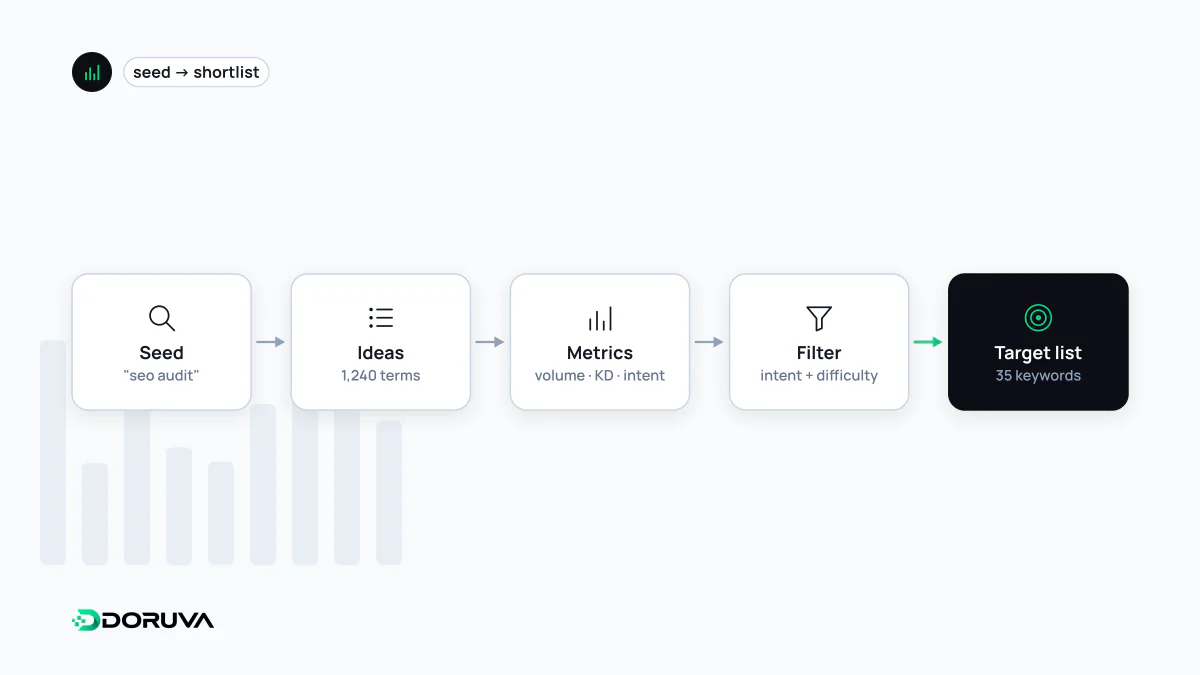
The real goal is learning your audience's language
Keyword research looks like list-building, but its real output is understanding: how customers describe their problems, what they ask at each stage, and whether your vocabulary matches theirs. A software company may market "enterprise resource planning solutions" while its buyers search for "inventory and invoicing software". Research lets you see that mismatch before you publish.
A workable process
- Seed topics: list 10–20 core topics drawn from what you sell, sales conversations and support tickets.
- Expand: for each seed, collect autocomplete suggestions, People Also Ask questions, your Search Console queries and suggestions from keyword tools.
- Group by intent: cluster queries that expect the same answer. The most reliable check is the results page: if two queries return largely the same URLs, one page can usually target both.
- Assess: score each group on search volume, keyword difficulty and business value.
- Map: assign each group to exactly one existing or planned page. Groups without an owner are your content gaps.
What each data source can and cannot tell you
| Source | What it gives you | Limitation |
|---|---|---|
| Google Search Console | Queries your site actually received impressions for, with clicks and average position | Only queries you already appear for; anonymized queries are omitted from the tables for privacy |
| Google Ads Keyword Planner | Average monthly searches for a keyword and its close variants, averaged over 12 months by default | Built for advertisers; its "Competition" column measures advertiser density, not organic competition |
| Google Trends | Relative interest over time and across regions | Sampled, normalised to a 0–100 scale; not absolute search counts |
| Third-party SEO tools | Volume, difficulty and competitor rankings | Estimates produced by each vendor's own models; tools often disagree |
No single source is the truth. Treat the numbers as directional input for decisions, not as precise targets.
Language and market nuances
- Spelling variants: "optimisation" and "optimization", "ecommerce" and "e-commerce" split volume across rows in most tools. Think about the combined demand, then choose one form for the page.
- Inflected languages: in languages such as Turkish, suffixes produce many surface forms of the same query. Tools list them separately even though they share one intent.
- Mixed-language searching: in many non-English markets, technical buyers search with English terms as often as local ones. Check which form your audience actually uses before writing the title.
Common mistakes
The most frequent one is sorting by volume and starting at the top. For a young site, the biggest terms are the hardest to rank for and often the vaguest in intent; specific, longer phrases, known as long-tail keywords, usually pay off sooner. The second is treating research as a one-off. Language, products and results pages all change, so the map needs revisiting.