

What is Keyword?
Definition
A keyword is a word or phrase that represents the topic a page aims to be found for in search engines. It summarises the queries people type: one keyword stands for many different phrasings and variants that share the same intent. In SEO, content planning, on-page optimisation and performance tracking are all organised around keywords.
Also known as: focus keyword, target keyword, keyphrase, SEO keyword
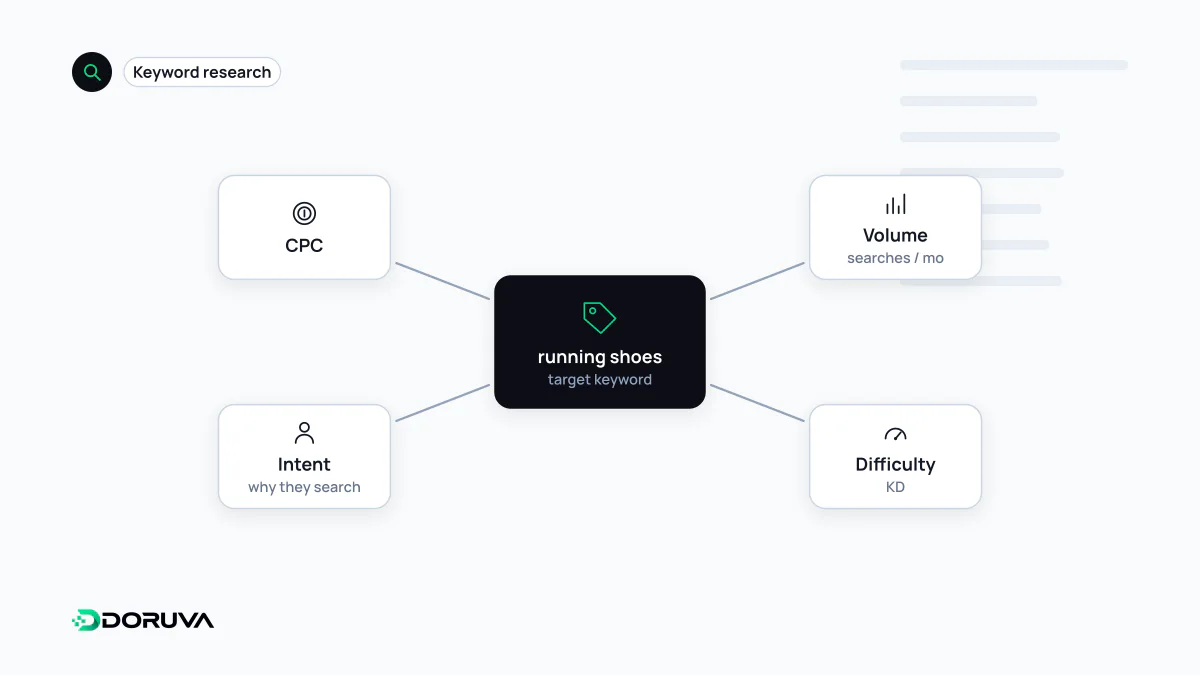
Keywords are not the same as queries
What a person types into the search box is a search query: "cheap running shoes for flat feet", "best budget shoes flat feet running", "running shoes for overpronation under 100". A keyword is the label you choose for the shared goal behind those queries, say "running shoes for flat feet". Queries belong to users; keywords belong to your strategy. The distinction matters because a page is optimised not for one exact string but for a family of queries with the same intent.
What to weigh before targeting one
| Attribute | The question it answers |
|---|---|
| Intent | Does the searcher want information, a comparison or to buy? |
| Search volume | Roughly how many people search for this each month? |
| Competition | How strong are the pages ranking now, and how well do they answer? |
| Business value | Is a visitor arriving from this search a potential customer? |
| Results page layout | Are there maps, videos, product listings or an AI summary on the page? |
The most decisive of these is usually search intent. A high-volume keyword whose intent does not match your offer can be worth less than a modest phrase used by people close to a purchase.
Using keywords on the page
Placing the main keyword, or a natural variant of it, in the title tag, the H1, the URL and the opening paragraph makes the page's subject clear to readers and search engines. Image alt text and the anchor text of internal links pointing at the page reinforce the same topic. Beyond that, modern search engines do not depend on exact matching: they understand synonyms, inflections and related concepts. Repeating the phrase in every paragraph does harm, not good, and Google's spam policies describe it as keyword stuffing.
Primary and secondary keywords
Each important page has one primary keyword and a few secondary ones that round it out. A page about "ecommerce website development" might also target "online store platform", "how to start an online shop" and "ecommerce website cost". Recording which keyword belongs to which page in a simple map stops two pages from chasing the same goal, which is how keyword cannibalization starts.
Two myths to retire
The meta keywords tag. Google's documentation states that it does not use <meta name="keywords"> and that the tag has no effect on indexing or ranking. Filling it in is wasted effort.
Ideal keyword density. Rules such as "the keyword should make up 2% of the text" have no basis in anything Google has defined. The useful test is whether the text covers the topic naturally and completely.