

What is Keyword Stuffing?
Definition
Keyword stuffing is the practice of filling a web page with keywords or numbers in an unnatural way in an attempt to manipulate search rankings. Typical forms are repeating the same phrase out of context in body copy, headings or image alt text, and adding long blocks of city names or phone numbers. It violates Google's spam policies and makes pages harder to read.
Also known as: keyword spamming, keyword loading
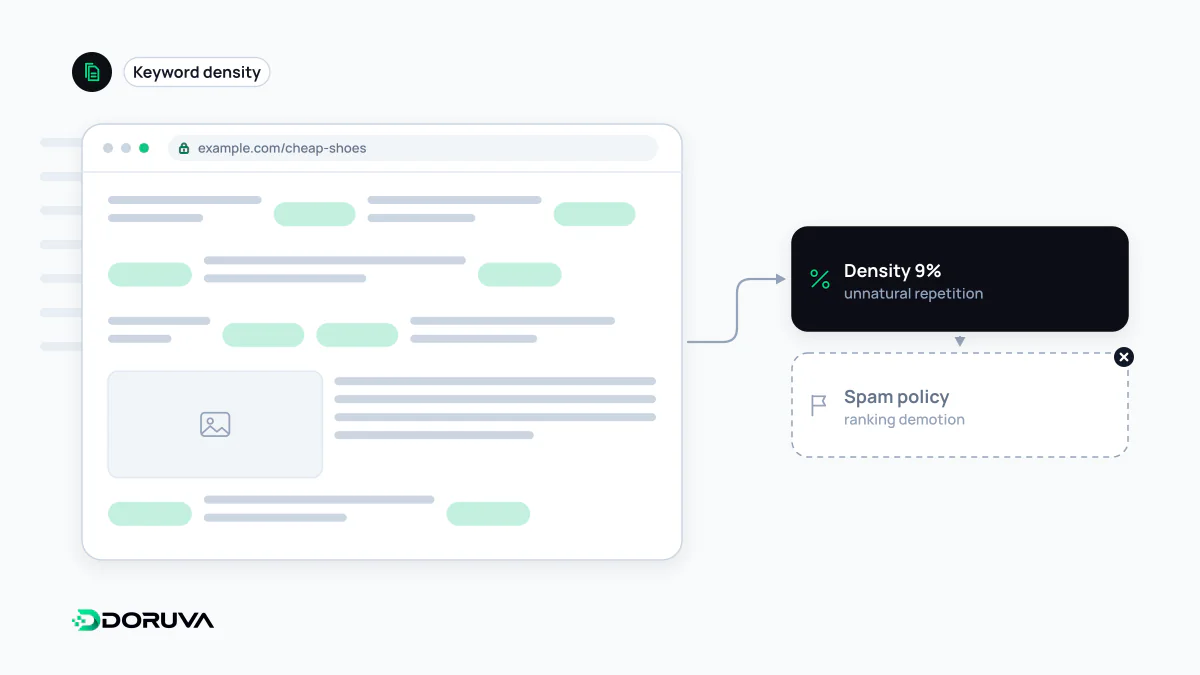
How Google describes it
Google's spam policies give three characteristic examples of keyword stuffing:
- lists of phone numbers without substantial added value,
- blocks of text listing cities and regions a page is trying to rank for,
- repeating the same words or phrases so often that the text sounds unnatural.
The SEO Starter Guide puts it more bluntly: excessively repeating the same words over and over, even in variations, is tiring for users and against Google's spam policies.
Before and after: a product description
Stuffed copy usually gives itself away immediately:
Looking for cheap running shoes? Our cheap running shoes are the best cheap running shoes, so browse our cheap running shoes deals and buy cheap running shoes today.
The version written for a reader covers the topic far better:
A lightweight trainer built for people running 20 to 30 km a week. The midsole keeps its cushioning on longer runs while the shoe stays around 260 grams, and it costs less than most models in its class.
The second version barely repeats the target phrase, yet it answers what a buyer actually asks about: distance, weight, cushioning and price. Search systems interpret language through synonyms and related concepts, so copy like this is usually the stronger candidate for the whole family of related queries.
Where stuffing hides
- Title elements: a title like "Running Shoes | Running Shoe | Cheap Running Shoes" invites Google to rewrite the title link, and Google's title guidance explicitly says to avoid keyword stuffing.
- Image alt text: pasting the same product phrase into every alt attribute turns a screen reader experience into noise.
- Footer location lists: dozens of towns you do not serve, listed at the bottom of every page, match Google's own example almost word for word.
- Hidden text: keywords in the same colour as the background also breach the hidden text policy.
- Internal anchors: forcing the exact phrase into every internal link reads as manipulation rather than navigation.
There is no ideal keyword density
Rules such as "a keyword should make up 2% of the text" circulated in SEO for years; no such ratio appears in Google's documentation. Likewise, Google Search does not use the keywords meta tag, so loading it gains nothing. The more useful question is whether the page fully covers the need behind the target keyword. A quick test is to read the copy aloud: a sentence no person would say in conversation was probably written for a search engine. The full list of related violations is in Google spam policies.