

What is Anchor Text?
Definition
Anchor text is the visible, clickable text of a hyperlink, the content between an a element's opening and closing tags. It tells users and search engines where the link leads and what the target page is about. For image links, the image's alt attribute plays this role. Good anchor text is short, descriptive and fits naturally into the surrounding sentence.
Also known as: link text, link label, hyperlink text, anchor
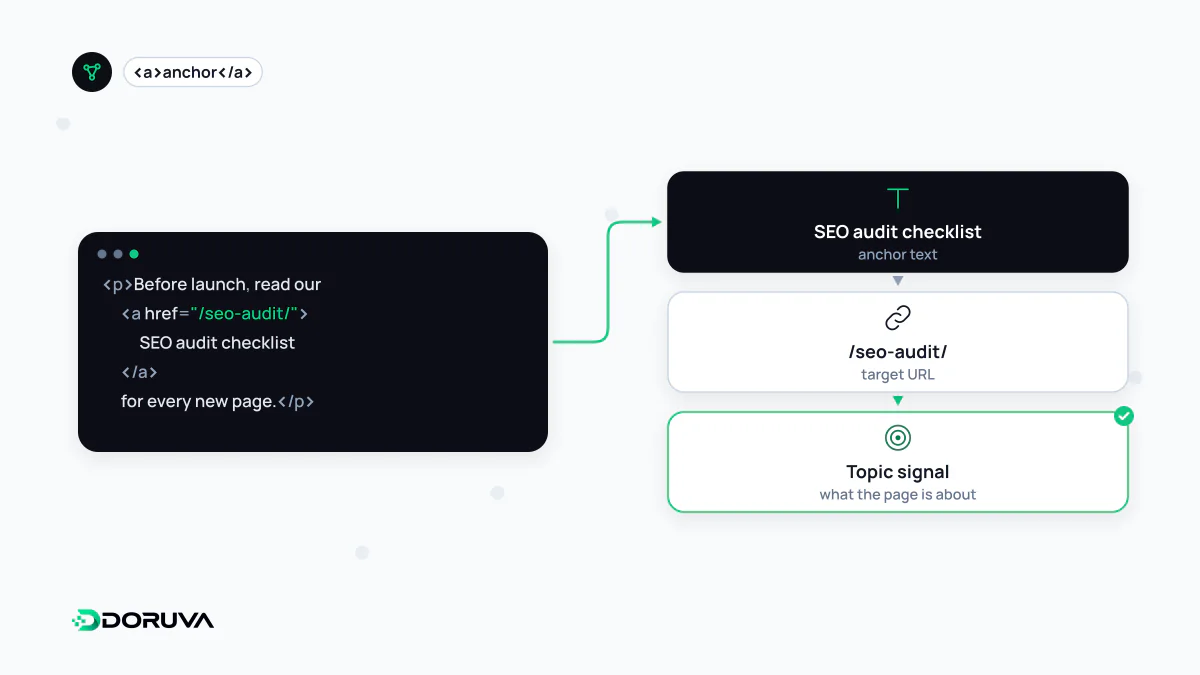
The link's label
In this example the anchor text is “running shoe size guide”:
<a href="/size-guide/">running shoe size guide</a>When the link is an image there is no text, so Google uses the image's alt attribute as the anchor text:
<a href="/womens-running/"><img src="womens-running.webp" alt="Women's running shoes"></a>What it tells whom
Readers: where they will land before they click. Someone skimming should understand a link without reading the whole sentence around it.
Screen reader users: screen readers can present all links on a page as a list, and five entries reading “click here” convey nothing. WCAG success criterion 2.4.4 Link Purpose (In Context) requires that a link's purpose be clear from its text or immediate context, which makes anchor text a web accessibility issue as well.
Search engines: Google says anchor text helps both people and Google make sense of the linked page. The text of a backlink shows how another site describes your page.
Types of anchor text
| Type | Example | Note |
|---|---|---|
| Descriptive | running shoe size guide | Clearest description of the target |
| Branded | Example Sports | One of the most natural forms for inbound links |
| Naked URL | www.example.com | Common in reference lists |
| Generic | click here, read more | Carries no information; avoid |
| Exact-match keyword | cheap running shoes | Fine in natural context; suspicious as a repeated pattern |
The over-optimization trap
Because anchor text matters, it has long been manipulated. Google's spam policies list keyword-rich anchor text in articles or press releases distributed on other sites as an example of link spam. Its linking guidance also advises resisting the urge to cram every related keyword into a link: if the reader doesn't need those words to understand the next page, they don't belong there.
Descriptive text on your own internal links is natural and expected. You don't have to use the identical phrase every time you link to a page; text that fits the sentence and describes the target accurately is enough.
Practical guidelines
- Make the link text meaningful out of context.
- Keep it short; linking an entire paragraph blurs the target.
- Don't use the same text for different destinations; readers can't tell them apart.
- Never leave alt text empty on image links.
- Match the promise: a link that says “price list” should open a price list.
How to check it
Lighthouse's SEO audit specifically flags non-descriptive link text such as “click here”. Search Console's Links report shows the most common text other sites use when linking to you. Google's advice and examples are in its link best practices. It is a small but frequently neglected part of on-page SEO.