

What is Nofollow?
Definition
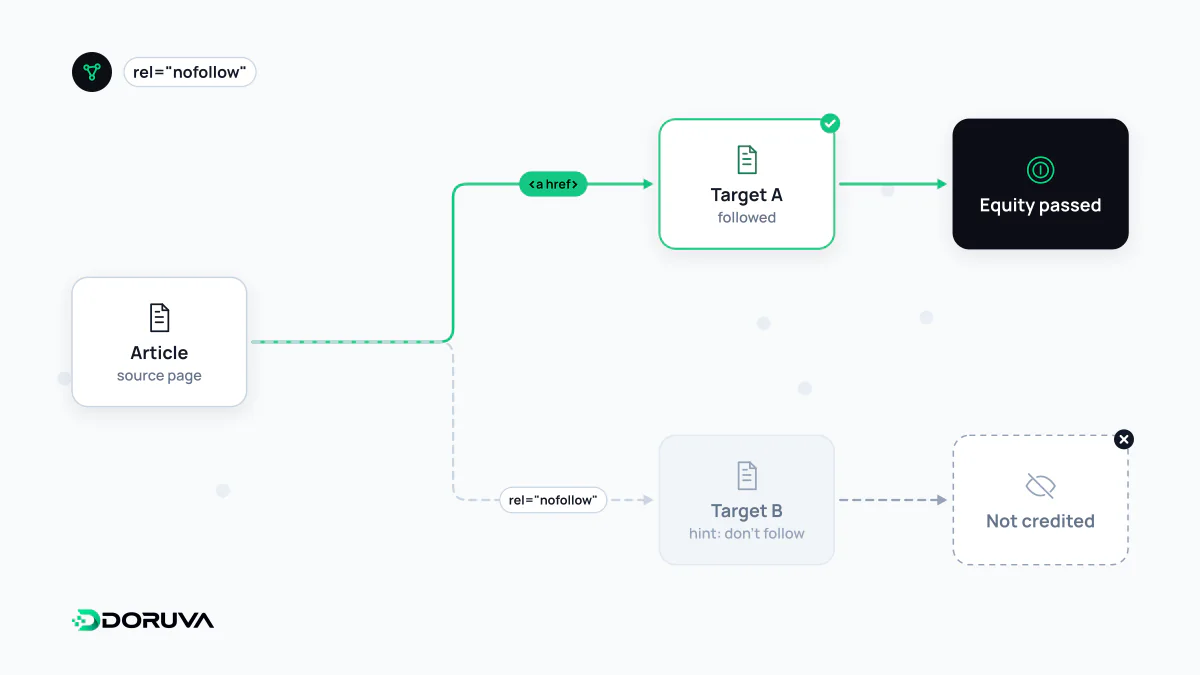
Nofollow is a link annotation, rel=nofollow, that tells search engines a site does not vouch for a link and does not want to be associated with the target. It can also be set for a whole page in the robots meta tag. In 2019 Google added sponsored for paid links and ugc for user-generated links; all three values are now treated as hints rather than strict directives.
Also known as: rel=nofollow, nofollow link, rel=sponsored, rel=ugc
A short history
rel="nofollow" appeared in 2005, backed jointly by the major search engines, to fight spam links in blog comments. The idea was simple: a site owner should be able to say “I didn't place this link, or I don't vouch for it.” For years Google ignored nofollowed links in its ranking calculations.
In September 2019 Google introduced two new values and changed its approach. Since then all three values have been treated as hints for ranking, and since March 1, 2020, also as hints for crawling and indexing. In other words, Google may still follow or consider a nofollowed link when it sees reason to.
Three values, three jobs
| Value | Use it for |
|---|---|
rel="sponsored" | Advertising, sponsorships, affiliate links or any link given in exchange for compensation |
rel="ugc" | Links inside user-generated content such as comments and forum posts |
rel="nofollow" | Other links you don't endorse or don't want your site associated with |
Values can be combined; Google accepts multiple values separated by spaces or commas:
<a href="https://example.com/product" rel="sponsored">See the product</a>
<a href="https://forum-example.com/" rel="ugc nofollow">a link a user posted</a>
Using nofollow for paid links is still acceptable, but Google states that sponsored is preferred.
Page-level nofollow
A nofollow in the robots meta tag applies to every link on the page, not just one:
<meta name="robots" content="nofollow">This is rarely needed. Annotating individual links is usually the more precise choice.
Paid links and spam policy
Google's spam policies define paid links that pass ranking credit as link spam. Leaving links in sponsored posts, advertorials or affiliate programs unqualified creates risk for both the linking and the linked site. It is one of the most common compliance issues in off-page SEO.
Myths worth dropping
- “A nofollowed page won't be indexed.” No. Nofollow concerns the link; the target can be discovered and indexed through other routes. To keep a page out of the index, use noindex.
- “Nofollow links are worthless.” They can still bring visitors, brand exposure and discovery. A natural backlink profile includes nofollowed links too.
- “I can sculpt crawling with nofollow on internal links.” For internal links, Google recommends robots.txt rather than nofollow to control crawling, and as a hint nofollow is not a reliable barrier anyway.
- “Nofollowing every outbound link is the safe default.” Linking normally to trustworthy sources that help readers is how the web is supposed to work. Blanket nofollow is unnecessary.
How to check it
Look at the link's rel attribute in the HTML, and for page-level rules check the robots meta tag and any X-Robots-Tag header. Google's definitions and examples are in its documentation on qualifying outbound links.