

What is Link Equity?
Definition
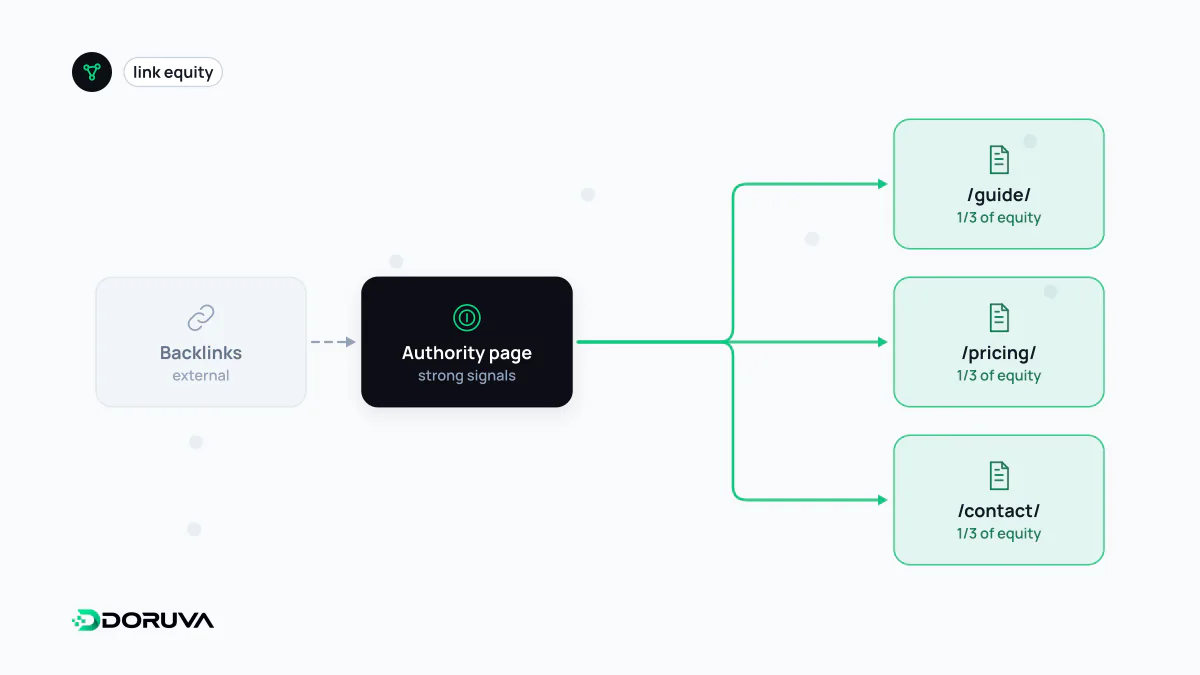
Link equity is the SEO term for the ranking value a link is assumed to pass to the page it points to; "link juice" is its informal nickname. The idea goes back to PageRank, which treats links as votes passed between pages. Google uses neither term and does not disclose how it values links in detail, so link equity is best understood as a practical model for the fact that links carry signals.
Also known as: link juice, link value, link authority, link power
Where the term comes from
PageRank, one of Google's earliest algorithms, modelled a page's value as something distributed to other pages through its outgoing links. SEOs started describing that flow with the playful "link juice" and later the more businesslike "link equity". Both are industry jargon; neither appears in Google's documentation.
The closest phrase in Google's own vocabulary is "ranking credit". Its spam policies say paid links should not pass ranking credit, which confirms that links carry value of some kind. How much, by what formula and how it combines with other signals is not disclosed.
What Google has actually said
- Links are analysed: Google says its link analysis systems use how pages link to each other to work out what pages are about and which might be most helpful for a query.
- rel values are hints: since 2019,
sponsored,ugcand nofollow have been treated as hints about whether a link should be considered. - Spam links lose their value: Google has announced that it neutralises unnatural links algorithmically and that any credit they passed is lost.
The popular rules about link position on the page, the number of links on a page or placement within body copy are either inferences from the original PageRank model or results of industry experiments. Treat them as hypotheses, not facts.
Keeping it: redirects and canonicals
The most concrete practical side of link equity is making sure signals end up on the right URL. If the same product is live at two URLs and other sites link to different versions, the signals are split. Google explains that choosing a canonical URL helps it consolidate signals for individual URLs, such as links to them, into a single preferred URL. When a page moves, a 301 redirect makes links to the old address point at the new one.
Old URL:  /products/pour-over-coffee-maker-x200   (linked from 30 sites)
New URL:  /products/x200/
Fix:      301 old → new; update internal links to the new URL directly
A page deleted without a redirect leaves every link to it pointing at a 404, and those signals are effectively wasted.
Equity inside your own site
Link equity doesn't only arrive from outside. Internal links tell users and search engines which pages you consider important. Contextual links from the homepage and from well-linked articles to key service or category pages make those pages easier to discover and to understand in the right topical context.
Adding nofollow to internal links to "channel" equity toward chosen pages, known as PageRank sculpting, was once common. There is no credible sign that it helps today; internal links are there to make your structure clear, not to hide parts of it.
Myths worth dropping
- "Linking out leaks equity": Google encourages linking to sources you cite, and your page does not become weaker for it.
- "Link equity is a score": metrics such as Ahrefs' Domain Rating estimate it from their own data; it is not a number Google sees.
- "Every link passes the same amount": irrelevant or spammy links may simply be ignored, while a few relevant editorial links mean far more.