

What is PageRank?
Definition
PageRank is the link analysis algorithm developed by Larry Page and Sergey Brin at Stanford that estimates a page's importance from the number and importance of the pages linking to it. It underpinned Google's ranking when the company launched. Google says the algorithm has evolved considerably since then and remains part of its core ranking systems, while the public 0–10 Toolbar PageRank score was retired years ago.
Also known as: PR, Google PageRank, Toolbar PageRank, PageRank algorithm
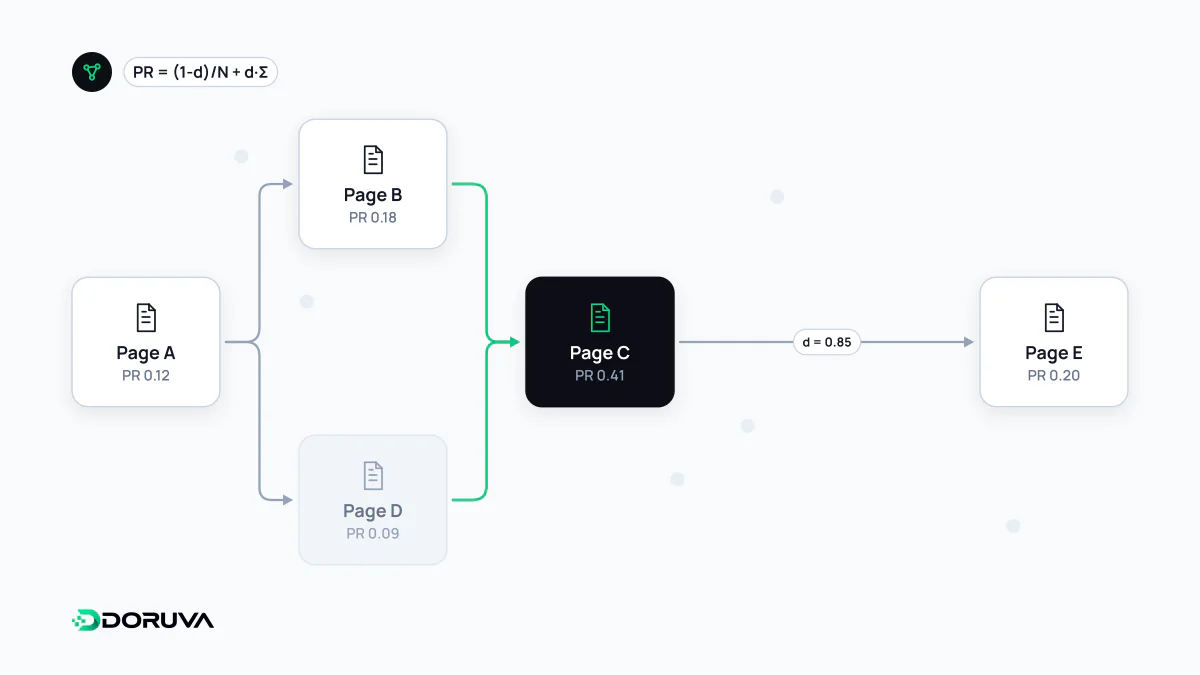
The random surfer
The intuitive explanation of PageRank, given in Brin and Page's 1998 paper, is the "random surfer". Someone starts on a random page and keeps clicking random links; every so often they get bored and jump to a completely random page instead. A page's PageRank is the probability that this surfer is on it at any given moment. Pages linked from many pages, and especially from pages that are themselves important, get visited more often on this walk.
The idea was powerful because it is recursive: the weight of a link depends on the importance of the page giving it. Not all links count equally, and simply piling up links isn't enough.
The formula
The simplified formula from the original paper is:
PR(A) = (1 - d) + d × ( PR(T1)/C(T1) + ... + PR(Tn)/C(Tn) )T1…Tn are the pages linking to page A; C(T) is the number of outgoing links on page T; and d is a damping factor, which the paper says is usually set to 0.85. A page with links to four other pages splits what it passes on among those four. The values are computed iteratively across the whole web graph until they stabilise. What the industry now calls link equity descends directly from this model.
Does Google still use PageRank?
Yes, though not in its 1998 form. Google's guide to its ranking systems describes link analysis systems that work out how pages link to each other, and names PageRank as one of the core ranking systems used when Google first launched. The same page states that how PageRank works has evolved a lot since then and that it continues to be part of the core ranking systems. The source for this is Google's ranking systems guide.
What Google doesn't say matters as much: the current formula, its weight relative to the many other signals and which links are included are not public. Any claim that puts precise numbers on this is a guess.
Toolbar PageRank and how it ended
In the 2000s, the Google Toolbar displayed the PageRank of the page you were viewing as a green bar from 0 to 10. That coarse, rarely updated number quickly became the currency of the link-selling market, with "links from PR5 sites" sold as a product. The public score stopped being updated after 2013, and in 2016 Google confirmed it had removed it altogether. There is no Google-published PageRank value today; sites offering a "PageRank check" show either stale data or their own estimates.
The metrics that filled the gap
Third-party metrics stepped into the space the toolbar left: Moz's Domain Authority and Ahrefs' Domain Rating and URL Rating, among others. Ahrefs openly says URL Rating is calculated using basic PageRank principles. None of these is Google data; each is an estimate based on the slice of the web that particular tool crawls.
The practical lesson hasn't changed: backlinks earned from relevant, reputable pages carry meaning, and links multiplied artificially are exactly what Google's spam policies target.