

What is Domain Authority?
Definition
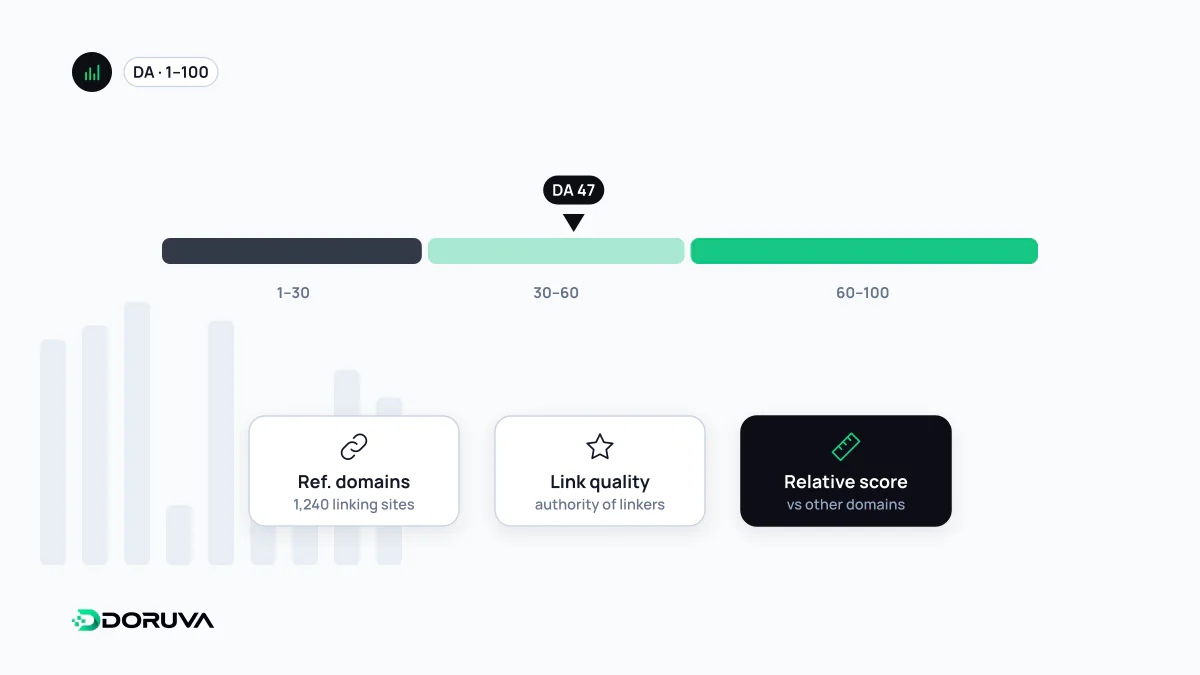
Domain Authority (DA) is a third-party score from the SEO software company Moz that predicts, on a scale of 1 to 100, how likely a domain is to rank in search results. It is based largely on backlink data. It is not a Google metric, and Google has stated that it does not use a domain authority score like this in ranking.
Also known as: DA, Moz Domain Authority, website authority score
Whose metric is it?
Domain Authority is a proprietary score that Moz calculates from its own crawl and link data. Other tool vendors publish their own equivalents, such as Ahrefs' Domain Rating (DR) and Semrush's Authority Score. They all approach the same question in different ways: "how strong is this domain's link profile within the part of the web this tool has crawled?"
The key point is that none of these numbers comes from Google. Google employees have said publicly, many times over the years, that Google does not use Moz's Domain Authority or any similar single "site authority" score for ranking, and no such score appears in Google's documentation.
How it is calculated
According to Moz, DA is produced by a machine-learning model from link data such as the number and quality of backlinks and linking root domains, and it uses a logarithmic scale. Moving from 20 to 30 is therefore far easier than from 70 to 80. The score is relative: when Moz updates its model or index, your DA can move even though nothing changed on your site.
Because each tool crawls a different slice of the web, the same site gets different scores in Moz, Ahrefs and Semrush. That alone is a reminder that none of them mirrors what Google sees.
Is it useful at all?
Used for the right job, yes. DA and similar metrics are a practical shorthand for roughly comparing link profiles:
- comparing competitors' off-page strength within the same tool,
- pre-screening a link opportunity,
- tracking the trend of your own link profile over time.
A high score does not mean a site will rank for a particular query. Ranking happens at page level and per query, and depends on how well the content satisfies the search intent, its depth on the subject and its technical accessibility.
Common mistakes
- Treating DA as the goal: buying low-quality links to raise it can amount to a link scheme under Google's spam policies.
- "Links from low-DA sites are harmful": a natural link from a small but genuinely relevant source can be valuable.
- Comparing scores across tools: Moz DA 40 and Ahrefs DR 40 do not mean the same thing.
- Confusing it with PageRank: Google describes PageRank, which uses links, as one of its fundamental algorithms while stressing that Search is about much more than links; the public PageRank indicator was retired years ago, and DA is not an official replacement.
In short, DA is an estimate, not a thermometer. It gives a quick read on a link profile; strategy should be built on content that earns topical authority, sound technical foundations and links that are actually earned.