

What is SEO (Search Engine Optimization)?
Definition
SEO (search engine optimization) is the practice of improving a website so that search engines such as Google can crawl, understand and index its pages, and show them in unpaid (organic) results for relevant queries. It combines technical work, content that answers what people actually search for, and trust signals the site earns from across the web.
Also known as: SEO, search engine optimisation, organic search optimization
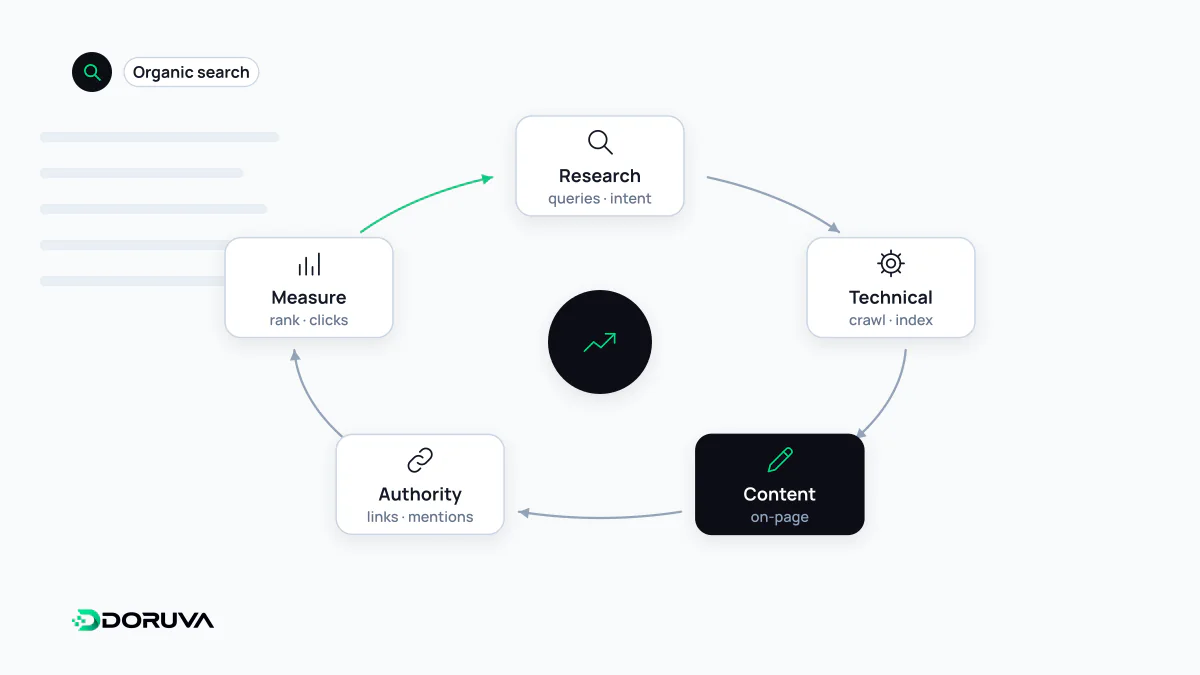
The three working areas of SEO
SEO is not a single setting or plugin. It is a set of related disciplines that only work well together:
- Technical SEO: making the site crawlable, indexable, fast and secure. Robots.txt, sitemaps, redirects, canonical tags and page performance live here.
- On-page SEO: the content and HTML of individual pages: the title tag, meta description, heading hierarchy, internal links and, above all, the content itself.
- Off-page SEO: reputation that forms outside the site: links from other websites, brand mentions, business profiles and reviews.
What ties them together is the searcher. A page that misreads the search intent behind a query will underperform even if it is technically flawless.
Where SEO fits in how search works
Google describes Search in three stages: crawling (Googlebot discovering and downloading pages), indexing (analysing the content and storing it in the index) and serving (returning the most relevant pages when someone searches). Each SEO task strengthens one link in that chain. Technical fixes mostly affect the first two stages; content and reputation work mostly affect the third.
Google states plainly that it does not guarantee it will crawl, index or serve a page, even one that follows its guidelines, and that it does not accept payment to crawl a site more often or rank it higher. Any promise of guaranteed first-page rankings should be read with that in mind.
Organic search vs. paid search
| Aspect | SEO (organic results) | Search ads |
|---|---|---|
| Cost per click | None | Yes |
| Time to impact | Usually weeks to months | As soon as the campaign runs |
| When spending stops | Earned visibility can persist for a while | Ads stop showing |
| What decides position | The search engine's ranking systems | Bids and ad quality |
Organic clicks are free, but organic traffic is not: content, development and measurement all take time and effort.
Common misconceptions
- Treating SEO as a one-off project. Sites change, competitors publish, and search systems are updated, so the work has to continue.
- Keyword stuffing. Repeating a phrase unnaturally is listed by name in Google's spam policies.
- Relying on the meta keywords tag. Google says it does not use it in Search.
- Watching rankings alone. What matters is traffic from the right audience, what those visitors do, and the value they bring to the business.
SEO and AI-powered search
Results pages are no longer just a list of links: AI summaries and chat assistants also build answers from web content. Google says there are no additional requirements, beyond normal SEO best practices, for a page to appear as a source in AI Overviews or AI Mode. Work aimed specifically at being cited by AI assistants is usually discussed as GEO, and it rests largely on the same foundations.
Where to start
- Add the site to Google Search Console and see which pages are indexed and which queries bring impressions.
- Remove technical blockers first; pages that cannot be crawled, return errors or are accidentally blocked waste every other effort.
- List the questions your audience actually asks and answer each with a clear, original page.
- Judge changes over weeks and months, not day-to-day fluctuations.
For a quick first check of a page's technical and on-page basics, you can run it through the SEO Checker. Google's own view is summarised well in the Google Search Central SEO Starter Guide.