

What is GEO (Generative Engine Optimization)?
Definition
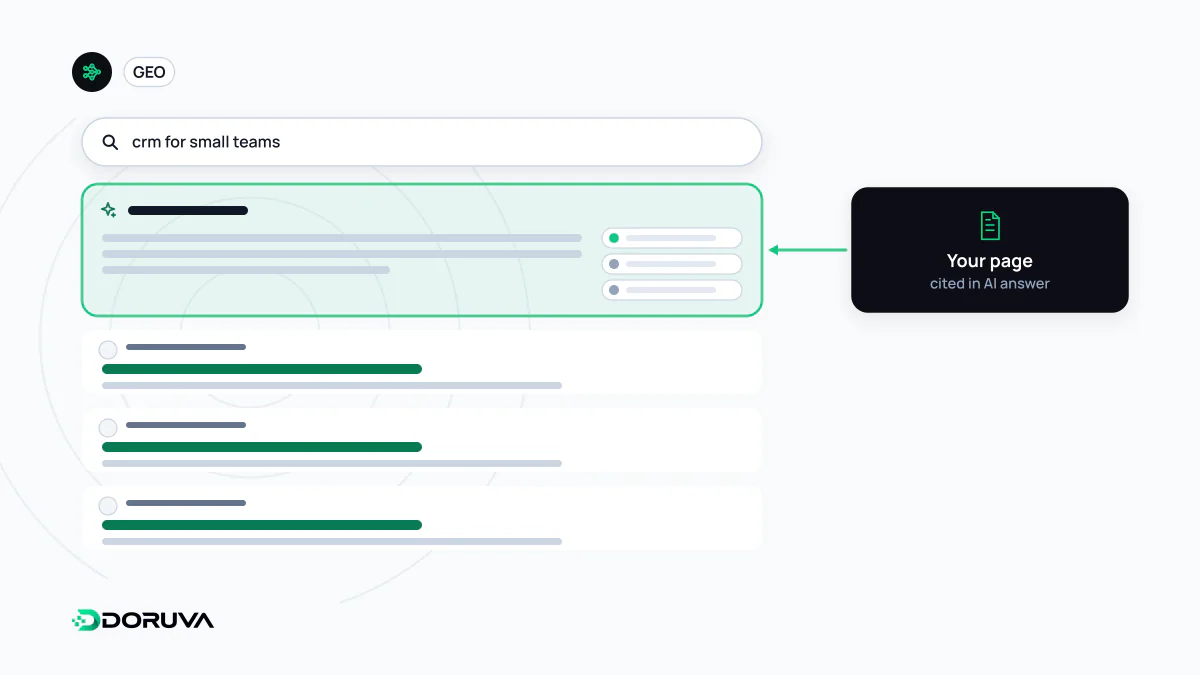
Generative Engine Optimization (GEO) is the practice of helping a brand and its content be understood correctly, mentioned and cited as a source in answers produced by AI-powered search and answer systems. It builds on SEO fundamentals such as crawlability and indexing, and focuses on clarity, consistent entity information and quotable content. No technique can guarantee inclusion in AI-generated answers.
Also known as: Generative Engine Optimization, AI SEO, LLM SEO, AI search optimization
Where the term comes from
The phrase was popularized by a research paper, GEO: Generative Engine Optimization by Aggarwal et al., first published in November 2023 and presented at KDD 2024. The authors describe systems that retrieve several sources and synthesize them into a single answer as “generative engines”, and they introduce a benchmark, GEO-bench, for measuring how visible a piece of content is inside those answers. They also found that the effect of a given content change varied by subject domain, which is a useful reminder: the paper describes an experimental framework, not a recipe that transfers unchanged to every industry or AI product.
In everyday use, GEO now names the practical work of improving how a brand is represented in AI search experiences.
How GEO relates to SEO
GEO is not a replacement for SEO; it sits on top of it. Many AI answers are built from web pages retrieved at query time. If a page cannot be crawled, is not indexed, or only renders its main text through client-side JavaScript, it is less likely to be used as a source. Google states in its documentation on AI features that there are no additional requirements or special optimizations for AI Overviews or AI Mode: a page needs to be indexed and eligible to appear in Search with a snippet.
| Aspect | Classic SEO focus | What GEO adds |
|---|---|---|
| Goal | Rankings and clicks on a results page | Being described accurately and cited inside the answer |
| Unit of work | Pages and queries | Passages, entities (brand, product, person) and facts |
| Measurement | Search Console, rank tracking | Repeated sampling of prompts; results vary between runs |
What the work involves
- Access: robots.txt rules that let search crawlers and the AI crawlers you deliberately allow reach your pages, with the important content present in server-rendered HTML.
- Entity clarity: the same brand name, address and service descriptions everywhere, reinforced with structured data such as Organization markup.
- Quotable content: passages that answer the question in the first sentence and still make sense out of context, plus definitions, lists and tables. See answer extractability for the details.
- Verifiability: claims backed by sources, dates and named authors; outdated facts corrected.
- Off-site consistency: accurate information about the brand on independent, reputable sites, and contradictory profiles cleaned up.
Common misconceptions
“There is a secret AI ranking factor.” No such factor is publicly documented, and there is no official source showing that a particular file, tag or phrasing pattern guarantees a place in AI answers.
“GEO guarantees citations.” Answers change with the model version, the wording of the question, location and session. Ask the same thing twice and you may see different sources. The realistic goal is to put in place the foundations that make your content a likely candidate.
“SEO no longer matters.” The opposite is true: content that is not crawled or indexed rarely makes it into web-grounded answers either.
Where to start
Begin by confirming that the site is technically readable. Doruva's GEO Checker inspects a URL for readiness signals such as AI crawler access, entity and schema markup and citation readiness; it does not query any AI model and does not tell you whether your brand appears in answers. To understand actual visibility, build a list of questions your audience would ask, run them on several systems at regular intervals and log the results with dates.