

What is Answer Extractability?
Definition
Answer extractability is how easily search engines and AI systems can locate information on a page and lift it out as a correct, self-contained answer. Passages that answer the question in their first sentence, clear headings, definitions, lists and tables all improve it. It does not guarantee a citation, but it makes content a more suitable candidate for being quoted.
Also known as: extractable answers, structured answers, quotability, passage extractability
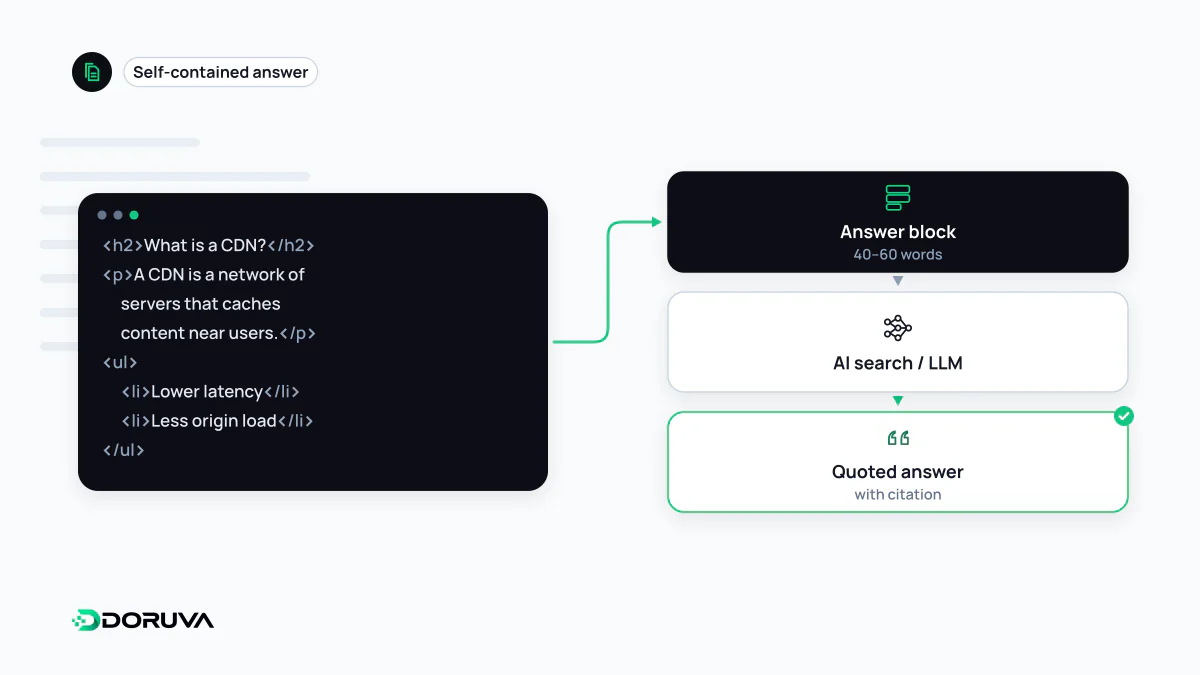
Systems quote passages, not pages
An AI answer or a featured snippet rarely uses a whole page; it uses a few sentences selected from it. Content is extractable when those sentences remain accurate and understandable once they are separated from everything around them. A paragraph that opens with “As mentioned above” or “This approach” loses its meaning the moment it is quoted on its own.
What an extractable passage looks like
- Answer first: the first sentence of a section answers the question; reasons, exceptions and detail follow.
- Self-contained sentences: the subject is named explicitly rather than referred to with a pronoun.
- Headings that match the question: a heading reflects what the section answers. A logical heading structure helps systems map passages to questions.
- Specifics: a duration instead of “fast”, a range instead of “affordable”, a number instead of “many”. Unverifiable generalities have little quotable value.
- One passage, one idea: do not squeeze two unrelated questions into the same paragraph.
Structured answer formats
Some kinds of information fit a particular format better than plain prose:
| Information | Suitable format |
|---|---|
| Definition | One clear sentence: “X is a … that …” |
| Steps, processes | Ordered list (ol) |
| Options, features | Unordered list (ul) |
| Comparisons, values | HTML table with a header row |
| FAQs | The question as a heading with a short answer directly below |
Use real HTML elements for these. A grid of divs that merely looks like a table, or text baked into an image, makes the information harder for machines to read. Describing the page with structured data adds further context.
Before and after
<!-- Weak: answer buried, depends on context -->
<h2>About pricing</h2>
<p>We get asked this a lot. As we said earlier, there are
many factors, but it's usually in a reasonable range.</p>

<!-- Strong: answer first, specific, stands alone -->
<h2>How long does a company website take to build?</h2>
<p>A company website of five to ten pages usually takes
3–6 weeks once the content is ready. Page count and the
content approval cycle affect the timeline the most.</p>
The timeline in the example only illustrates the format; on your own pages, state only what you can actually deliver.
Mistakes to avoid
- Hiding the actual answer at the end of a long introduction.
- Putting key information only in images, PDFs or JavaScript content that loads after user interaction.
- Writing every passage to the same template until it reads mechanically; extractability is a by-product of clear writing.
- Adding questions that have nothing to do with search intent just to fill an FAQ block.
How to check a page
Read the first two sentences under each heading and ask whether they make sense without the rest of the page. Then check the page source to confirm that tables and lists are real HTML elements. Doruva's GEO Checker looks at page structure as part of its citation-readiness signals; it does not measure whether an AI model actually quotes the page.