

What is Search Intent?
Definition
Search intent is the underlying goal behind a search query: what the person actually wants to achieve, such as learning something, reaching a specific website, comparing options before buying, or completing an action. Because search engines shape their results around this goal, matching intent is one of the basic conditions for a page to be visible.
Also known as: user intent, query intent, keyword intent
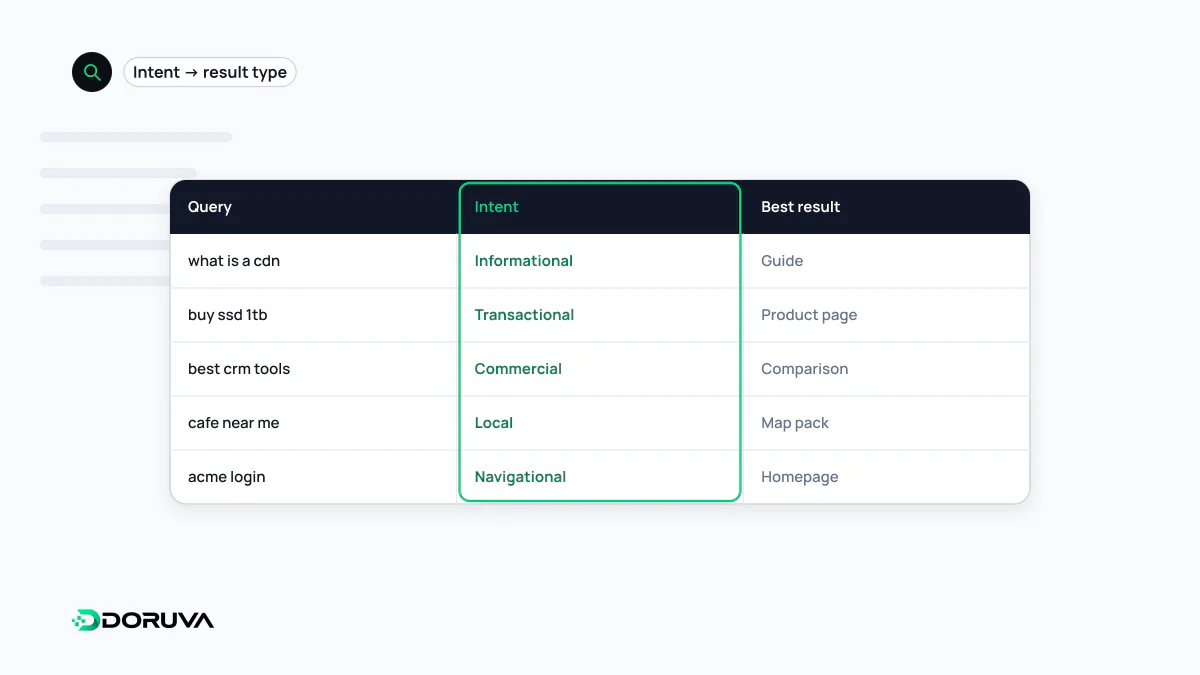
Same words, different expectations
Someone typing "robots.txt" may want to know what the file is. Someone typing "robots.txt example" wants a template to copy, and "robots.txt tester" means they want to check something right now. The words overlap; the goals do not. Search intent is that goal, and a good page answers one question first: what does this person hope to find when they land here?
Four common intent types
| Type | The searcher wants to | Example query | Content that fits |
|---|---|---|---|
| Informational | Learn or understand something | what does a canonical tag do | Guide, glossary entry, explainer |
| Navigational | Reach a specific site or page | search console login | The brand's own page |
| Commercial investigation | Weigh options before buying | ecommerce platforms compared | Comparison, review, case write-up |
| Transactional | Complete an action | request a website quote | Service page, product page, form |
This four-way split is an industry convention, not official Google terminology. Google's Search Quality Rater Guidelines group queries with their own labels (such as Know, Do, Website and Visit-in-Person). The names differ; the idea is the same.
Reading intent
- Look at the results page. Does the SERP for the query show mostly guides, product listings or local businesses? That is the clearest evidence of how the search engine interprets it.
- Watch the modifiers. "How", "what is" and "example" suggest informational intent; "price", "quote" and "buy" suggest transactional; "best", "vs" and "alternatives" suggest commercial investigation.
- Accept mixed intent. Some queries carry more than one expectation, and their results are mixed too. A page can serve the dominant need while offering a short path to the secondary one.
Common mistakes
- Showing a sales page to someone who wants to learn, or a long introduction to someone ready to buy.
- Trying to satisfy very different intents with a single page.
- Publishing several pages for the same intent so that they compete with one another.
Planning content around intent also makes it easier to build pages that complement each other within a topic, which over time underpins topical authority. Most of the work of reflecting intent on the page itself falls under on-page SEO.
Intent in conversational search
In AI search experiences, people write longer, more contextual questions and narrow them down over a conversation. Search systems in turn try to capture meaning rather than exact word matches. Clearly structured content that answers a whole need, not a single keyword, is more useful both in classic results and in AI-generated answers.