

What is Semantic Search?
Definition
Semantic search is a retrieval approach that returns results based on the meaning of a query and of the content, not just on exact word matches. It accounts for synonyms, context, entities and user intent. Today it is often implemented with vector search, where text is converted into numerical vectors (embeddings) and the content closest in meaning to the query is retrieved.
Also known as: meaning-based search, neural search, semantic retrieval
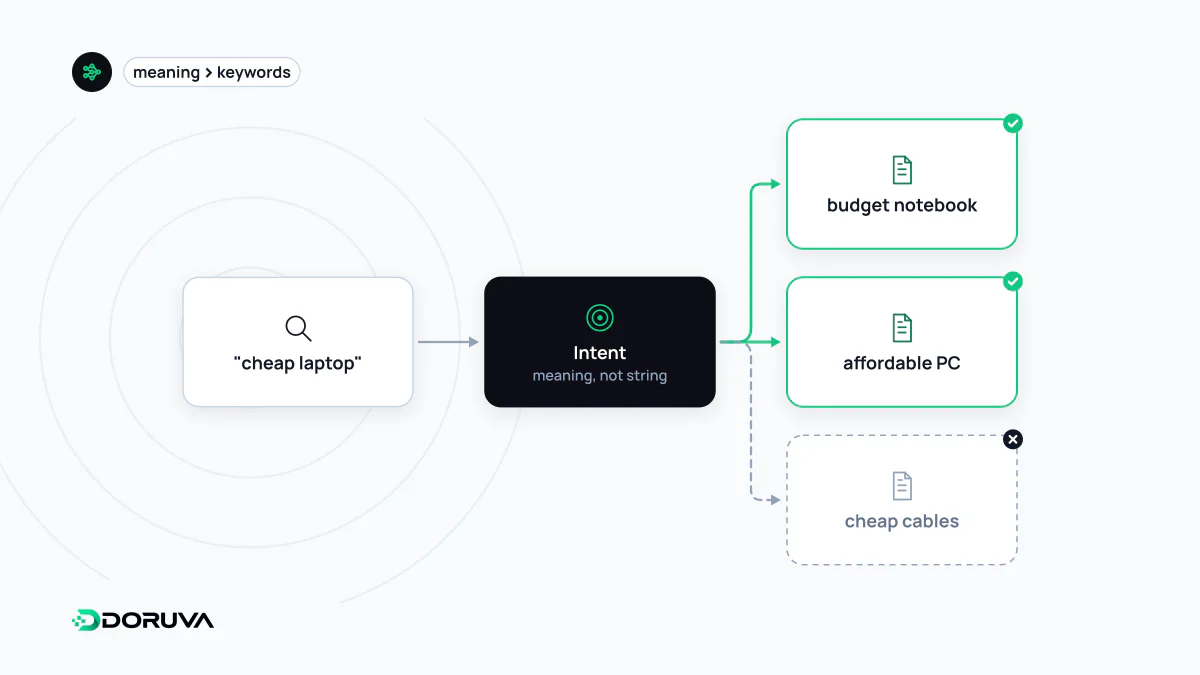
From matching words to matching meaning
Lexical search checks whether the words in a query appear in a document and how often. Someone searching “how to change a car tyre” could miss an excellent guide that only uses the words “replace” and “wheel”. Semantic search tries to recognize that both phrasings mean the same thing.
It draws on several signals to do this: synonyms and related terms, the surrounding context, the entities in the query, and the user's search intent. In “dinner in Bodrum”, Bodrum is a place entity and the intent is most likely to find a restaurant.
| Lexical search | Semantic search | |
|---|---|---|
| Match criterion | Shared words | Similarity of meaning |
| Synonyms | Missed unless configured | Usually captured |
| Strongest for | Product codes, names, exact phrases | Natural-language questions, vague wording |
Vector search in brief
Vector search is one of the most common ways to implement semantic search. A language model converts each piece of text — a query, a paragraph, a document — into a list of hundreds of numbers called an embedding. Texts with similar meanings end up close together in that vector space. At query time the query's vector is computed and the nearest vectors are found using a measure such as cosine similarity. Approximate nearest neighbour (ANN) indexes make this fast across millions of records.
Many systems combine both approaches in hybrid search, merging lexical and vector results so that exact-phrase queries and natural-language questions are both handled well. In AI answer systems, the retrieval step that selects passages for the model usually relies on these techniques — the pattern known as RAG.
What it means for content
- Keyword repetition does not help: using the same word again and again does not strengthen meaning; explaining the topic well does.
- Coverage matters: content that addresses sub-questions, related concepts and examples matches more of the ways people phrase a question.
- Focused passages: with passage-level retrieval, sections that stick to one topic are easier to match with the right query.
- Exact terms still count: product codes, model numbers and brand names still depend on lexical matching, so write them out explicitly.
Common misreadings
“With semantic search, word choice no longer matters” is wrong; knowing how your audience phrases a topic is still valuable. Another myth is that lists of “LSI keywords” are the secret to semantic search; Google has not documented any such ranking factor. The reliable approach is to explain the topic clearly and completely, in a way that actually answers the user's question.