

What is Knowledge Graph?
Definition
A knowledge graph is a data structure that stores entities such as people, organizations, places and concepts as nodes, and the relationships between them as edges. Search engines and AI systems use it to work out which entity a query refers to and to look up facts about it. Google's knowledge panels in search results are drawn from its Knowledge Graph.
Also known as: Google Knowledge Graph, knowledge base, entity graph
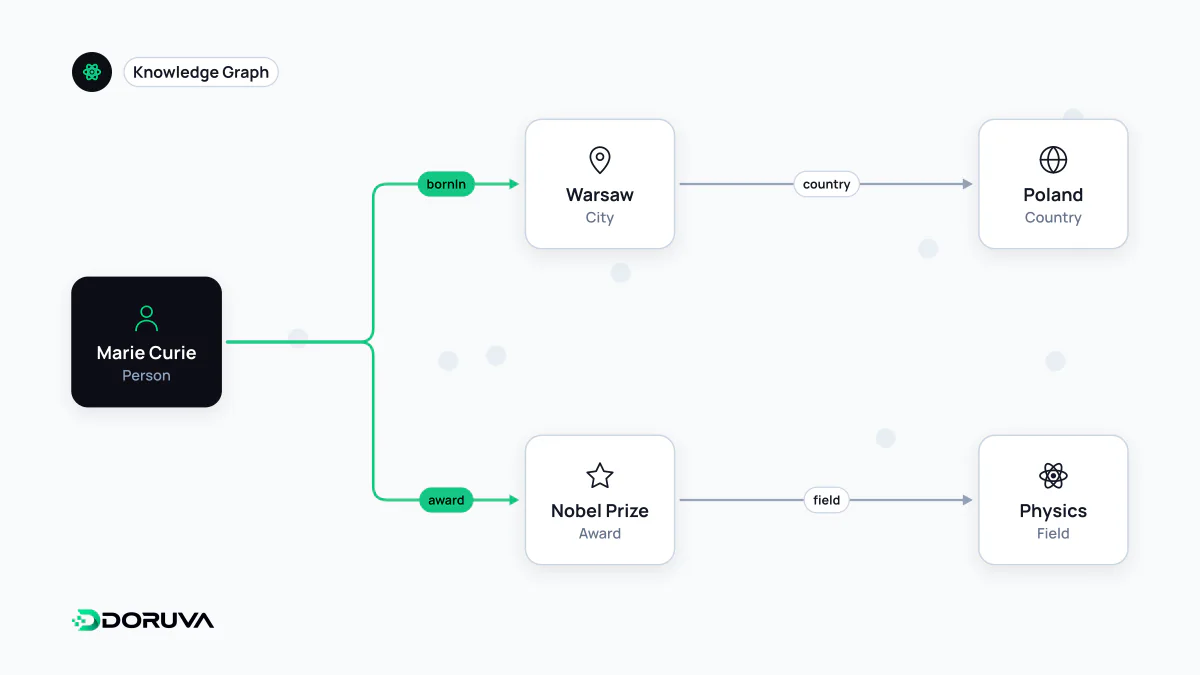
Nodes, edges and triples
A knowledge graph treats information as a network rather than a set of tables. Each node is an entity, and the edges that connect nodes describe relationships. The smallest unit of knowledge is usually a subject–predicate–object triple:
Mimar Sinan     —  designed     —  Selimiye Mosque
Selimiye Mosque —  located in   —  Edirne
Edirne          —  country      —  Türkiye
Because the facts are linked, a system can answer “Which city is the Selimiye Mosque in?” by following relationships instead of matching text. Open knowledge graphs such as Wikidata follow the same idea and serve as reference sources for many systems.
Google's Knowledge Graph
Google launched its Knowledge Graph in 2012, and the knowledge panels shown beside search results are built from its entity records. Developers can look up entities through the Knowledge Graph Search API, although Google notes that it returns individual matching entities rather than graphs of interconnected entities and is not suitable as a production-critical service.
Why it matters for search and AI
- Understanding queries: mapping a name in a query to the right entity is a core step of semantic search.
- Direct facts: attributes such as a person's birth date or a company's headquarters can be read from the graph and shown on the results page.
- Consistency in AI answers: some systems can support model output with structured fact sources, which is one form of grounding. Exactly which product uses which graph, and how, is generally not documented in detail.
How a website contributes
There is no form for adding a record to Google's Knowledge Graph directly. Entities are compiled from many sources across the web and from licensed data. What an organization can do is send clear, consistent signals:
- Add structured data for the Organization or Person, including the official name, logo, URL and sameAs links.
- Keep brand details identical across profiles and directories.
- Be covered accurately on independent, reputable sources.
- If a knowledge panel already appears, use Google's verification and claim process to suggest corrections.
Expectations to adjust
Adding markup does not create a knowledge panel on demand; Google says such markup can influence what is shown, not that it will be shown. Likewise, being in the graph does not mean ranking higher. A knowledge graph is not a ranking lever but a layer of knowledge that systems use to make sense of the world.