

What is Schema.org?
Definition
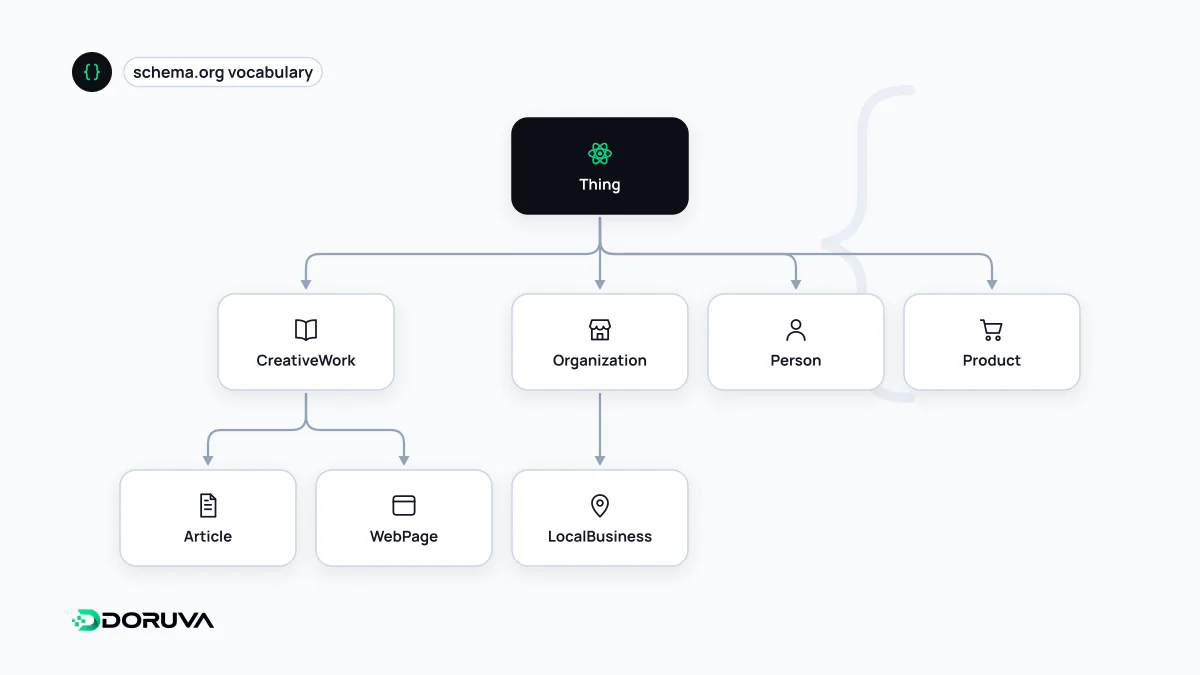
Schema.org is an open project that publishes a shared vocabulary of types and properties for describing entities and their relationships on web pages. It was launched in 2011 by Google, Bing and Yahoo, with Yandex joining shortly after. It defines types such as Organization, Product and Article, all descending from Thing, plus properties such as name, author and price, and can be expressed in JSON-LD, Microdata or RDFa.
Also known as: schema.org vocabulary, schema vocabulary, schema.org types
A vocabulary, not a syntax
The most common confusion about Schema.org is treating it as a code format. It is a vocabulary: it says there is a type called "Product", that this type has a property called "offers", and that the property expects an "Offer" as its value. How those words are written into a page is a separate question; the same Product description can be carried by JSON-LD, Microdata or RDFa. Think of Schema.org as the dictionary and the formats as the alphabet the sentence is written in.
The project was announced jointly by Google, Bing and Yahoo on 2 June 2011, and Yandex joined later. The goal was to spare site owners from marking up their pages differently for every search engine. As its own FAQ states, Schema.org is not a formal standards body and not a W3C standard; it is a collaboration between search engines.
How types and properties fit together
Every type descends from Thing, and subtypes inherit the properties of their parents. In the chain Thing › CreativeWork › Article › NewsArticle, NewsArticle gets name from Thing and author from CreativeWork. A restaurant sits at Organization › LocalBusiness › FoodEstablishment › Restaurant.
Each property declares the kinds of value it expects: author takes a Person or Organization, datePublished takes a date. As of release 30.1 the vocabulary has 826 types, 1,540 properties, 19 datatypes, 96 enumerations and 544 enumeration members. With that much breadth there is usually a fitting type for almost anything, and the right choice is usually the most specific one; Google's guidelines likewise ask for the most specific applicable type and property names defined by schema.org.
Core, pending, attic and extensions
The vocabulary isn't monolithic. Alongside the core, several hosted sections cover particular domains: auto (automotive), bib (libraries and bibliographic data), health-lifesci (health and life sciences), meta and pending.
- pending: a staging area for new terms under discussion. They may lack consensus and can still change, so use them knowing that.
- meta: terms schema.org uses internally, not intended for general publishing.
- attic: an archive of deprecated or rejected terms that publishers are told not to use.
- External extensions: independent vocabularies such as the GS1 Web Vocabulary, run outside the Schema.org steering group's oversight.
Governance and releases
Decisions rest with a Steering Group drawn from the founding search engines, while broader participation happens in a W3C Community Group that anyone can join after agreeing to the contributor licence agreement. Examples, schemas and issue discussions live in the project's GitHub repository. New releases ship several times a year; at the time of checking, the latest was version 30.1, published on 16 September 2026, which added terms for EU Digital Product Passports and common e-commerce product data. The project describes itself as a work in progress that will keep evolving.
In Schema.org doesn't mean supported by Google
Only a small share of Schema.org's types map to a Google rich result, and Google's search gallery lists the features it supports. That is why there are two validators: the Schema Markup Validator (validator.schema.org) checks markup against the vocabulary in general, while Google's Rich Results Test only checks eligibility for Google's own features. Types without a rich result aren't pointless: naming the entities on a page and linking them explicitly helps systems such as the Knowledge Graph, and other machine readers, interpret the content. For the broader concept and the rules, see structured data.