

What is Rich Result?
Definition
A rich result is a Google search result that goes beyond the standard title, URL and description by adding elements such as review stars, prices, event dates, recipe details or an image carousel. Most rich results are enabled by structured data on the page; valid markup makes a page eligible but never guarantees the enhanced display.
Also known as: rich snippet, rich results, enhanced search result, rich search result
Rich results versus rich attributes
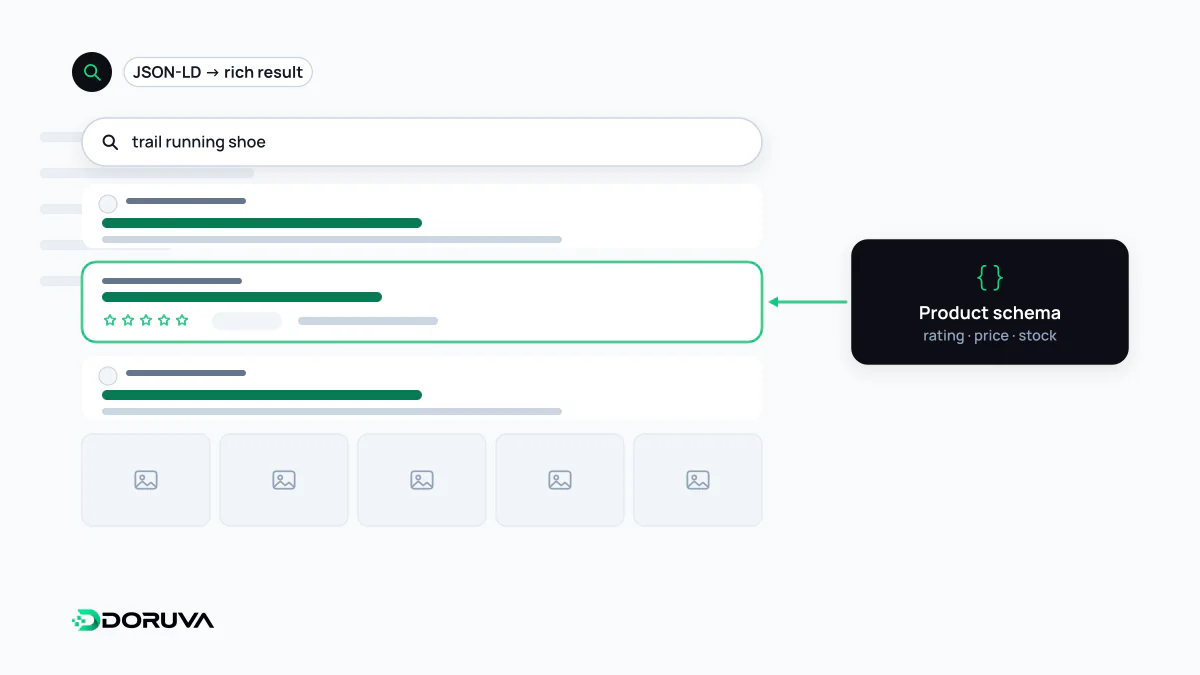
Google's visual elements gallery separates two things. A rich result typically relies on structured data to show graphical elements or an interactive experience, such as a recipe card, a job listing or an event list. Rich attributes are one or more extra lines added to an ordinary text result: review stars, a price, availability. The older industry term "rich snippet" is still used loosely for both.
Rich results are one subset of the wider family of SERP features. The difference lies in the data source: a featured snippet is selected automatically from content, whereas a rich result depends largely on markup you provide.
What is supported now, and what is gone
As of its June 2026 update, Google's structured data gallery lists around 25 features, including article, breadcrumb, carousel, event, job posting, local business, product, review snippet, recipe, video, software app, discussion forum, Q&A, profile page, organization and vacation rental. The list is not fixed, and it has shrunk noticeably:
| Type | What happened |
|---|---|
| HowTo | Removed from mobile in August 2023 and from desktop in September 2023 |
| FAQ | Limited to well-known government and health sites from August 2023; no longer shown at all since May 2026 |
| Book Actions, Course Info, ClaimReview, Estimated Salary, Learning Video, Special Announcement, Vehicle Listing | Phase-out announced in June 2025 |
| Practice Problem | Announced in November 2025; documentation removed in January 2026 |
Google says these changes do not affect ranking and that unused structured data causes no problems for Search, so there is no need to rush to delete markup for retired types.
From markup to display
Every link in the chain has to hold:
- Syntactically valid markup; in most cases Google recommends JSON-LD.
- All required properties for the type, with recommended properties filled in where accurate data exists.
- Compliance with the general guidelines: marked-up content must be visible to users on the page and must not be misleading.
- The final decision rests with Google's algorithms. Google does not guarantee display even when markup passes the Rich Results Test.
{
  "@context": "https://schema.org",
  "@type": "Product",
  "name": "Ceramic Pour-Over Coffee Dripper",
  "image": "https://example.com/products/dripper.jpg",
  "offers": {
    "@type": "Offer",
    "price": "34.00",
    "priceCurrency": "GBP",
    "availability": "https://schema.org/InStock"
  }
}
Markup that breaks the guidelines, such as reviews that do not appear on the page or hidden content, can lead to a manual action, and the page then loses eligibility for rich results.
Testing and measuring impact
Use the Rich Results Test during development and the rich result status reports in Search Console after launch. The "Search appearance" filter in the Performance report separates impressions and clicks for individual rich result types.
Treat impact figures with care. In case studies published by Google, Rotten Tomatoes reported a 25% higher click-through rate on pages with structured data, and Nestlé measured an 82% higher click-through rate for pages appearing as rich results. These are the sites' own measurements and promise nothing for every site or query. The current list of types lives in Google's structured data search gallery.