

What is Manual Action?
Definition
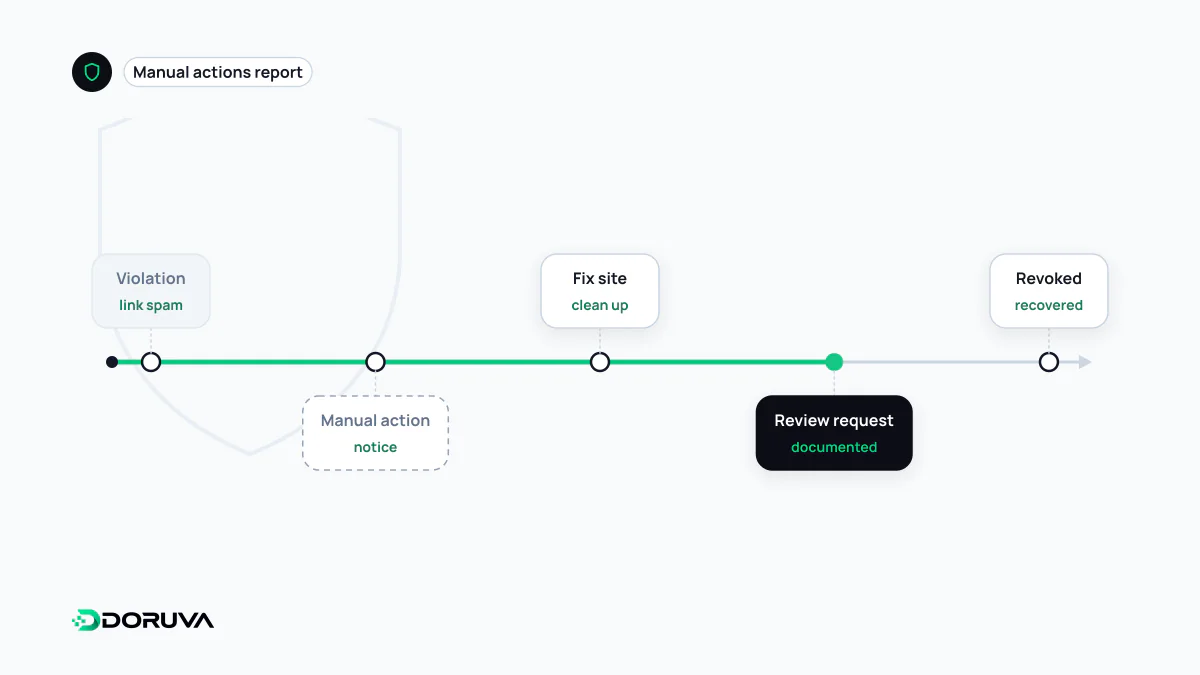
A manual action is a penalty Google applies when a human reviewer determines that pages on a site do not comply with Google's spam policies. Affected pages can be ranked lower or removed from search results entirely. Site owners are notified through the Manual Actions report and messages in Search Console, and can request a review once the problem has been fixed.
Also known as: Google manual penalty, manual penalty, Google penalty, manual spam action
Manual vs algorithmic
"Google penalty" gets used for two different things. A manual action means a human reviewer at Google looked at your site, found it in breach of the spam policies and told you so. An algorithmic drop is the effect of automated systems, whether spam detection or core ranking, and comes with no notice at all. Google says its algorithms catch the vast majority of spam automatically, so most traffic losses are not manual actions. If the Manual Actions report shows a green check mark, look for the cause elsewhere.
Reading the report
The Manual Actions report in Google Search Console lists active actions, the type of violation and the affected URL patterns. An action can cover part of a site, such as one forum directory, or the whole domain. The types you are most likely to meet:
| Action | Typical cause |
|---|---|
| Unnatural links to your site | Bought links or link schemes pointing at you |
| Unnatural links from your site | Selling links that pass ranking credit without qualifying them |
| Thin content with little or no added value | Scraped, auto-generated or doorway pages |
| Cloaking and/or sneaky redirects | Different content for Googlebot and users |
| Hidden text and/or keyword stuffing | Invisible text, unnatural repetition |
| User-generated spam | Spam in comments, forums or profiles |
| Structured data issue | Markup that misrepresents the page; rich result eligibility is lost |
| Site reputation policy | Third-party content exploiting the host site's signals |
The full list also includes back-button hijacking, spammy free hosts and a long series of content-policy actions that apply only to Google News and Discover.
Fixing it and asking for review
- Fix the issue on every affected page, not just the sample URLs shown in the report.
- Make sure Google can reach the fixed pages: no login wall, no
noindex, no robots.txt block. - For link-related actions, try to get the links removed first, then disavow what you could not remove. Google warns that disavowing everything without attempting removal can get a request rejected.
- Submit via Request Review in the report.
Google says a good request does three things: explains the exact quality issue, describes the steps taken to fix it and documents the outcome. "We removed 95 of 140 paid links, contacted the remaining site owners (list attached) and disavowed the domains that did not respond" is far more convincing than "we fixed everything".
Timelines and what recovery really means
Most reconsideration reviews take several days to a few weeks; link-related ones can take longer. You will get email updates, and Google asks owners not to resubmit before a final decision arrives. Once an action is revoked, the pages are eligible to rank again, but whatever the manipulation once provided does not come back. Expecting rankings to return exactly to their pre-violation level is therefore unrealistic. A revoked action also does not exempt the site from future algorithmic demotion, a separate mechanism that can coincide with, but is not the same as, a core update drop.