

What is Google Spam Policies?
Definition
Google's spam policies are the rules content must not violate to be eligible to appear in Google web search results. They define practices that manipulate rankings or mislead users, including cloaking, doorway abuse, keyword stuffing, link spam, scaled content abuse, site reputation abuse and expired domain abuse. Sites that violate them may rank lower or not appear in results at all.
Also known as: Google spam guidelines, Google webmaster guidelines, link spam, doorway pages, site reputation abuse
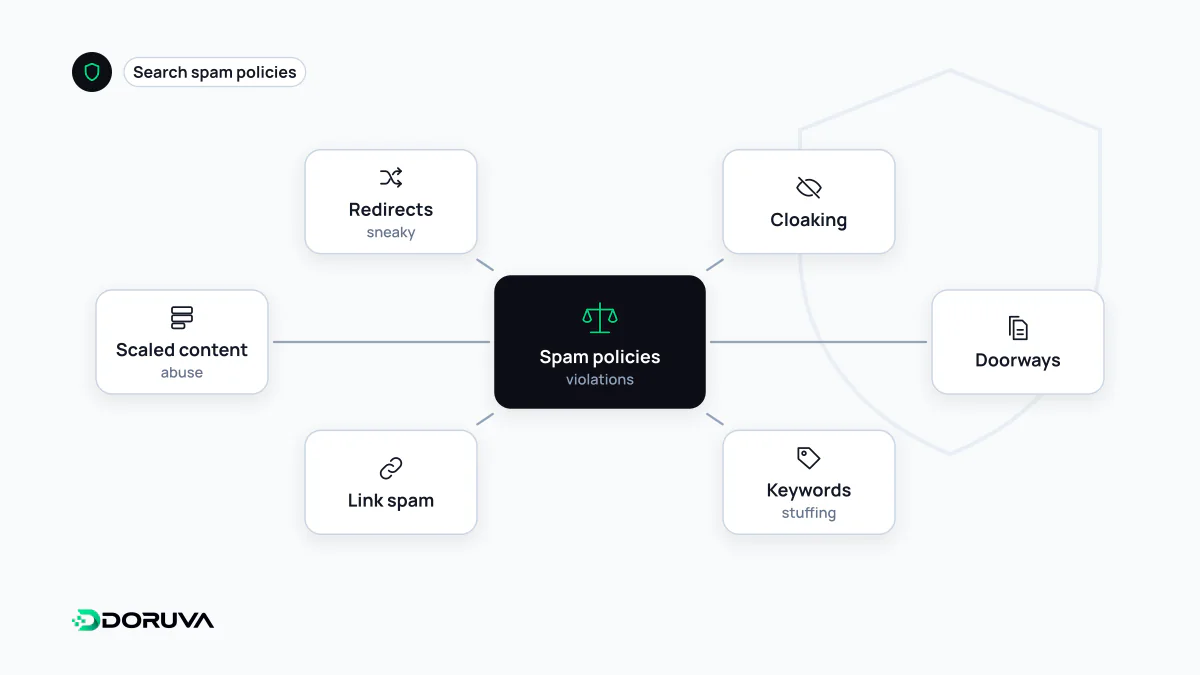
What the policies cover
The rules that used to be scattered across the old Webmaster Guidelines now live in a single spam policies page within Google Search Essentials. They apply not just to web pages but to images, videos, news content and anything else Google finds across the web. Google detects violations mainly through automated systems such as SpamBrain and, when needed, through human review. A human reviewer's decision shows up in Search Console as a manual action; automated demotions come with no notification.
The current list
As of the version updated on August 28, 2026, the page covers:
| Policy | In short |
|---|---|
| Cloaking | Showing search engines and users different content |
| Doorway abuse | Intermediate pages built for similar queries that funnel users elsewhere |
| Expired domain abuse | Buying a lapsed domain to exploit its history with low-value content |
| Hacked content | Content placed on a site without permission through a security hole |
| Hidden text and link abuse | Content meant for search engines and hidden from visitors |
| Keyword stuffing | Filling a page with keywords or numbers unnaturally |
| Link spam | Links created primarily to manipulate rankings |
| Machine-generated traffic | Sending automated queries to Google without permission |
| Malicious practices | Malware, unwanted software, back-button hijacking |
| Misleading functionality | Pages pretending to offer a service they do not provide |
| Scaled content abuse | Mass-producing pages to rank rather than to help users |
| Scraping | Republishing other sites' content without adding value |
| Site reputation abuse | Third-party content published to ride a host site's ranking signals |
| Sneaky redirects | Sending users somewhere they did not expect, deceptively |
| Thin affiliation | Affiliate pages with copied descriptions and no original value |
| User-generated spam | Spam added through comments, forums, profiles and similar channels |
The page also lists other behaviour that can lead to demotion or removal: high volumes of valid legal or personal-information removal requests, policy circumvention (for example continuing a violation on a fresh subdomain) and scams or fraud.
Link spam and doorway pages
These are the two violations that come up most often in practice. Link spam is creating links to or from a site primarily to manipulate rankings. Google's examples include buying or selling links that pass ranking credit, excessive link exchanges, links produced by automated programs, distributed articles or press releases with optimised anchor text, and low-quality directory or bookmark sites. Google accepts that paid links are a normal part of advertising and sponsorship, provided they carry rel="sponsored" or nofollow. The link-building side is covered in more depth under backlink.
Doorway pages are created to rank for specific, similar queries and lead users to intermediate pages that are less useful than the real destination. The textbook case is hundreds of "plumber in [city]" pages where only the city name changes. The dividing line is substance: a location page with the branch's real address, team, opening hours and local detail is legitimate; a templated copy with a swapped place name is a doorway. This is the main risk to manage in any programmatic SEO project.
The three policies added in 2024
In March 2024 Google introduced three policies. Scaled content abuse broadened the old rule on automatically generated content: whether pages are produced by AI, by people or by a mix does not matter; what matters is generating many pages primarily to manipulate rankings rather than help users. Expired domain abuse targets repurposing a lapsed domain's reputation, such as putting casino content on a former school's domain. Site reputation abuse, enforced from May 5, 2024, covers third-party content published on an established site mainly because of the host's ranking signals. Google's examples of what is not site reputation abuse include wire-service content, user-generated content sites and clearly attributed freelance articles.
If you suspect a problem
Start with the Manual Actions and Security Issues reports in Search Console; hacked content and user-generated spam often appear without the owner's knowledge. Deliberate schemes such as bought links, cloned city pages or text served only to Googlebot need to be removed before any recovery is realistic. If you spot violations on another site, Google offers a spam report form. The authoritative wording is always the current spam policies page.