

What is Black Hat SEO?
Definition
Black hat SEO is the umbrella term for tactics that try to manipulate search rankings by breaking search engine rules, such as buying links, cloaking, doorway pages, keyword stuffing or mass-produced low-value content. Its opposite, white hat SEO, works within search engine guidelines and focuses on creating value for users. Both are industry jargon; in Google's own documentation, the boundary is drawn by its spam policies.
Also known as: blackhat SEO, white hat SEO, grey hat SEO, gray hat SEO, spammy SEO
Where the labels come from
The black hat and white hat labels come from old Westerns, where villains wore black hats and heroes wore white, and the security world uses them in a similar way. In SEO, black hat means knowingly breaking search engine rules to rank faster. Google itself does not use these terms: it defines what is unacceptable through its spam policies. In practice, "is this black hat?" really means "does this fall under one of the spam policies?"
People also talk about grey hat: practices that the rules do not explicitly name but that work against their intent. The problem with grey is that the line moves. Mass AI-generated content and rented-out subfolders on authoritative sites were treated as grey by many until 2024; they are now spelled out as scaled content abuse and site reputation abuse.
Common tactics and the rules they break
| Tactic | Policy it runs into |
|---|---|
| Buying link packages, running private blog networks (PBNs) | Link spam |
| Serving Googlebot a different page | Cloaking |
| Hundreds of near-identical city pages | Doorway abuse |
| Packing copy and footers with phrases | Keyword stuffing |
| Publishing thousands of unreviewed AI pages | Scaled content abuse |
| Filling expired, well-linked domains with unrelated content | Expired domain abuse |
| Renting a subfolder on a strong site for third-party content | Site reputation abuse |
| Using click bots to influence results | Machine-generated traffic |
Why the shortcut rarely pays
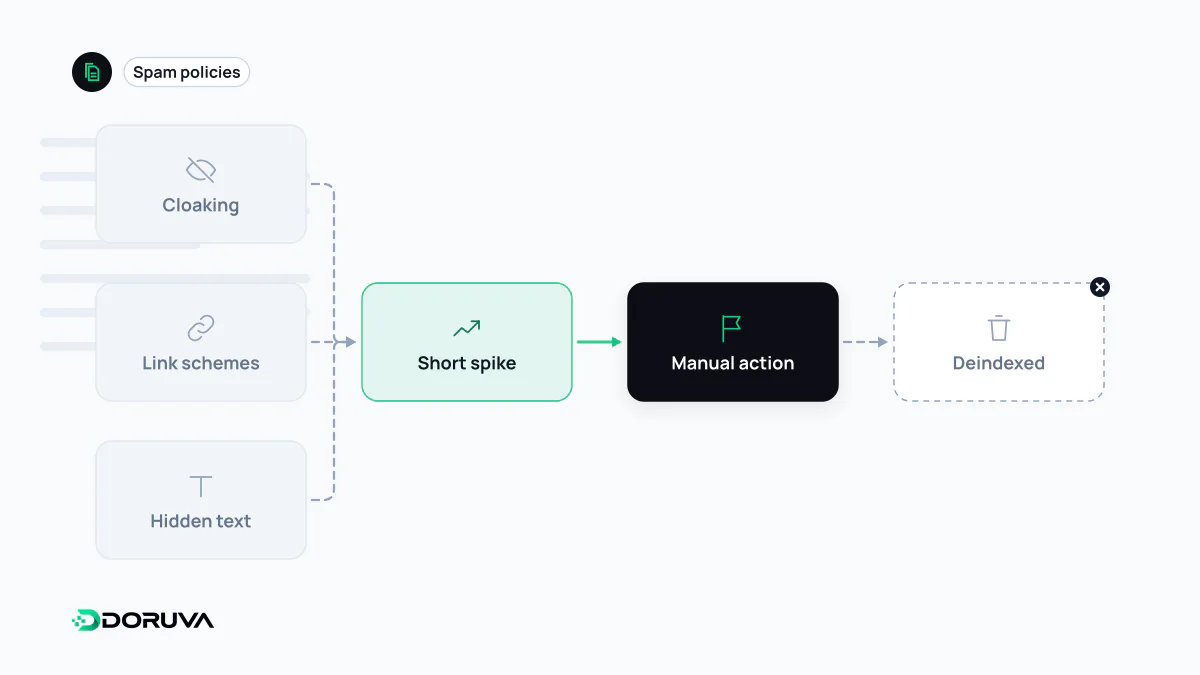
Some black hat tactics work for a while; the real questions are how long and at what cost. Automated systems such as SpamBrain keep improving, and detection can affect an entire domain, not just the manipulated pages. A manual action means a clean-up and reconsideration cycle that can last months. Bought links, cloned pages and scraped content also damage the brand itself, and the same patterns can undermine trust when AI assistants decide which sources to cite.
There is a passive side too. Attackers who compromise an outdated CMS can inject spam pages and hidden links without the owner noticing, which makes routine security patching part of SEO hygiene.
White hat as the durable alternative
White hat SEO pursues the same visibility by aligning with what search engines try to reward: a crawlable, fast site; content that fully satisfies the search intent; clear authorship and organisational information; and links earned because the work is worth referencing. Progress is slower but compounds, and one update is unlikely to wipe it out. Scaled approaches such as programmatic SEO stay on this side only when every page carries genuinely distinct information.
Red flags when hiring an SEO
- A guaranteed number-one ranking. Google's own hiring guidance states that no one can guarantee a #1 ranking.
- Claims of a "special relationship" with Google or "priority submission".
- Link packages sold by quantity with undisclosed sources.
- Secrecy about methods, or reluctance to explain what will be changed.
- Asking for full Search Console permissions straight away; Google suggests granting read access first.