

What is Programmatic SEO?
Definition
Programmatic SEO is the practice of generating large numbers of pages automatically by combining a structured dataset with a page template, so that each page targets one of many similar search queries. Currency converters, integration pages and location-based listings are typical examples. When pages do not offer genuinely distinct, useful data, the approach runs into Google's scaled content abuse and doorway policies.
Also known as: pSEO, programmatic page generation, template-based SEO, SEO at scale
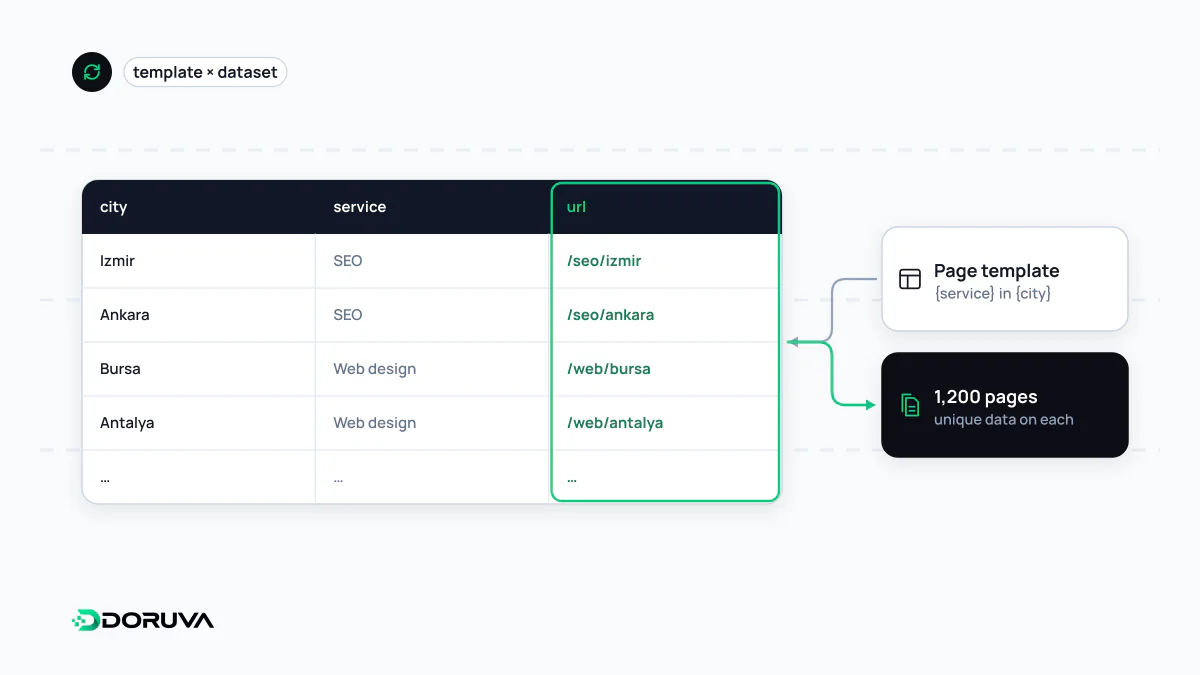
The building blocks
A programmatic project has four parts: a dataset whose rows become pages, a template that turns each row into something readable, a predictable URL pattern, and hub pages that tie thousands of URLs into a navigable structure. On the demand side it targets a family of long-tail queries that share one shape.
- "100 USD to EUR"-style currency conversion pages,
- "Connect X with Y" integration pages for a SaaS product,
- listing sites combining a location and a category, such as "two-bed flats to rent in Hackney",
- product or software comparison pages.
The technique itself is neutral. Category pages on large marketplaces are generated programmatically too. What matters is whether each page tells the searcher something useful about the specific query it targets.
What a good generated page has
A quick test: if you change the variable in the template, does anything else on the page change in a meaningful way? If the Manchester and Leeds pages differ only by the city name, you have duplicated copy, not a data page. Strong examples carry their own facts in every row: the current exchange rate, the real number of listings and their price range, the fields an integration actually syncs, details specific to that neighbourhood.
Publishing should depend on the data as well. A threshold like the one below keeps empty combinations from ever going live:
for (const row of dataset) {
  // skip combinations without enough real data
  if (row.listingCount < 5 || !row.medianRent) continue;

  pages.push({
    url: "/to-rent/" + row.areaSlug + "/",
    title: "Flats to Rent in " + row.areaName,
    summary: row.listingCount + " listings, median rent " + row.medianRent,
  });
}
Where Google draws the line
Google's spam policies define scaled content abuse as generating many pages primarily to manipulate rankings rather than help users, and stress that this applies no matter how the content is created. Examples include:
- using generative AI or similar tools to produce many pages without adding value,
- scraping feeds, search results or other content and multiplying it through automated transformations such as synonym swapping or translation,
- stitching together content from different pages without adding value.
The doorway section of the same policies is just as relevant. It lists pages targeted at specific regions or cities that funnel users to one page, and substantially similar pages that are closer to search results than to a clearly defined, browsable hierarchy. Padding each page with AI-written paragraphs does not fix this, because what is missing is data, not words. The usual outcome is thousands of URLs judged as thin content.
Technical side effects
Publishing tens of thousands of URLs overnight does not mean they will be crawled and indexed at the same pace. Crawl budget is finite on large sites, and low-value pages can delay the crawling of valuable ones. A growing pile of URLs under "Crawled – currently not indexed" in Search Console's Page indexing report is a typical sign that Google sees too little value in them.
Another frequent issue is linking. URLs that exist only in the sitemap, with no category or hub page pointing to them, end up as orphan pages.
Before you launch
- Does every page carry data that answers the query and appears nowhere else on the site?
- Can the source be kept accurate? Stale rates or expired listings make pages misleading.
- Is there a rule to skip or
noindexcombinations with too little data? - Do the pages receive internal links through a sensible hierarchy?
- Did you start with a small batch and watch indexing rates and real clicks before scaling up?