

What is Thin Content?
Definition
Thin content is a page that offers visitors no original information, experience or function of its own, typically because it is copied from elsewhere, mass-produced from a template or created only to attract search traffic. Google addresses it through its spam policies and quality systems, and severe cases can receive a 'Thin content with little or no added value' manual action in Search Console.
Also known as: low-value content, thin pages, shallow content
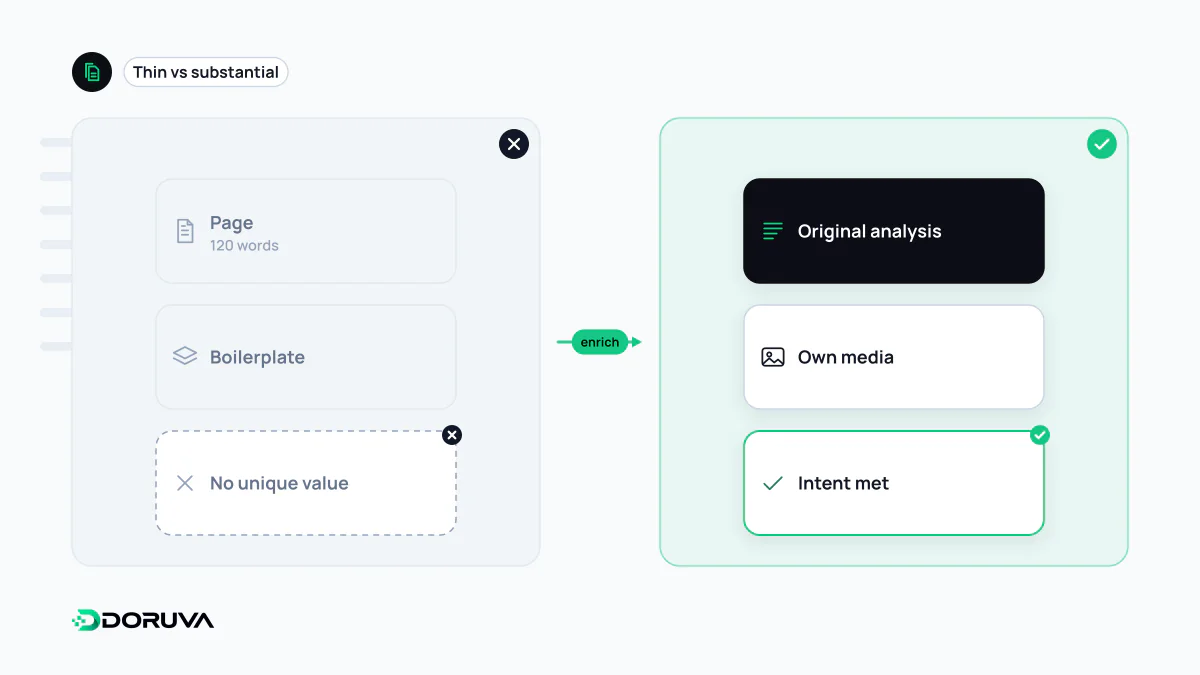
Short is not the same as thin
Thin content is often equated with low word count, but the real test is added value. A currency converter, a weather page or a single precise answer can be brief and still do the job. A 2,000-word article that rearranges what other sites already say, with no new data, observation or experience, is thin. Google's guidance on helpful content says it outright: there is no preferred word count, and "mainly summarizing what others have to say without adding much value" is a warning sign.
Where it appears in Google's policies
"Thin content" is not one policy. It maps onto several sections of Google's spam policies:
- Thin affiliation: affiliate pages whose product descriptions and reviews are copied straight from the merchant without original content. The policy also stresses that not every affiliate site is thin; original testing, comparisons and price analysis add value.
- Scaled content abuse: generating many pages primarily to manipulate rankings rather than help users, whether by people, templates or generative AI.
- Scraping: republishing other sites' content without any unique benefit to the user.
- Doorway abuse: near-identical pages created per city or keyword that all funnel visitors to the same destination.
When these patterns are widespread, the Manual Actions report in Search Console can show a "Thin content with little or no added value" manual action. Without one, thin pages are still assessed by Google's automated systems; since 2024 the helpful content signals have been part of the core ranking systems.
How sites accumulate it without trying
Most thin pages are a by-product of growth, not deliberate spam:
- Thousands of product pages with a name, a price and the manufacturer's stock description.
- Indexable filter and tag pages that list one or two items.
- Programmatic SEO experiments producing "[service] in [city]" pages that differ only by the city name.
- Short blog posts that cover the same topic again under a new headline.
- Archive, author and date listings generated automatically by the CMS.
Some of these are really a duplicate content issue. What they share is that a visitor landing on the URL finds nothing they could not get elsewhere.
Finding and fixing it
- Inventory by template. Group indexable URLs by page type. The problem usually sits in a template, not in individual pages.
- Check performance. URL groups with no impressions or clicks in Search Console over a long period are a good starting list.
- Decide per group. Strengthen pages with original information, data, media or first-hand experience; consolidate overlapping pages into one and 301-redirect the rest; apply
noindexto pages that help users on-site but have no search value; remove pages with no purpose at all. - Fix the source. If the template, filter or automated feed that creates thin pages stays as it is, the cleanup refills within months.
The same guidance notes that adding or removing large amounts of content just to make a site seem "fresh" does not help rankings. The point of a cleanup is not a smaller page count; it is making sure every remaining page has a job.