

What is E-E-A-T?
Definition
E-E-A-T stands for Experience, Expertise, Authoritativeness and Trust, the concepts Google's Search Quality Rater Guidelines use to assess page quality. Trust sits at the centre and is the most important of the four. According to Google, E-E-A-T itself is not a specific ranking factor; its automated systems use a mix of signals to identify content that demonstrates these qualities.
Also known as: EEAT, E-A-T, Experience, Expertise, Authoritativeness, Trustworthiness, EAT
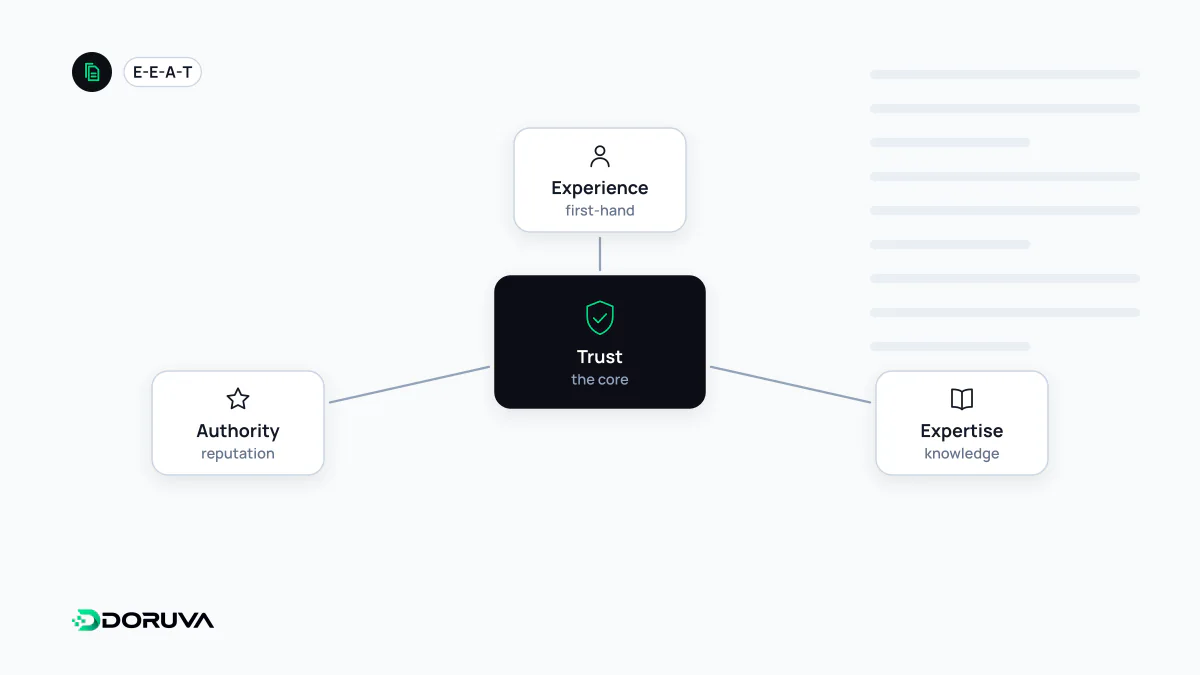
Four letters, with Trust in the middle
The concept was known as E-A-T for years; in December 2022 Google added Experience to its rater guidelines. The September 2025 edition of the guidelines describes the four parts like this:
| Element | Question raters ask | Example from the guidelines |
|---|---|---|
| Trust | Is the page accurate, honest, safe and reliable? | An online store with secure payments and reliable customer service |
| Experience | Does the creator have first-hand or life experience of the topic? | A review from someone who has actually used the product |
| Expertise | Does the creator have the knowledge or skill the topic requires? | Home rewiring advice from a qualified electrician |
| Authoritativeness | Is the creator or site known as a go-to source for the topic? | The official government page for passport renewal |
The guidelines call Trust the most important member of the family: an untrustworthy page has low E-E-A-T no matter how experienced, expert or authoritative it appears. The other three are evidence that supports Trust, and content doesn't need to show all of them.
Is it a ranking factor?
Not as a single, measurable ranking factor. Google states that E-E-A-T itself isn't a specific ranking factor; its automated systems rely on a mix of signals that can identify content with good E-E-A-T. Quality raters have no control over how pages rank, and their ratings are not used directly in ranking algorithms. Their work tells Google whether its systems are returning good results.
How much E-E-A-T matters depends on the topic. For YMYL subjects, those that can affect health, financial stability, safety or the welfare of society, Google gives extra weight to strong E-E-A-T. A humour page isn't held to the same standard.
What raters look at
- What the site or creator says about itself: the About page, author profiles, contact and ownership details.
- What others say: independent reviews, news coverage, references. The guidelines treat this reputation research as especially important for catching untrustworthy sites.
- What is visible on the page: the main content itself and sections such as comments. A video of a stylist cutting hair demonstrates expertise directly.
Conflicts of interest lower trust. A manufacturer praising its own product, or a paid influencer's "review", carries less weight than the account of an independent owner.
Demonstrating it in practice
Google's guidance on helpful content boils it down to three questions: who created the content, how, and why?
- Who: clear bylines and author pages that describe real qualifications. Marking these up with ProfilePage structured data helps machines read them, but markup alone creates no trust.
- How: the testing method behind a product review, original photos and measurements, and disclosure of automation or AI use where readers would expect it.
- Why: content made to help a defined audience, not primarily to attract search traffic.
Public detail on how AI search systems choose their sources is limited. Still, verifiable claims, transparent authorship and independent references make a page easier to assess as a credible source in any context, which is the core of source authority.
Common misconceptions
- "There is an E-E-A-T score." Google publishes no such score; tools that show one are offering third-party estimates.
- "An author box boosts rankings." A byline without real expertise behind it changes nothing; the evidence matters, not the widget.
- "It only matters for YMYL sites." The bar rises for YMYL topics, but trustworthiness is the baseline everywhere.