

What is YMYL (Your Money or Your Life)?
Definition
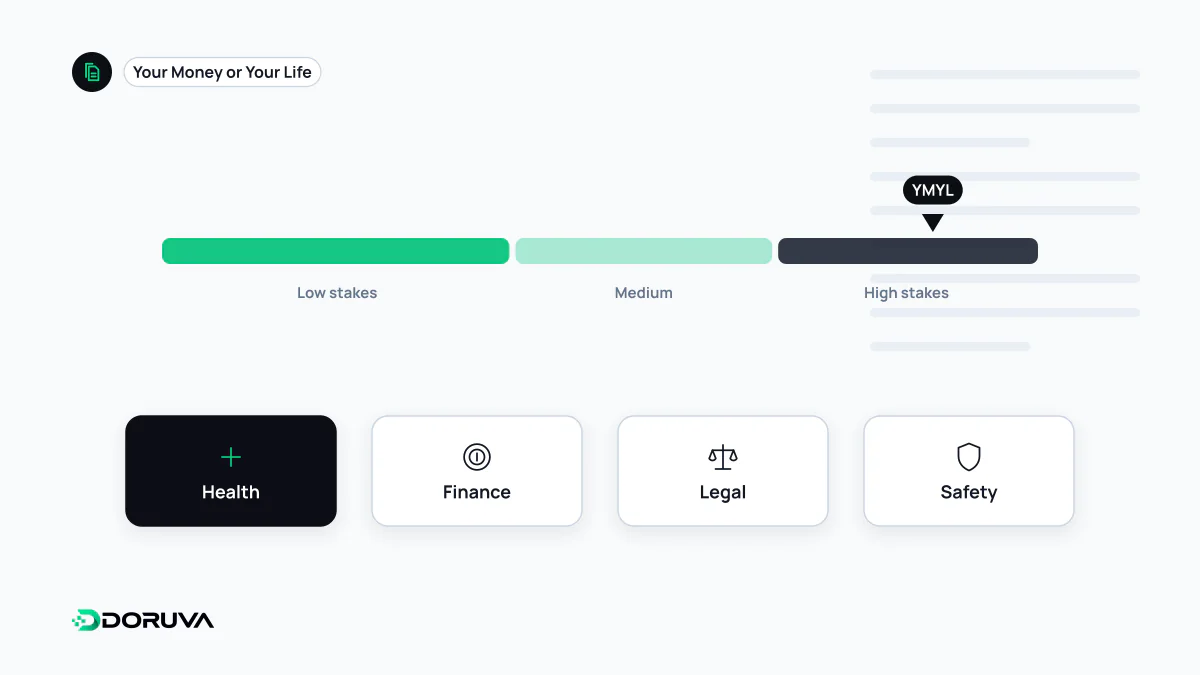
YMYL (Your Money or Your Life) is a term from Google's Search Quality Rater Guidelines for topics that could significantly affect people's health, financial stability or safety, or the welfare of society. Because inaccurate information on these topics can cause real harm, Google says its systems give more weight to content that shows strong signals of trustworthiness when a query falls into this territory.
Also known as: Your Money or Your Life, YMYL topics, YMYL content, YMYL pages
Where the term comes from
YMYL is defined near the start of the page quality section in the guidelines Google publishes for its external search quality raters. In the version dated September 11, 2025 it has its own section, "Your Money or Your Life (YMYL) Topics". Raters score search results, but Google is clear that those scores do not directly move individual pages; they are used to evaluate whether the ranking systems are doing a good job.
Google's guidance for content creators states the same idea in plainer terms: for topics that could significantly affect health, financial stability, safety or the well-being of society, its systems give even more weight to content that aligns with strong E-E-A-T. YMYL is, in effect, a risk classification: the cost of being wrong is high.
What falls into YMYL
The industry a site belongs to matters less than the decision a reader might make based on the page. Typical areas:
| Area | Example topics | Potential harm |
|---|---|---|
| Health and safety | Drug interactions, what a symptom means, first aid | Wrong treatment, delayed care |
| Financial security | Loans, investing, taxes, retirement | Lost money, unmanageable debt |
| Civics and society | Voting information, official procedures, legal rights | Missed deadlines, lost entitlements |
The boundary is a spectrum rather than a switch. A cake recipe is usually not YMYL, but a page claiming a recipe is safe for people with coeliac disease touches a health outcome. A phone review is low risk; a page on the same site calculating the real interest cost of buying that phone on credit steers a financial decision.
A common misreading: YMYL is not a penalty
There is no "YMYL site" status in Search Console, no label Google stamps on a domain and no standalone YMYL ranking factor. Publishing in these areas is not punished; the bar is simply higher. Two pages of similar craft can be judged very differently if one explains a pasta sauce and the other explains chemotherapy options. This is also why the loudest stories after a core update tend to come from health and finance publishers: on those queries, the systems are especially sensitive to signals of reliability.
Experience or expertise?
The rater guidelines devote a subsection to this question. A first-person account of living with a chronic condition can be genuinely valuable precisely because of that lived experience. Dosage guidance, a diagnosis or an investment recommendation, however, calls for expertise. Strong YMYL pages keep the two apart: personal experience is framed as personal experience, and anything that reads like advice is grounded in a qualified source.
Making trust visible on the page
- Authorship and review: show who wrote the piece, who checked it if anyone did, and why they are qualified on this subject.
- Sourcing: link figures, rates and legal references to primary sources such as regulators, official bodies or peer-reviewed work.
- Real maintenance: when a rate, tax band or clinical guideline changes, update the content itself. Google's guidance explicitly lists changing dates to look fresh, without substantive changes, as a warning sign.
- Organisational transparency: contact details, the responsible entity, a corrections policy and any affiliate or advertising relationships should be easy to find.
- Honest scope: a "this is not medical advice" line does not fix a page that is, in substance, giving personalised medical advice. Narrowing the claims does.
The same habits also feed the source authority that AI assistants weigh when choosing what to cite. Google's current wording on the topic lives in its guide to creating helpful content.