

What is Content Freshness?
Definition
Content freshness is how recent the information on a page is and how clearly that recency is communicated to readers and machines. Google's 'query deserves freshness' systems surface newer content for queries where up-to-date information is expected; for queries where it is not, being new is no advantage by itself. In AI-generated answers the same idea appears as source freshness.
Also known as: source freshness, freshness, query deserves freshness, QDF, fresh content
Freshness depends on the query
Google's guide to its ranking systems says it runs various "query deserves freshness" systems to show fresher content where it would be expected. Its own example: someone searching for a film that has just been released probably wants recent reviews rather than older articles about the production. The reverse also holds. For "Pythagorean theorem" or "how to build an HTML table", recency barely matters.
Queries where freshness counts tend to fall into three groups:
- Breaking events: elections, earthquakes, product launches, service outages.
- Recurring events: match results, annual budgets, tax deadlines, exam schedules.
- Frequently changing information: prices, software versions, regulations, product comparisons.
How a search engine dates a page
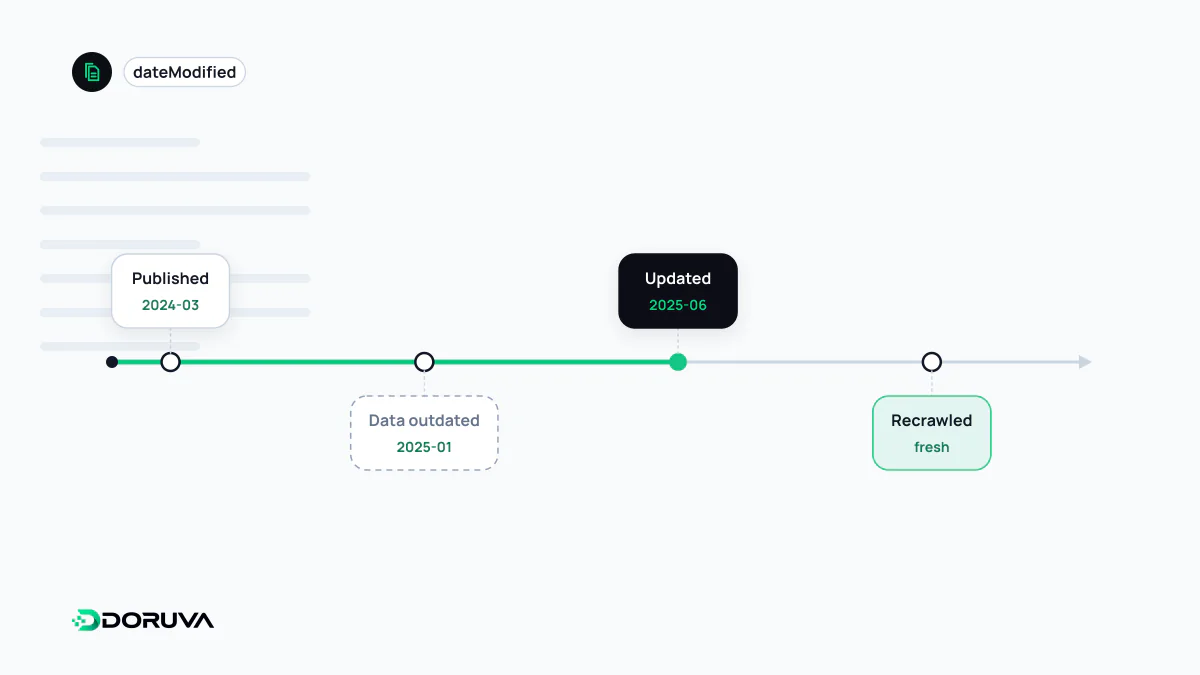
Google explains that it does not rely on a single date signal but weighs several, including the visible date and structured data. The recommendation is to show the date clearly and mark the same values up consistently with datePublished and dateModified in Article schema:
<p>Published 12 March 2026 · Updated 18 September 2026</p>

<script type="application/ld+json">
{
  "@context": "https://schema.org",
  "@type": "Article",
  "headline": "Minimum Wage Calculator Guide 2026",
  "datePublished": "2026-03-12T09:00:00+03:00",
  "dateModified": "2026-09-18T14:30:00+03:00"
}
</script>
The same guidance asks for timezone information, no future dates and no competing dates on the page. In XML sitemaps, Google says it uses the lastmod value only when it is consistently and verifiably accurate.
A new date is not an update
Google's self-assessment questions for helpful content target two common tactics: changing a page's date when the content has not substantially changed, and adding or deleting content in bulk to make a site seem fresh, which the guidance states plainly will not help. A substantive update corrects facts that have gone stale, adds new developments, replaces examples and screenshots and answers the questions readers now have. Fixing a typo or rolling over the copyright year does not justify a new dateModified.
Source freshness in AI answers
A language model's built-in knowledge ends at its knowledge cutoff. AI search systems that answer current questions therefore usually fetch web pages at query time and base the response on them, a process known as grounding. Source freshness describes how recent a retrieved page's information is and how clearly it says so.
How each system chooses its sources varies and is not documented in detail. For Google's AI Overviews and AI Mode there are no additional technical requirements beyond being indexed and eligible to appear with a snippet, so freshness works through the usual search signals. What can be said with confidence is that an undated page, one carrying old figures or one that contradicts itself is hard for a reader or a model to trust on a time-sensitive question. Stating when figures were valid ("as of September 2026"), naming version numbers and keeping a visible update date make recency legible to people and machines alike.