

What is Evergreen Content?
Definition
Evergreen content is content whose subject and answer do not go out of date, so it keeps being searched for and read months or years after publication. How-to guides, explanations of fundamental concepts and answers to perennial questions are typical examples. Unlike news and trend pieces, its traffic does not collapse after an early peak, but it still needs maintenance.
Also known as: timeless content, evergreen article, evergreen post
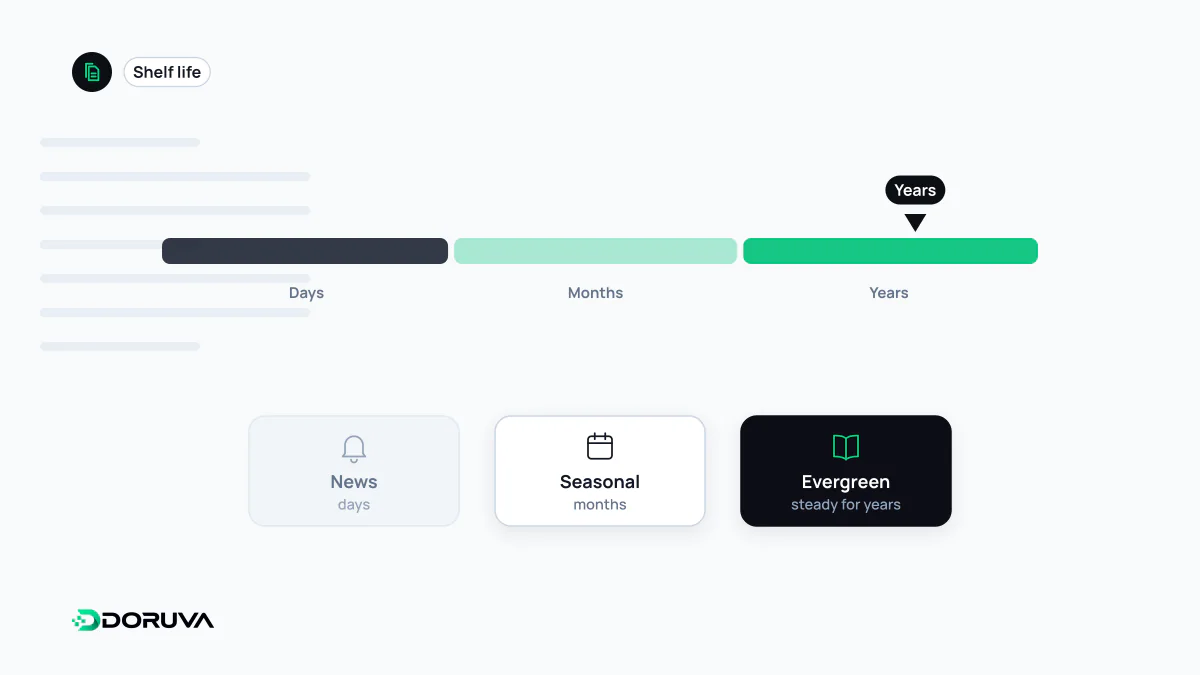
Evergreen versus time-bound
A piece's traffic curve mirrors the lifespan of its subject. A news story or trend post spikes on the day or week it appears, then fades fast. Evergreen content draws a lower but steadier line, because the question it answers gets asked again every month.
| Evergreen | Not evergreen |
|---|---|
| "How to choose a coffee grind size" | "The 10 best coffee machines this year" |
| "301 vs 302 redirects" | "Last week's Google algorithm update" |
| "How to read a tenancy agreement" | "This year's rent cap explained" |
The line is not always sharp. Best-of lists, prices, legal thresholds and product comparisons have lasting topics but perishable data; they only stay evergreen if someone keeps them up to date.
Why it is worth the effort
- It compounds. A page that brings in visitors every month becomes one of the site's most dependable entry points.
- It attracts links. A source that answers a fundamental question well gets cited by other writers for years, which is how backlinks are earned naturally.
- It anchors a cluster. In a topic cluster, the pillar and most supporting pages are evergreen; timely posts hang off that spine.
Not "publish and forget"
Evergreen pages erode too. Competitors publish fuller answers, tools and screenshots in the examples date, the question people ask shifts slightly, or the results page itself changes shape. That slow slide is content decay, and you only catch it by tracking traffic and positions over time.
A sensible review asks: is the information still correct? Has the search intent moved? Does the page skip a sub-question that the pages now ranking on top cover? Do the links and examples still work?
Updating versus redating
One of the self-assessment questions in Google's guidance on helpful content addresses this directly: are you changing the date of pages to make them seem fresh when the content has not substantially changed? Swapping the year in the title or bumping the "last updated" stamp misleads readers and adds nothing.
After a substantive revision, updating the date is exactly right. The same principle applies to the lastmod value in an XML sitemap: Google uses it when it is consistently and verifiably accurate, and counts changes to main content, structured data or links as significant, but not a new copyright year. For queries where content freshness matters, honest signals like these are worth even more.