

What is Topic Cluster?
Definition
A topic cluster is a content structure in which a pillar page covering a broad subject is connected by internal links to supporting pages that each explore one sub-question in depth. It helps visitors move through a subject and helps search engines understand how the pages relate. It is an editorial and information architecture model, not a Google ranking signal.
Also known as: pillar page, content cluster, pillar-cluster model, hub and spoke content
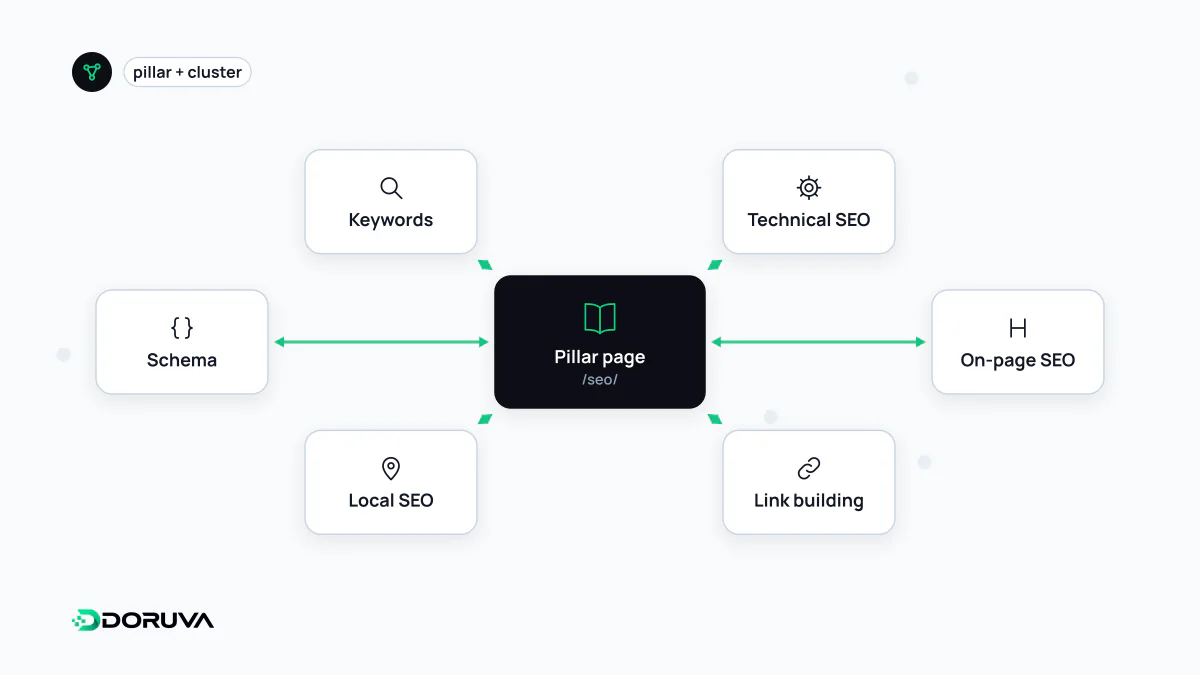
Pillar, cluster and the links between them
- The pillar page frames the whole subject, summarises each subtopic briefly and points to supporting pages for the detail. Think of a guide to "Brewing coffee at home".
- Cluster pages each target one sub-question or intent and go much deeper than the pillar can: "How to use a French press", "Coffee grind sizes explained", "The right water temperature for pour-over".
- Links run from the pillar to every cluster page, from each cluster page back to the pillar, and between cluster pages where it genuinely helps, always with descriptive anchor text.
Readers can move naturally from a narrow question to the big picture and on to the next question. For search engines, internal links and anchor text make explicit which page represents which subtopic and how the pages fit together.
What it does and doesn't promise
A topic cluster is not a ranking factor that appears anywhere in Google's documentation. It is a content planning and information architecture method, and its benefits are indirect. A site that covers a subject thoroughly and coherently is genuinely more useful, is more likely to earn links naturally, and over time builds the kind of depth people describe as topical authority. No page ranks simply because it sits in a well-linked cluster; each still has to be the best answer to its own question.
Building one
- Split the subject by intent, not by keyword list. Group the distinct questions people ask. Queries that share the same search intent belong on the same page.
- Give each intent exactly one page. Two cluster pages answering the same question compete with each other; this keyword cannibalisation is the most common way clusters go wrong.
- Map what you have, then find the gaps. Once existing content is placed on the map, missing sub-questions become obvious, and they make the editorial plan.
- Link in context. A link inside the sentence that mentions the subtopic tells readers and crawlers far more than a long "related posts" block at the bottom.
This glossary is built on the same idea: the hub lists categories, each entry links to the concepts it actually discusses, and related terms are chosen for a real relationship rather than for being in the same category.
Clusters and AI search
AI-powered search systems often retrieve the passage most relevant to a question rather than a whole page. A cluster that answers each sub-question clearly on its own page suits that kind of passage retrieval: the answer is easy to locate, and context is one link away on the pillar. That is not a guarantee of being cited, but it produces a far more legible source than one long page that tries to cover everything at once.
Familiar failure modes
- A pillar page that is nothing but a list of links.
- Thin, near-identical cluster pages spun up for every long-tail variant.
- Linking every page to every other page until the links stop meaning anything.