

What is Keyword Cannibalization?
Definition
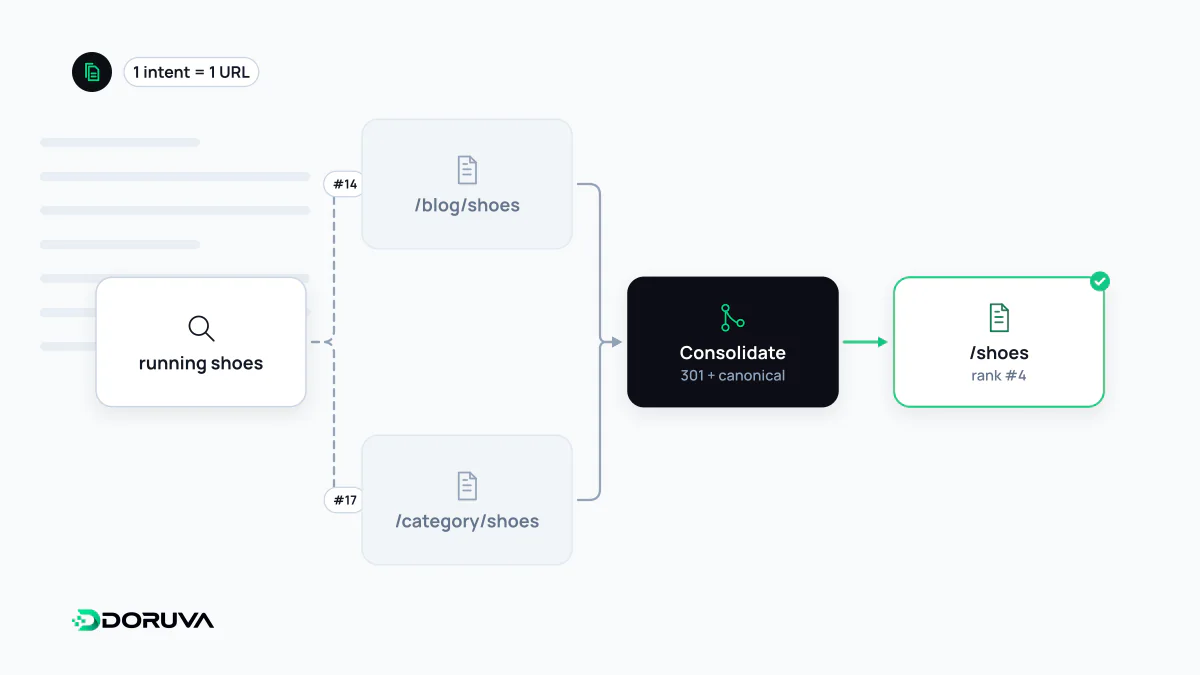
Keyword cannibalization is when two or more pages on the same site target the same search intent and end up competing for the same queries. The search engine may struggle to settle on one URL, rankings can fluctuate between them and link signals get split. Pages that merely share a keyword are not cannibalizing each other; the problem arises when their intent overlaps.
Also known as: content cannibalization, SEO cannibalization, keyword cannibalisation, page cannibalization
Same intent, not same keyword
A phrase like "business website" will naturally appear on dozens of pages of a web agency's site. Cannibalization is something narrower: two pages trying to give the same answer to the same question. Think of two blog posts titled "Speed up WordPress" and "WordPress performance optimization tips" whose content overlaps almost entirely. The search engine has to pick which one is the better answer, and it may keep changing its mind.
The diagnosis therefore starts with search intent. "Web design pricing" and "how to choose a web design agency" share vocabulary but serve different needs, so those pages do not eat into each other.
Signs it is costing you
- Flip-flopping URLs: for the same query, page A ranks one week and page B the next, and neither settles.
- The wrong page ranks: an old blog post appears where the service page built for conversions should.
- Split signals: external links and internal links are spread across two URLs, so neither is strong enough on its own.
- Near-identical content: at that point the issue is closer to duplicate content than to cannibalization.
When it is not a problem
Seeing two URLs for one query does not automatically call for action. Google's ranking systems guide describes a site diversity system that generally shows no more than two listings from the same site in the top results, while allowing more when they are especially relevant. Two results from your site on one query is often a win. Branded queries that return the homepage, contact and about pages together are normal, as is a category page and a buying guide serving people at different stages. The rule of thumb: if both pages perform well for their own intent, merging them can lose more than it gains.
Spotting it in Search Console
- In the Performance report, filter by the query you care about.
- Open the Pages tab to see every URL that earned impressions for it.
- Widen the date range and compare pages over time. Impressions passing back and forth between two URLs is the classic pattern.
- Open the pages and compare their intent yourself before acting on the numbers.
Anonymized queries are left out of the tables for privacy, so very low-volume phrases may not show the full picture.
Ways to resolve it
| Situation | Fix |
|---|---|
| Same intent, one page clearly stronger | Merge the content into the stronger page and 301-redirect the weaker one |
| Both pages needed, intent blurred | Differentiate titles, scope and the question each page answers |
| Technical variants (parameters, sort orders, print versions) | Declare the preferred version with a canonical URL |
| The wrong page ranks | Point internal links and their anchor text at the intended page |
Prevention is mostly bookkeeping. Keep a content map that assigns one "owner" page to each main query group, and check it before commissioning new articles. A topic cluster structure makes that ownership explicit.