

What is Content Gap?
Definition
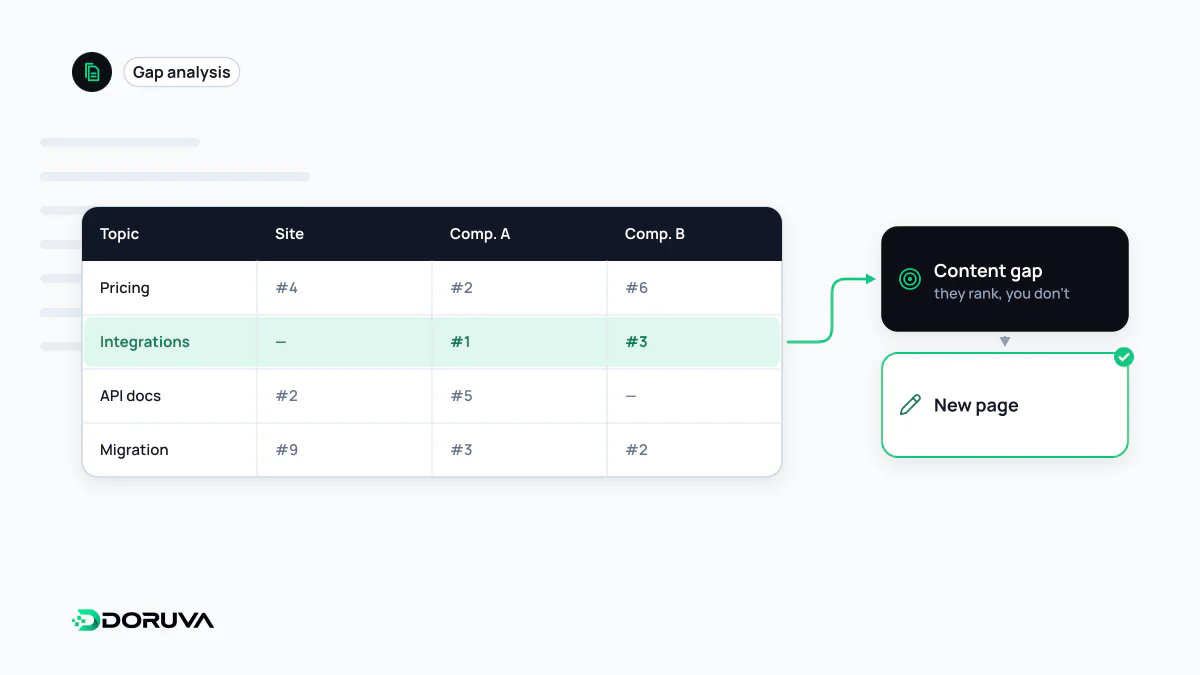
A content gap is a topic, question or search intent that your audience is looking for and that clearly belongs to your subject area, but that your site does not cover or covers only partially. Gaps are usually found by comparing the queries competitors rank for, the questions customers repeatedly ask and the subtopics missing from existing pages against what your site actually offers.
Also known as: content gap analysis, keyword gap, topic gap, competitor gap
Not every gap is a missing keyword
Most people hear "content gap" and picture a list of keywords competitors rank for and you do not. That is one kind of gap. In practice there are three worth looking for:
- Topic gaps: subjects your audience weighs during a decision that you never address. A custom software firm with no page comparing custom builds with off-the-shelf SaaS is a typical example.
- Depth gaps: the page exists but stops before the visitor's next question, like a pricing page that never explains what drives the price.
- Format and intent gaps: the topic is covered, but in the wrong shape. Visitors want a comparison table or a step-by-step guide and get a general essay.
Sources that reveal gaps
Competitor comparisons. The "keyword gap" features in third-party SEO tools compare the queries you and your competitors rank for. Those lists rest on estimated data, and not every query a competitor ranks for fits your business. Turning the raw export straight into an editorial calendar is a common mistake.
Your own Search Console data. Queries with impressions but few clicks, or with a poor average position, show where your site is close to a topic without fully answering it. This is the most reliable source of depth gaps.
The results page itself. People Also Ask boxes, autocomplete and related searches show what people ask around a topic.
Customer-facing teams. Questions that recur in sales calls, support tickets and contact forms are often gaps no tool will surface.
Why AI answers make gaps more visible
Google documents that AI Overviews and AI Mode may issue several related searches across subtopics while building a response, a technique it calls query fan-out. A site that answers only the headline question of a topic and leaves the side questions empty has little chance of being cited for any of those sub-searches. Gap analysis is therefore less about "which keyword are we missing?" and more about "which part of this topic can nobody learn from us?"
Deciding which gaps to fill
| Question | Why it matters |
|---|---|
| Does this topic connect directly to what we sell? | Unrelated traffic builds neither conversions nor topical authority |
| Do we have something original to say? | Rewriting a competitor's article does not close a gap; it creates a weaker copy |
| New page, or extend an existing one? | Unnecessary new pages raise the risk of competing with yourself |
| Where in the buying journey does it sit? | Questions close to a purchase usually deserve priority |
Gap analysis works best alongside a topic cluster map, so every gap becomes either an extension of an existing page or a new page with a defined place in the cluster. The query list that feeds the analysis comes from keyword research.