

What is Query Fan-Out?
Definition
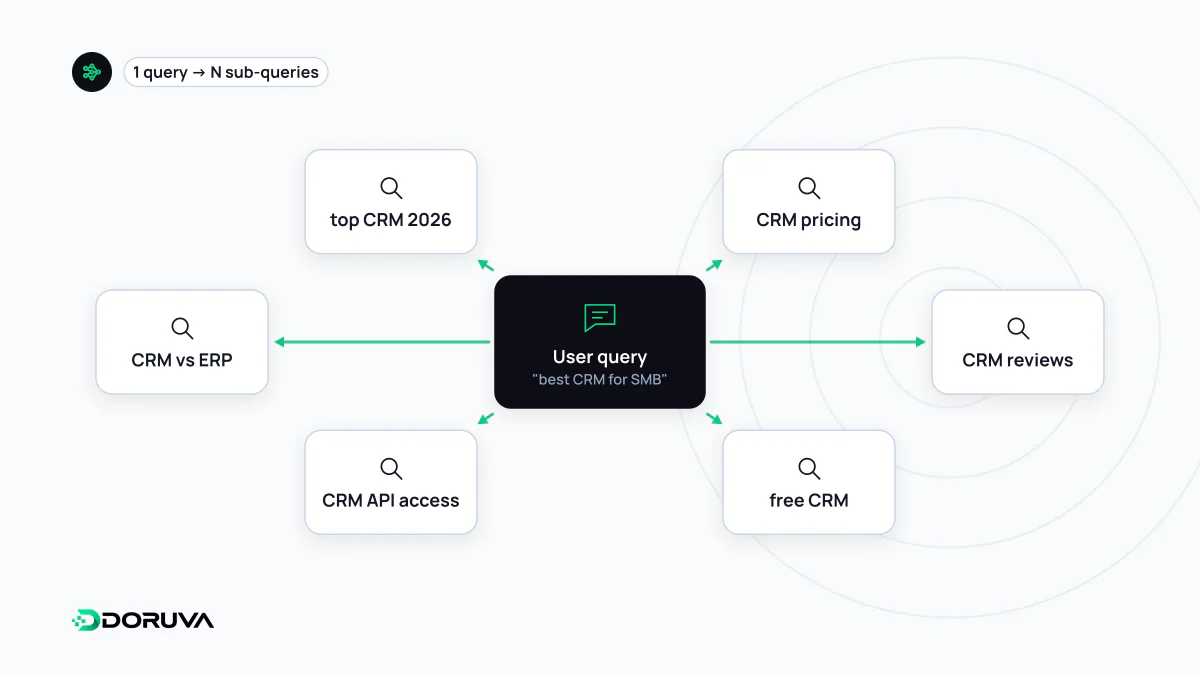
Query fan-out is a technique in which an AI-powered search system turns one user question into multiple related queries about its subtopics, runs them concurrently and combines what they retrieve into a single response. Google describes it for AI Overviews and AI Mode as a way to reach a broader and more diverse set of sources than one search would return.
Also known as: fan-out queries, query fanout, fanout queries, sub-query generation
Google's definition, with an example
In its guide to generative AI features in Search, Google defines query fan-out as a set of concurrent, related queries generated by the model to request more information and fetch additional search results for the user's query. Its example: "how to fix a lawn that's full of weeds" might fan out into "best herbicides for lawns", "remove weeds without chemicals" and "how to prevent weeds in lawn".
The Search Console documentation puts it more plainly for AI Mode: it groups the user's question into subtopics and searches for each one simultaneously. Google also says those searches reach beyond the web index into other data sources, such as the Knowledge Graph and shopping data.
The pipeline behind one answer
- Decompose: the model reads the question and separates its parts, such as the comparison, the constraints and the location.
- Fan out: one or more search queries are generated for each part and run in parallel.
- Gather: results and passages from every sub-search are pooled and de-duplicated.
- Synthesise: the model writes a single response grounded in the retrieved sources and shows supporting links.
This is retrieval-augmented generation at search-engine scale, with retrieval driven by a family of queries instead of one. Google says the result is a wider and more diverse set of links than a classic search would show. Deep Search in AI Mode applies the same technique at a larger scale, issuing up to hundreds of searches.
Fan-out versus query expansion
Query expansion enriches a single query with synonyms, stems and rewrites so that it matches the same need more reliably. Fan-out treats different parts of the question as separate needs and searches for each. Expansion asks the same question with a wider net of words; fan-out splits the question into several questions. The two can work together, since every generated sub-query can itself be expanded.
What site owners can and cannot see
Google does not reveal which sub-queries were generated. In Search Console, AI Overviews and AI Mode data is reported against the query the user typed, and a follow-up question in AI Mode counts as a new query. Bing Webmaster Tools offers a partial window on the idea: its AI Performance report shows a sample of "grounding queries", the phrases its AI used when retrieving content that was later cited. That data comes from Microsoft's systems and says nothing direct about Google's fan-out.
Implications for content
- A page can be cited as the answer to a sub-query rather than to the headline question. Pages that cover a topic's side questions in genuine depth have more ways to be retrieved.
- Answering each sub-question under a clear heading, in a passage that makes sense on its own, makes it easier for a sub-query to land on the right section.
- A topic cluster of interlinked pages naturally covers the questions that fan-out generates around a subject.
- The limit is explicit. Google states that creating separate content for every variation or fan-out query, primarily to manipulate rankings or AI responses, violates its scaled content abuse policy. Use likely sub-questions to find gaps in content you already have, not as a list of pages to mass-produce.