

What is AI Mode (Google)?
Definition
AI Mode is a conversational AI search experience offered as a separate tab in Google Search. It breaks complex, multi-part questions into subtopics, runs searches for them simultaneously and combines the findings into one response with links to supporting websites, and it lets users ask follow-up questions. It started as a Labs experiment in March 2025 and opened to everyone in the US in May 2025.
Also known as: Google AI Mode, AI Mode tab, Google Search AI Mode
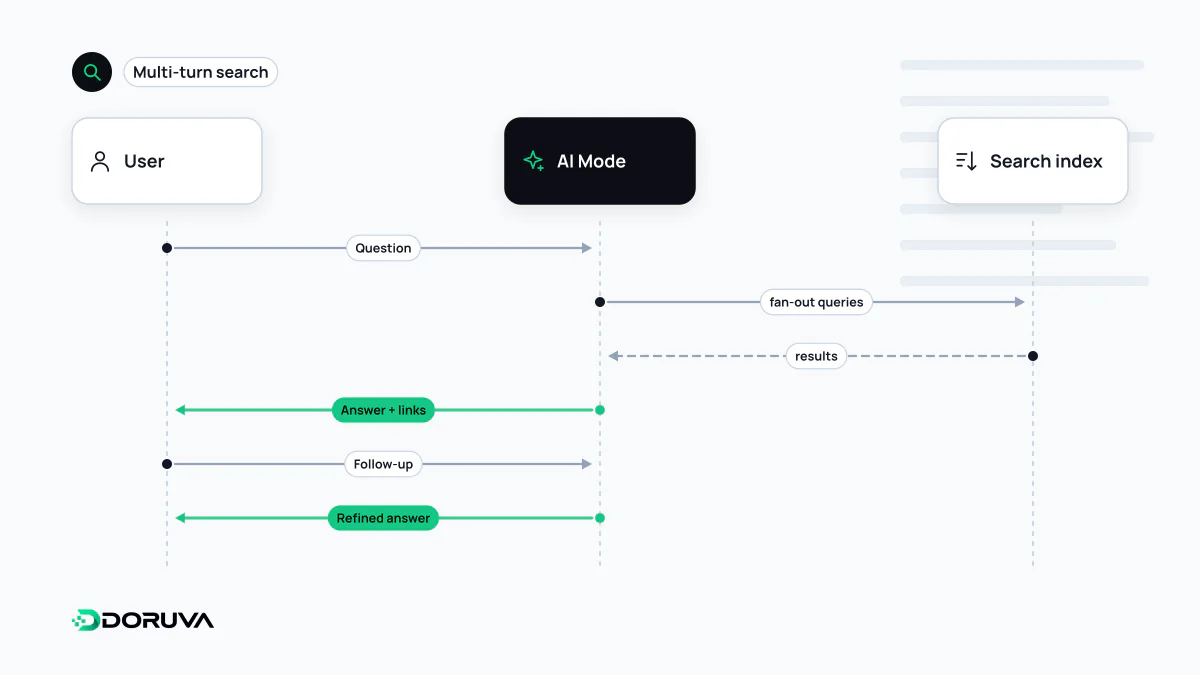
A conversation inside Search
Google announced AI Mode on 5 March 2025 as a limited, opt-in experiment in Search Labs. At Google I/O 2025 it opened to everyone in the US without a Labs sign-up, appearing as its own tab in Search and in the search bar of the Google app. On 7 October 2025 Google added more than 35 languages and over 40 countries and territories, bringing availability to more than 200 countries and territories in total.
Google positions AI Mode for queries that need further exploration, reasoning or complex comparisons. Instead of splitting a question into several searches, a user asks it once, reads a single synthesised answer and keeps going with follow-ups in the same context.
Under the hood: fan-out and Deep Search
According to Google, AI Mode breaks the question into subtopics and issues searches for each of them at the same time, a technique called query fan-out. The web index is not the only source: Google says AI Mode also draws on the Knowledge Graph, real-time information about the world and shopping data covering billions of products. Deep Search, aimed at research-style questions, takes the same technique further, issuing up to hundreds of searches and producing a fully cited report.
AI Mode is rooted in Google's core quality and ranking systems. Where Google lacks confidence that an AI response will be helpful, it falls back to a set of regular web results.
How it differs from AI Overviews
| AI Overviews | AI Mode | |
|---|---|---|
| Placement | At the top of the normal results page | A separate, full-page tab |
| Trigger | Only when the system judges it additive | Whenever the user chooses the mode |
| Interaction | A one-off summary | An ongoing conversation with follow-ups |
| Typical query | Broad range | Multi-part, comparative and research questions |
The two features may use different models and techniques, so their answers and links can differ for the same question. Appearing in AI Overviews says nothing certain about appearing in AI Mode.
What site owners should know
There are no extra technical requirements here either: a supporting link must be indexed and eligible to show with a snippet. Snippet controls (nosnippet, data-nosnippet, max-snippet) and noindex apply, and the "Search generative AI" control in Search Console excludes a site from AI Mode as well as from AI Overviews.
Measurement has a few quirks worth knowing. In the Search Console Performance report, AI Mode data is part of the "Web" search type; position follows the same method as a regular results page, and clicking an external link inside AI Mode counts as a click. A follow-up question in the same conversation is treated as a new query, so impressions and clicks in that response are attributed to the follow-up, not to the original search. The separate Generative AI performance report includes AI Mode impressions but no clicks, and features still in Labs are not reported at all.
Fan-out means a page can surface for many sub-queries rather than one headline query, which can favour sources that cover the side questions of a topic in real depth. Google is equally clear about the limit: creating separate pages for every possible variation or fan-out query, primarily to manipulate rankings or AI responses, violates its scaled content abuse policy.