

What is AI Search?
Definition
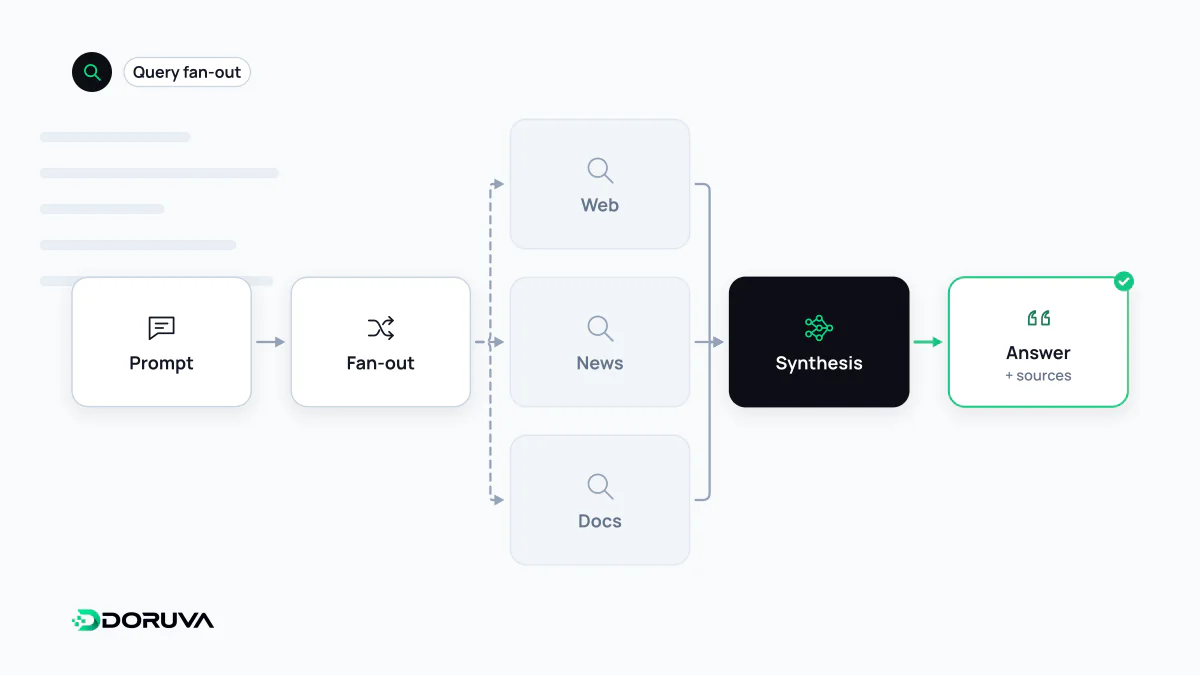
AI search is a search experience that responds to a question with an answer written by a large language model instead of only a list of links. The system typically breaks the question into several searches, retrieves relevant web pages and presents a synthesized answer together with source links. Google AI Overviews and AI Mode, ChatGPT search and Perplexity are examples.
Also known as: generative search, AI-powered search, answer engine, conversational search
From a list of links to a written answer
A classic search engine ranks the pages that best match a query and leaves the user to choose. AI search does part of that work for them: it reads the sources, summarizes them and writes a direct answer. Links do not disappear, but they move into a supporting role as sources next to the answer.
| Classic search | AI search | |
|---|---|---|
| Output | Ranked links and snippets (the SERP) | A synthesized answer with source links |
| Queries | Often short keywords | Longer, conversational questions and follow-ups |
| Repeatability | Relatively stable | The same question can produce different answers |
How an answer is put together
Details differ by product, but the overall pipeline looks similar:
- Understanding the question: intent and the entities mentioned are identified.
- Expanding the query: the question is split into subtopics and several searches are issued. Google calls this “query fan-out” and says it lets AI Overviews and AI Mode show a wider and more diverse set of links.
- Retrieval: relevant pages and passages are pulled from a search index or from content the provider's own crawlers collected, usually with semantic search techniques.
- Generation: a large language model writes the answer based on the selected passages — the general pattern known as RAG.
- Attribution: the pages used are listed as links or source cards.
What changes for websites
AI search changes how content is discovered, not the fundamentals behind it. Google states that there are no additional technical requirements for AI Overviews or AI Mode beyond being indexed and eligible to show with a snippet. Other products may rely on their own crawlers or search partners, which makes it relevant which AI crawlers your robots.txt allows.
In practice, the areas that deserve attention are:
- Passages that answer questions directly and are easy to quote.
- Consistent, verifiable information about the brand, its products and people.
- Coverage deep enough to address likely follow-up questions.
- Important text present in the HTML rather than dependent on JavaScript.
Limits worth knowing
AI search products change quickly, and detailed rules for source selection are not published. Answers can be wrong, sources do not always support the claim they are attached to, and the same question can be answered differently at different times. Visibility in these experiences should be judged through regular, repeated observation rather than one-off checks; the broader discipline is called GEO.