

What is Grounding?
Definition
Grounding is the practice of making a language model base its answer on verifiable sources supplied at answer time — web results, documents or database records — rather than only on what it learned during training. The aim is to keep answers current and checkable and to reduce the risk of fabricated information. A grounded answer usually shows the sources it relied on.
Also known as: AI grounding, grounded generation, source grounding, web grounding
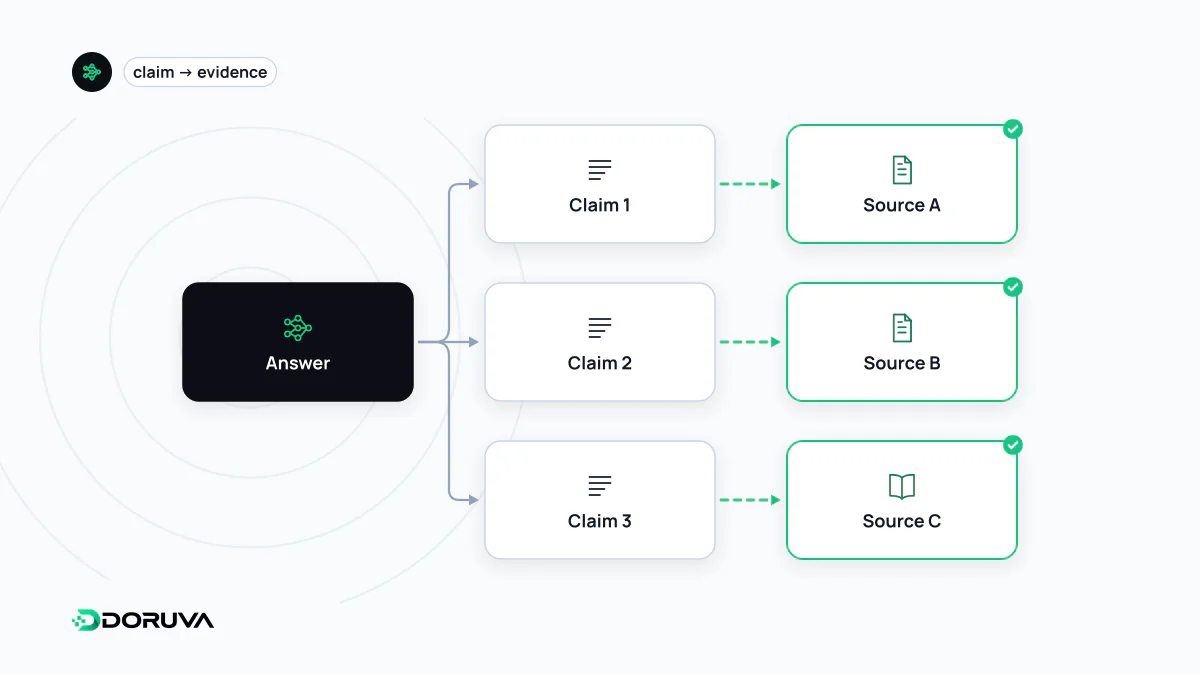
Model memory versus retrieved sources
A large language model carries patterns learned from its training data in its parameters. That memory is broad, but it has two weaknesses: it is frozen at a point in time, and the model cannot show where a particular fact came from. Grounding addresses this by giving the model relevant sources at the moment it answers.
| Model memory | Grounded answer | |
|---|---|---|
| Source of knowledge | Training data (parameters) | Documents or data retrieved at answer time |
| Freshness | Limited by the training cutoff | As current as the source |
| Verifiability | No source to show | Sources can be listed |
| Typical failure | Outdated or invented facts | Wrong source selected or source misread |
How it is implemented
The most common method is to find relevant content through a search step and place it in the model's context window, so the model writes its answer from those texts. This pattern is known as RAG (retrieval-augmented generation). The source can be the open web, internal company documents, a product database or a structured knowledge graph. AI search products that ground answers in the web display the pages they used as citations.
A simple example: “What will the weather be like in Istanbul this weekend?” cannot be answered from model memory, because the information is not in the training data. A grounded system first retrieves a current forecast, bases its answer on the values in that source and cites it. The same logic applies to a company's current prices, opening hours or a newly launched product.
What grounding does not fix
Grounding lowers the risk of hallucination but does not eliminate it:
- The retrieval step can pick a wrong or low-quality source, and the model may then faithfully produce a wrong answer.
- The model can add details from its own memory that the source never stated.
- When sources conflict, it is not always clear which one was chosen.
- A citation is not proof that every claim in the sentence appears in that source.
A grounded answer is therefore easier to verify, not automatically correct.
What it means for site owners
For web-based grounding, a page first has to be findable: crawlable, indexed and open to the relevant crawlers. After that, clear, current and easily quotable content raises the chance that the right passage is selected.
Some providers offer separate controls over grounding use. According to Google's crawler documentation, the Google-Extended token lets publishers manage whether content Google crawls may be used for training future Gemini models and for grounding in Gemini Apps and Vertex AI; it does not affect inclusion in Google Search and is not a ranking signal. Decisions like this should weigh visibility against how you want your content to be used.