

What is Hallucination (AI)?
Definition
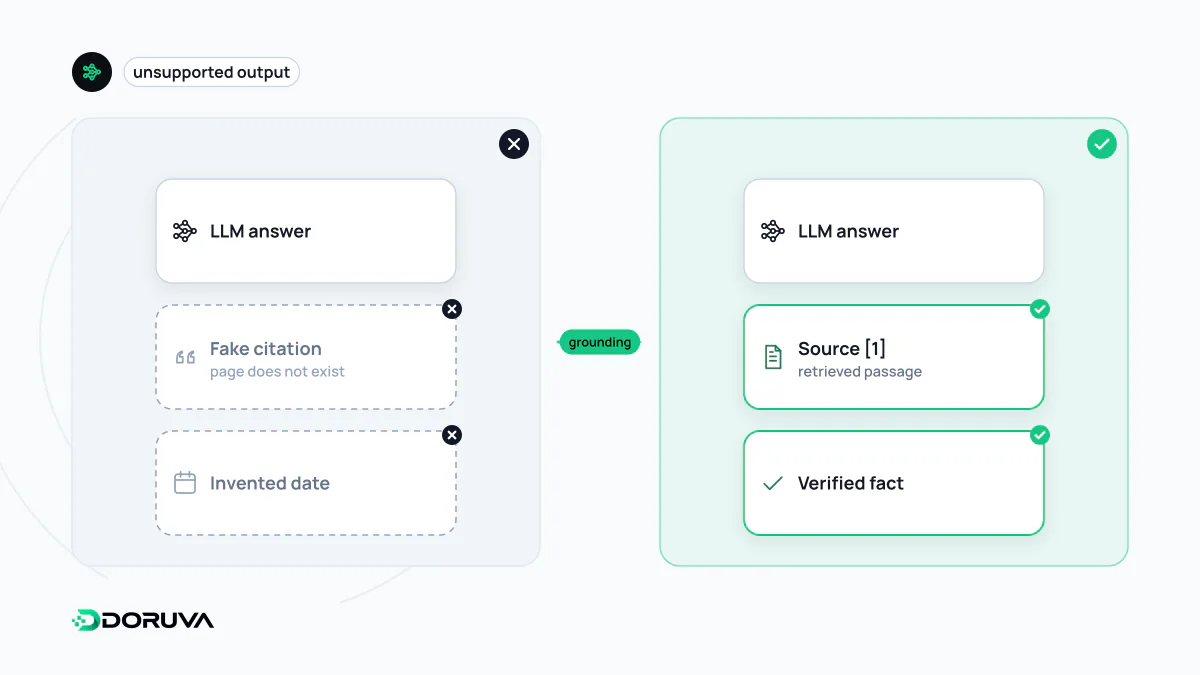
An AI hallucination is output in which a model states something false, fabricated or unsupported by its sources in fluent, confident language. Typical examples are invented statistics, citations to sources that do not exist, wrong dates, or services attributed to the wrong company. It stems from language models generating likely-sounding text rather than verifying facts.
Also known as: AI hallucination, LLM hallucination, confabulation, fabricated output
Why it happens
A language model is not a fact-checking system; it produces the most plausible continuation of the text in front of it. When its training data holds little or contradictory information about something, it can fill the gap with a statement that sounds right but is not. It does so in the same assured tone it uses for correct answers, so style tells you nothing about accuracy.
Hallucinations are more likely with:
- Rarely documented entities: niche topics, small brands, local businesses
- Facts that changed after the knowledge cutoff, such as prices, addresses, executives or product lines
- People, companies or products with similar names
- Details that demand precision: references, quotes, figures, URLs
- Questions built on a false premise, such as asking about a company's 2019 acquisition that never happened
Forms it takes
| Type | Example |
|---|---|
| Fabricated fact | An award, certification or statistic that does not exist |
| Fabricated source | An article title or URL that was never published |
| Misattribution | A competitor's service credited to your brand |
| Stale information | A closed location or an outdated price |
| Misreading a source | A detail attributed to a retrieved page that the page never says |
How it is reduced
For teams building or deploying AI systems, the most effective lever is tying answers to verifiable sources, known as grounding. Its most common implementation is RAG, where relevant documents are retrieved before the answer is written. Showing citations lets users check a claim themselves. None of this eliminates the problem: a model given the right source can still misread it.
What a brand can do
You cannot edit what an AI assistant says about you directly. You can strengthen the sources that models and retrieval systems draw on:
- Publish a clear source of truth: pages that state who you are, what you offer, where you operate and how to reach you, and that are kept current.
- Be consistent: when your name, address and founding year match across your site, business profiles and social accounts, it is easier to recognize you as a distinct entity.
- Add machine-readable facts: structured data types such as Organization, LocalBusiness or Product state core facts explicitly.
- Do not block access: if search-oriented AI crawlers cannot reach your current pages, answers will lean on older or third-party sources.
Keeping an eye on it
Periodically ask several AI assistants the questions people typically ask about your business, such as what you do, where you operate, your pricing and how you differ from alternatives, and record the answers with their cited sources. When a wrong claim can be traced to a specific source, correcting that source or stating the fact more plainly on your own site may help. Answers vary over time and between users, so do not draw conclusions from a single attempt.