

What is AI Citation?
Definition
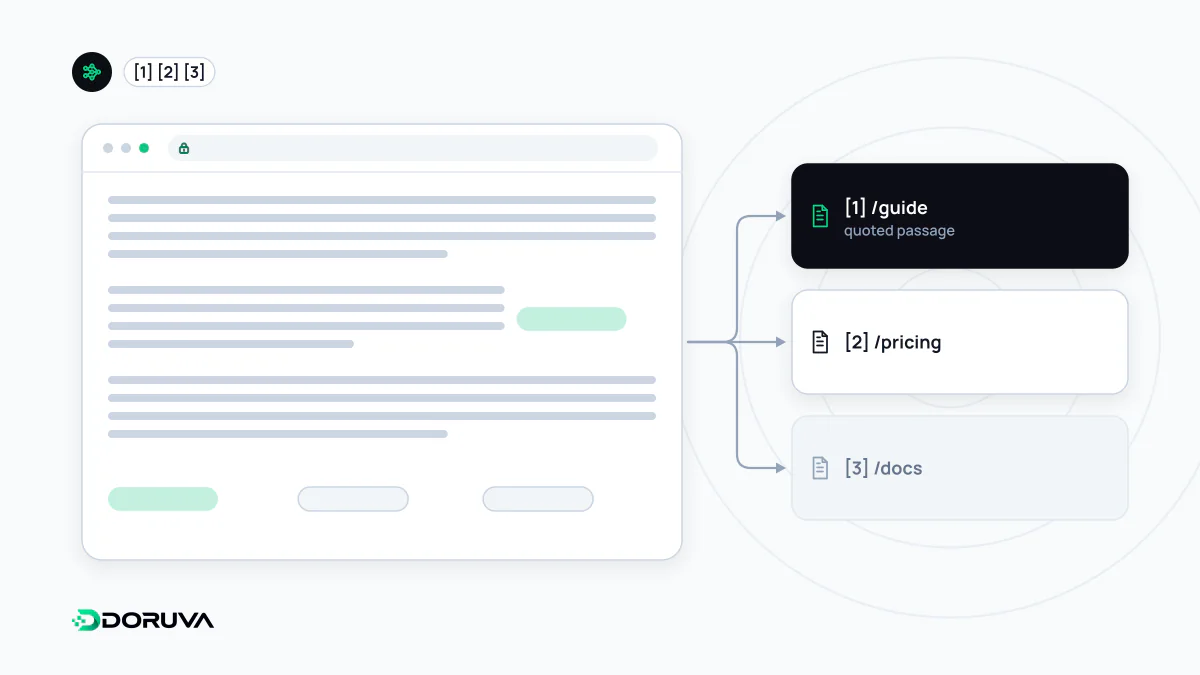
An AI citation is a link, footnote or source card in an answer generated by an AI-powered search or answer system that shows which web page the information came from. Citations let users verify claims and are the main route by which websites gain visibility and traffic from AI answers. Being selected as a cited source is never guaranteed.
Also known as: source attribution, AI source citation, LLM citation
Mentioned is not the same as cited
An AI answer can name your brand without linking to your site. The reverse also happens: your page is listed as a source while your name never appears in the answer text. The two are measured separately and have different consequences.
| Mention | Citation | |
|---|---|---|
| What you see | The brand name appears in the answer | A link to the page as a footnote, card or inline link |
| Where it comes from | Model memory or retrieved content | Usually a page retrieved at answer time |
| Traffic | Indirect (people search the brand) | A direct click is possible |
How attribution happens
Most web-grounded answer systems follow a similar flow: the question becomes one or more searches, relevant pages are retrieved, passages are selected, and the model writes an answer based on them. The sources used are then displayed with the answer. The mechanics are covered under RAG and grounding. When a model answers purely from its training data, there is usually no source link to show.
The limits of source attribution
A link next to a sentence does not prove that every claim in the sentence appears on that page. Citations can point to the wrong passage, summarize a source incompletely or add details the source never stated. Readers and publishers should click through to check important claims. If you find an inaccurate citation about your own brand, the practical steps are to use the product's feedback option and to make the relevant statement on your page clearer.
Citation readiness
No provider documents its source selection in detail, but some prerequisites are reasonable for a page to be a candidate at all:
- Access: the page is crawlable, indexed and not blocked for the relevant crawlers in robots.txt.
- A clear answer: passages that answer the question in their first sentences and still make sense out of context — what we call answer extractability.
- Verifiability: concrete data, dates, author and organization details, and links to primary sources where possible.
- Freshness: facts that change (prices, versions, regulations) are kept current, with an updated date.
- Clear identity: it is obvious who publishes the page, supported by structured data.
Doruva's GEO Checker reviews these readiness signals on a URL; it does not measure whether the page is actually being cited.
How to track citations
To see citations you need to run your target questions on the relevant systems regularly and record the sources shown next to each answer. Because answers vary between runs, look at repeated samples rather than a single attempt. Visits from some AI products also show up as referrers in your analytics, and Google reports clicks from AI Overviews and AI Mode within overall web search traffic in Search Console.