

What is AI Visibility?
Definition
AI visibility describes how often a brand is mentioned, how accurately it is described and whether it is cited as a source in answers from AI-powered systems such as ChatGPT search, Google AI Overviews and AI Mode, Perplexity or Claude. Because these answers vary from one run to the next, it is measured by repeatedly sampling a set of prompts rather than by a single ranking.
Also known as: AI search visibility, LLM visibility, AI brand visibility, generative search visibility
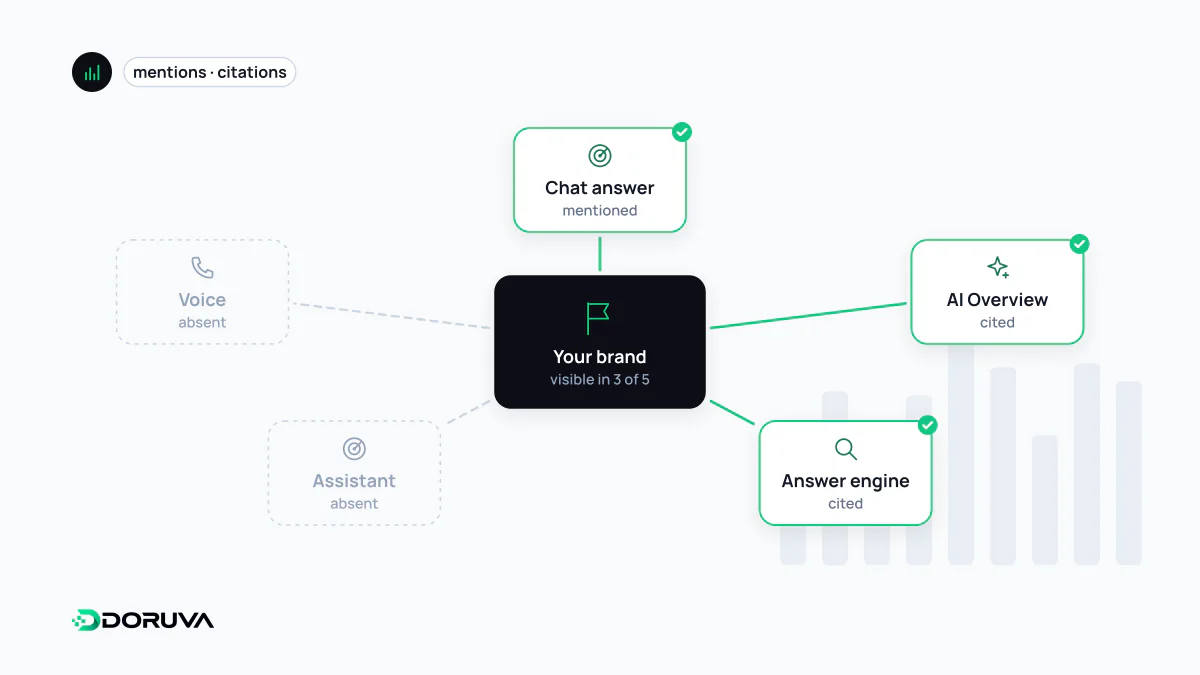
Three things, not one number
In classic search, visibility often boils down to “what position am I in?”. AI answers have no single position: the user reads one synthesized response drawn from several sources. It is therefore more useful to split AI visibility into three questions:
- Mention: does your brand appear in the answer to a relevant question at all?
- Accuracy: if it appears, is it described correctly — what you do, where you operate, what you offer? An outdated price, a closed location or confusion with a similarly named company is visibility working against you.
- Citation: does the answer link to your site as an AI citation?
A brand can be mentioned often but never cited, or cited but described wrongly. Tracking the three separately shows which problem actually needs work.
Why measurement relies on sampling
AI answers are non-deterministic. The same prompt can produce different wording and different sources within the same day. Models are updated, web retrieval is triggered for some prompts and not others, and location, language and session history can all change the result. Credible measurement therefore follows a few rules:
- Use a fixed prompt set built from questions your audience would really ask, including prompts that do not name your brand.
- Run each prompt several times and on more than one system.
- Record the date, product, language and, where possible, location.
- Draw conclusions from trends across periods, not from a single screenshot.
| Metric | What it tells you |
|---|---|
| Mention rate | Share of sampled answers that name the brand |
| Citation rate | Share of answers that link to your site |
| Accuracy | Share of brand statements that are correct and current |
| Share of voice | How often competitors appear for the same prompts |
These figures are estimates derived from the sample you chose. First-party reporting exists but is still narrow: Google Search Console's generative AI performance report shows impressions only, and Bing Webmaster Tools' AI Performance report covers Microsoft's own surfaces. Reading sampled measurements alongside these reports gives the more reliable picture.
What influences it
No provider publishes a detailed account of how brands are selected for its answers. Some foundations are still reasonable to prioritize: a crawlable, indexed site; consistent brand information that forms a clear entity; content with passages that are easy to quote; and accurate coverage of the brand on independent sources. Together, this work is what GEO refers to.
Misdescription and hallucination
When a model answers without retrieving a current source, it may lean on stale or incomplete training data, which can lead to hallucinations about your company. Clear, current and consistent information on your own site does not remove that risk, but it makes correct facts easier to find when an answer is grounded in the web.
Readiness is not visibility
Audits such as Doruva's GEO Checker look at how ready a page is for AI systems — crawler access, schema, quotable structure — and do not measure whether your brand actually shows up in answers. Readiness is a prerequisite; visibility can only be observed by running real prompts over time.