

What is AI Share of Voice?
Definition
AI share of voice is a measure of how much space a brand takes up, relative to the competitors being tracked, in the answers AI systems give to a defined set of questions. It is usually calculated as the brand's mentions or citations divided by the total for all tracked brands in the same answers. Because answers vary from run to run, it is estimated by sampling rather than measured exactly.
Also known as: AI SOV, LLM share of voice, generative AI share of voice, AI search share of voice
An advertising metric, adapted
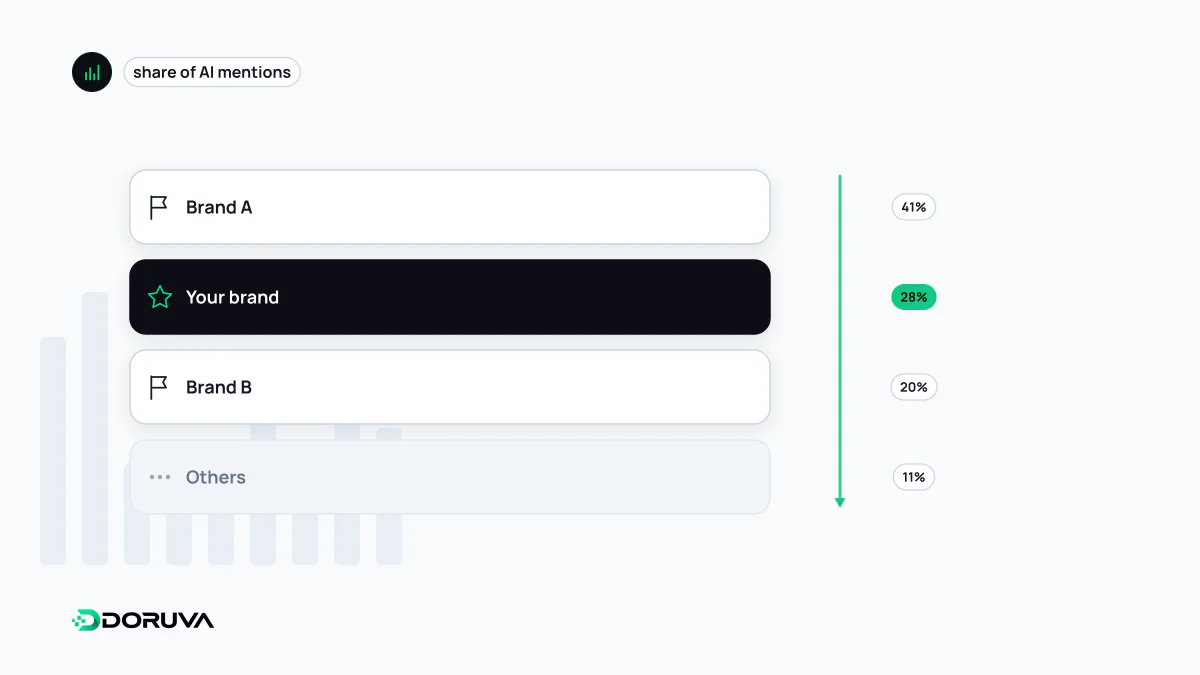
In advertising, share of voice is a brand's slice of total ad exposure in its market. Applied to AI, the question becomes: across the answers AI assistants give to the questions your market actually asks, how often does your brand appear compared with your competitors? AI visibility looks at whether a brand is mentioned and described correctly at all; share of voice is relative, comparing who occupies how much of the same answers.
A worked example
A boiler service brand runs 20 real customer questions through two AI assistants, five times each, collecting 200 answers. Across those answers, the four tracked brands are mentioned this often:
| Brand | Mentions | Share of voice |
|---|---|---|
| A (yours) | 48 | 30% |
| B | 64 | 40% |
| C | 32 | 20% |
| D | 16 | 10% |
| Total | 160 | 100% |
The same exercise can use other definitions: counting only appearances as a linked source (citation share), weighting a first-position mention more heavily, or separating positive from negative mentions. A share-of-voice figure without its definition cannot be compared with anything.
Sampling and margins of error
AI answers are non-deterministic. The same question can be answered with different wording and different sources on the same day. Model updates, whether web search is triggered, location, language, session history and generation settings such as temperature all move the result. Share of voice is therefore an estimate from a sample, and it comes with a margin of error.
As a rough guide, a 20% share measured on 50 answers carries a 95% confidence interval of about ±11 points; with 400 answers it narrows to about ±4. A "rise" from 18% to 24% on a small sample is usually noise. When questions cluster around one topic and answers are correlated, the true uncertainty is larger than this simple calculation suggests.
What first-party data exists
- Bing Webmaster Tools: Citation Share, added in preview in June 2026, is the percentage of all citations shown for a given grounding query that point to your site. Microsoft stresses that it is observational, not a ranking or competitive scoreboard, that it does not expose competitor domains and that it does not represent traffic share. Coverage spans Copilot, AI-generated summaries in Bing and select partner integrations.
- Google Search Console: the Generative AI performance report shows your impressions in AI Overviews and AI Mode, with no competitor data or share calculation.
- Other assistants: most offer site owners no reporting at all, so measurement relies on your own question set.
Where the metric falls short
- The question set drives the result. A set built from questions where you are already strong inflates your share; use real, unbranded questions your audience asks.
- Answers fetched through an API may differ from what users see in the consumer interface, where search, personalisation and system settings can differ.
- A mention count says nothing about accuracy: an answer that describes you wrongly still adds to your share.
- Share-of-voice numbers from third-party tools are estimates produced by each vendor's method, not Google or Microsoft metrics, and they do not compare across tools.
The most reliable use is tracking the trend between periods with a fixed method. To understand where mentions originate, see brand mention; for being linked as a source inside answers, see AI citation.