

What is Structured Data (Schema Markup)?
Definition
Structured data is information on a page (a product, article, business or event, for example) marked up in a standardised format that search engines and other machines can interpret unambiguously. The most widely used vocabulary is schema.org, and Google recommends the JSON-LD format. Valid structured data can make a page eligible for rich results, but it does not guarantee that they will be shown.
Also known as: schema markup, schema
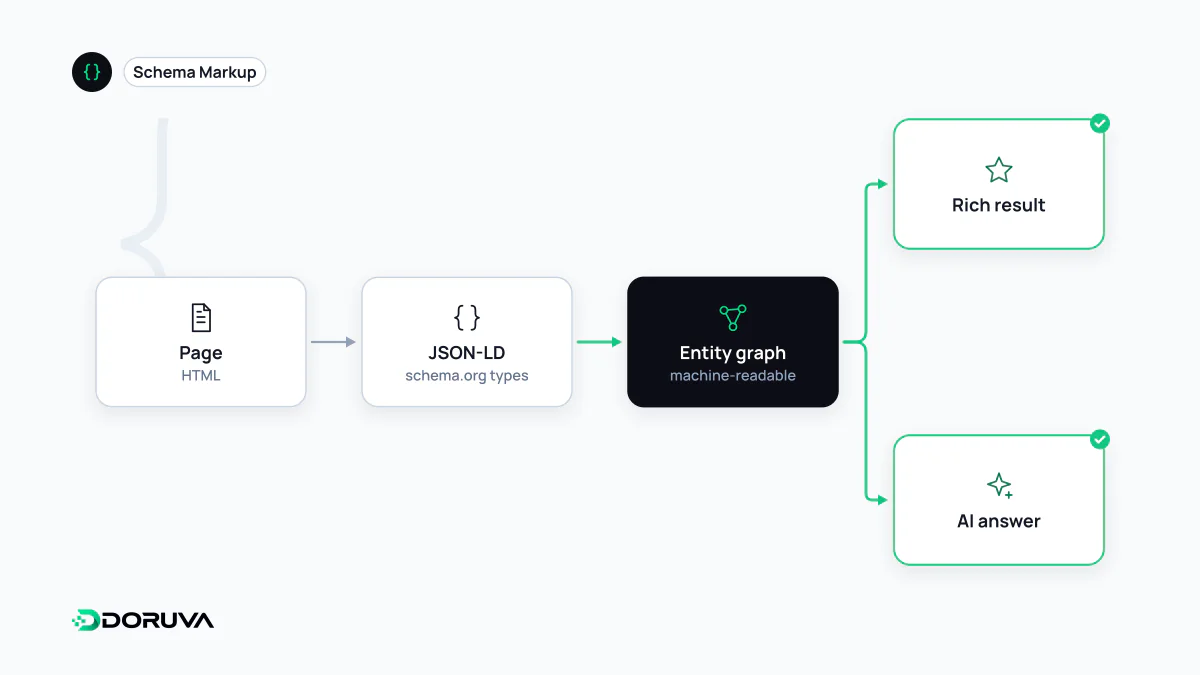
A language machines can read
A person instantly understands that "$129" on a product page is a price and the stars are a user rating. To a crawler, both are just text and images. Structured data states the facts explicitly: "this is a Product, its name is X, its price is 129, the currency is USD". The search engine no longer has to guess.
The vocabulary comes from schema.org: hundreds of types such as Organization, Product, Article, LocalBusiness, Event and BreadcrumbList, each with its own properties. Three syntaxes can carry it: JSON-LD, Microdata and RDFa. Google supports all three but recommends JSON-LD, because it sits apart from the HTML and is easier to maintain.
Example: JSON-LD for a business
<script type="application/ld+json">
{
  "@context": "https://schema.org",
  "@type": "Organization",
  "@id": "https://www.example.com/#organization",
  "name": "Example Technology Ltd",
  "url": "https://www.example.com/",
  "logo": "https://www.example.com/logo.png",
  "sameAs": [
    "https://www.linkedin.com/company/example"
  ]
}
</script>
A stable @id lets you refer to the same organisation across pages and other markup (for instance as an article's publisher), so machines see one consistent entity.
Rich results: eligibility, not a guarantee
Google can turn certain schema types into enhanced listings on the results page: product price and availability, review stars, event dates, breadcrumb trails and so on. That requires a type Google supports and all of its required properties. Even then, Google decides whether to show the rich result.
Supported features change over time. In 2023, for example, HowTo rich results were removed and FAQ rich results were limited to authoritative government and health sites; since May 2026 Google no longer shows FAQ rich results at all. Rather than assuming "markup equals stars", follow Google's current list of supported features.
Google does not document structured data as a direct ranking factor. Its value lies in helping a page be understood precisely, in rich result eligibility and in helping systems such as the Knowledge Graph connect entities. For AI-powered search and answer engines, clear, consistent markup that matches the visible content also makes a page easier to interpret, although how those systems use structured data is mostly not publicly documented.
Rules to respect
- Markup must reflect content visible on the page. Marking up ratings, prices or reviews that are not there violates Google's structured data guidelines and can lead to a manual action.
- Adding irrelevant types everywhere (Product on every page, say) brings no benefit.
- Fewer, accurate properties beat many incomplete or wrong ones.
- Google can read JSON-LD injected by JavaScript after rendering, but shipping it in the initial HTML is more reliable.
How to validate it
Google's Rich Results Test shows whether a page qualifies for the rich result types Google supports. The Schema Markup Validator (validator.schema.org) performs generic, non-Google-specific schema.org validation. After launch, the rich result reports in Search Console track errors and warnings. The detailed rules are in Google's structured data documentation, and the SEO Checker also checks whether a page's JSON-LD is valid and well-formed.