

What is Passage Retrieval?
Definition
Passage retrieval is a retrieval approach that finds and ranks paragraph- or section-sized passages within documents, rather than whole documents, in response to a query. AI search systems typically build their answers from such passages. Google also documents a passage ranking system that identifies individual sections of a web page to better understand how relevant the page is to a search.
Also known as: passage ranking, Google passage ranking, passage-level retrieval, passage indexing
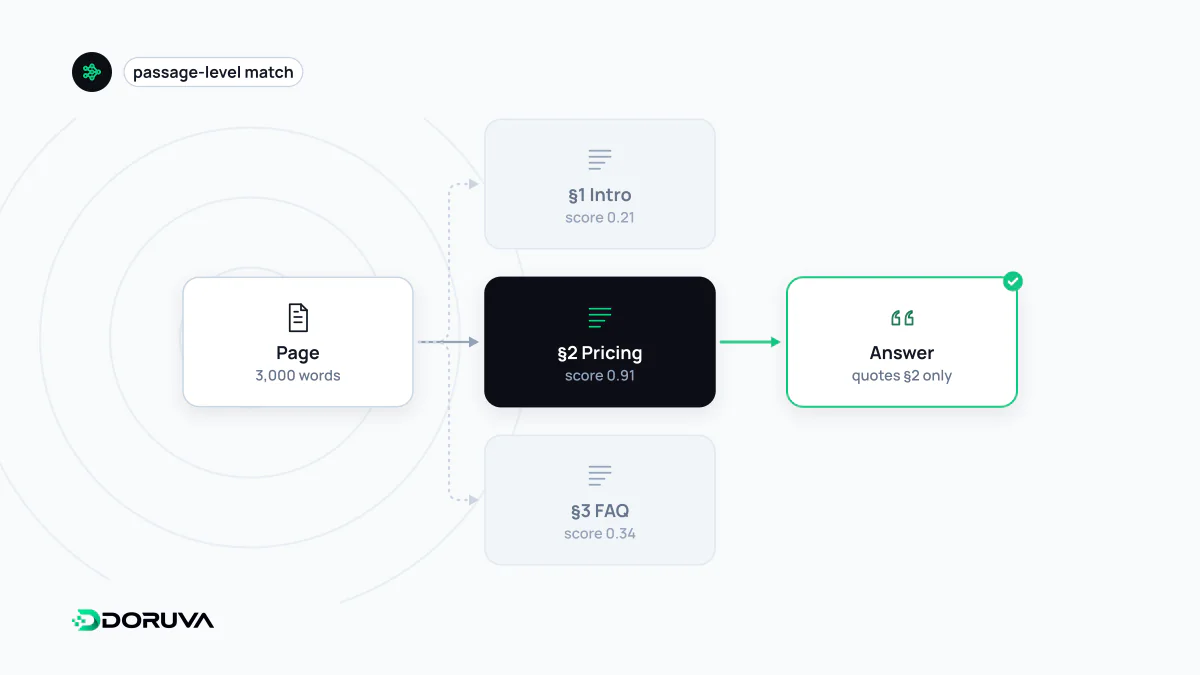
From documents to passages
Classic retrieval systems score documents as a whole. On a long page that covers several topics, that causes a problem: one paragraph that answers a specific question very well gets diluted when it is judged together with everything else on the page. Passage retrieval solves this by evaluating documents in paragraph- or section-sized units. A narrow question such as "how should an IP ownership clause in a software contract be worded?" can then match the relevant section of a broad contracts guide.
What Google's passage ranking does
In its guide to ranking systems, Google describes passage ranking as an AI system it uses to identify individual sections or "passages" of a web page to better understand how relevant a page is to a search. Two things follow from that wording:
- It is still the page that ranks. Passages are described as a means of understanding the page's relevance; Google does not describe a system that ranks passages independently of their pages in search results.
- It is not a display feature. A featured snippet, which highlights an excerpt on the results page, is a separate thing, and the two are often confused.
Google does not publish technical details of how the system works. The practical takeaway from the documentation is that a well-written section of a long page can be recognized even when the rest of the page is about other things.
Passages in AI-generated answers
In AI search, the passage level matters even more. A typical pipeline finds pages relevant to the query, splits them into passages, re-ranks the candidates and hands the best few to the language model as context. Users see a link to your page beneath the answer, but what the model actually read was usually a few selected paragraphs, not the whole page. Providers rarely disclose how that selection works, yet earning an AI citation often comes down to how well a single passage answers the question.
Writing sections that can be lifted
Compare two sentences. The first: "There are a few ways to do this, and for the reasons above the second makes more sense." The second: "When moving to a new domain, setting up 301 redirects from every old URL to its new equivalent is the most reliable way to help search engines transfer signals to the new address." The second stands on its own; the first means nothing out of context.
- Let each heading name the question its section answers.
- Give the answer in the first sentence or two, then the detail.
- Avoid opening paragraphs with "this", "these" or "as mentioned"; repeat the subject's name instead.
- State numbers with their units and sources, and put comparisons in tables.
How documents get split in the first place is covered under chunking. A well-written section keeps its meaning whichever splitting strategy cuts it.
Testing your own pages
There is no way to see directly which of your passages a system picked, but a simple test helps: copy one section out of the page and read it on its own. If the heading makes the question clear and the opening sentences answer it, the section is ready to be used as a passage. Doruva's GEO Checker looks at paragraph length, openings that depend on earlier text, and question-and-answer layout across the sampled pages.