

What is Topical Authority?
Definition
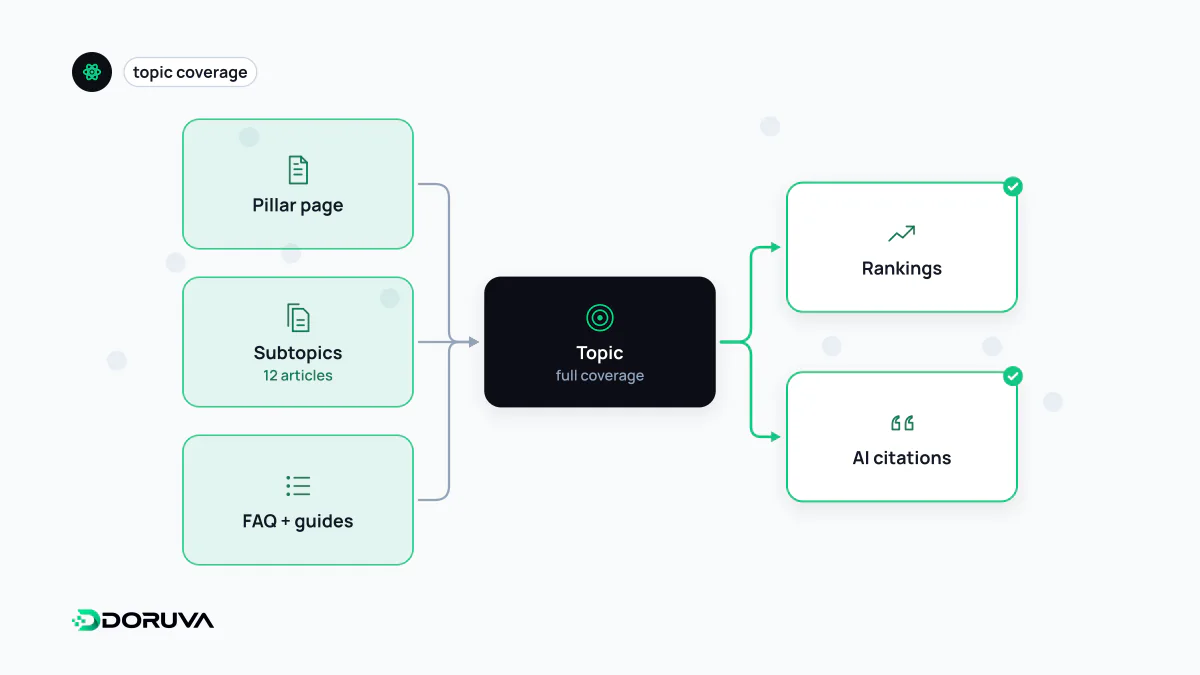
Topical authority is an SEO industry concept describing how a website becomes a go-to source on a subject by covering it comprehensively, consistently and credibly. It is associated with interlinked content clusters, thorough coverage of subtopics and external recognition. Google does not publish or expose a single 'topical authority' score for general web search.
Also known as: topic authority, topical expertise, subject-matter authority
Where the concept comes from, and its limits
In SEO, "topical authority" describes the idea that a site earns expertise by covering a whole subject rather than publishing isolated pages. Think of the difference between a site with one article on credit card annual fees and one that covers card types, interest calculation, limit increases, fee refunds and security, all linked together.
Care is needed: this is an industry concept, not a measurable Google metric. The closest thing Google has published is the "topic authority" system it described for news in 2023. That system helps surface publications with expertise in specific topics and locations by looking at signals such as a publication's notability for a topic, how often its original reporting is cited by other publishers and its reputation. It is specific to news and does not mean a general score exists for every kind of site. Google's Search Central blog post describes it in detail.
Google's general guidance, meanwhile, says its systems aim to reward helpful, people-first content that demonstrates experience, expertise and trustworthiness. A topical authority strategy is best understood as a content-planning approach consistent with that guidance.
What it means in practice
- Coverage: map the questions and search intents under your main subject and publish pages that genuinely answer each one.
- Structure: connect a broad guide page and its detailed subpages into a meaningful cluster with internal links.
- Consistency: use the same terms and definitions for the same concepts, and present entities such as the organisation, people and products consistently.
- Evidence: make authorship, experience and sources visible.
- Focus: resist chasing traffic topics unrelated to your core expertise.
Relevance to AI search
Why AI-powered search and answer engines choose particular sources is largely undocumented. Still, it is a reasonable expectation that a site which covers a subject with clear definitions, interlinked subpages and consistent terminology is easier to interpret for both classic search and these systems. That is not a guarantee of citation or visibility.
Common mistakes
- Equating topical authority with publishing volume; near-duplicate thin articles dilute a cluster rather than strengthen it.
- Publishing subpages without linking them to the hub and to each other, which creates orphan pages.
- Reading a tool's "topical authority" score as something Google sees; like Domain Authority, such scores are third-party estimates.
- Producing content from keyword lists in areas where you have no real expertise.
To review your internal linking and topical context, the GEO Checker reports signals such as orphan pages, contextual links and breadcrumbs.