

What is Keyword Difficulty?
Definition
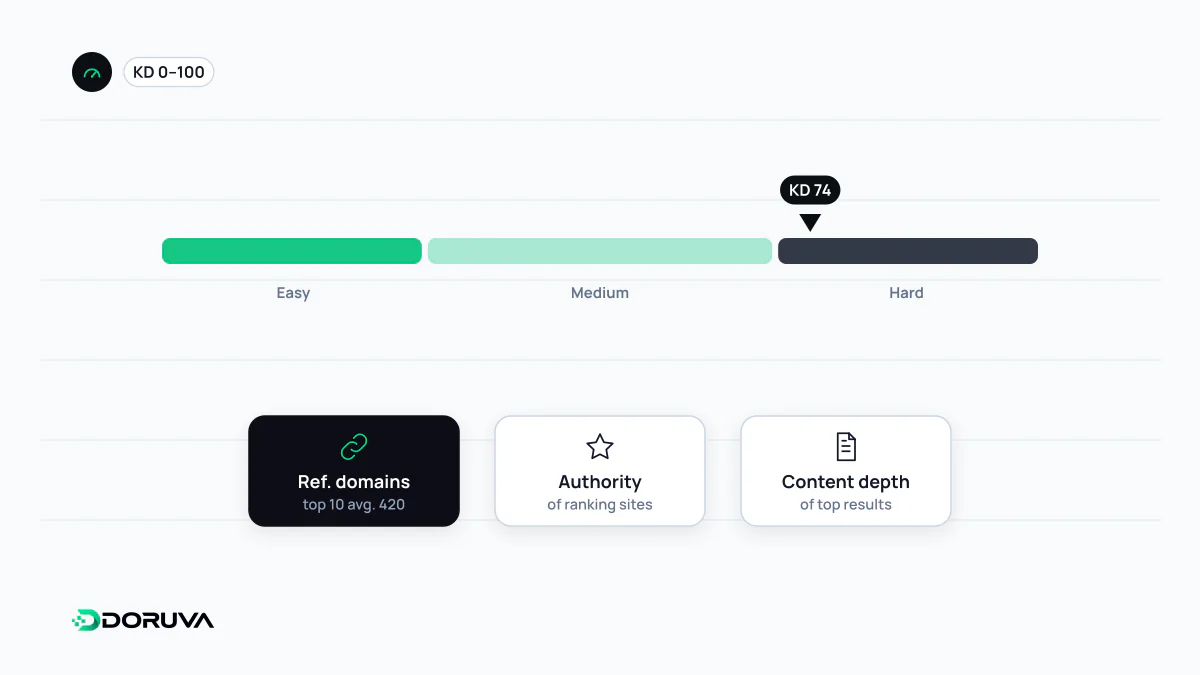
Keyword difficulty (KD) is a score, usually from 0 to 100, that third-party SEO tools calculate to estimate how hard it will be to reach the first page of organic results for a keyword. It is not a metric Google publishes or uses. Each tool applies its own formula, and most rely heavily on the link profiles of the pages currently ranking.
Also known as: KD, SEO difficulty, keyword competition score, ranking difficulty
An estimate, not a Google metric
Keyword difficulty is a convenience score that SEO tools offer to help users prioritise. Google publishes no such score and its ranking systems use no "difficulty" value. Every vendor applies its own formula, usually without disclosing it fully, so the same keyword can show 35 in one tool and 62 in another.
A frequent mix-up: the "Competition" column in Google Ads Keyword Planner is not a difficulty score. It reflects how many advertisers bid on the keyword relative to others and says little about organic competition.
What the scores are usually built on
The common approach is to look at the pages currently ranking and count how many different domains send them backlinks. Some tools blend in their own domain-level scores, such as Domain Authority or Domain Rating, which are themselves third-party estimates rather than Google signals. Others mix in content length, results page features or search volume. In effect, the score tends to summarise "how much link strength the current top results have".
What the number cannot see
- Intent fit: if the top pages are strong but answer the question poorly, a better answer can still break in.
- Your own site: a keyword is far easier for a site with depth and topical authority in the subject than for a brand-new generalist site. The score has no idea who is asking.
- Local and personalised results: when results vary by location, a single difficulty value loses meaning.
- Freshness and SERP shifts: on news-, forum- or video-heavy results pages, backlink counts may not be decisive.
Judging difficulty from the results page
Before investing in a keyword, looking at the SERP yourself tells you more than any score:
- Who holds the top ten: major brands, government sites, forums, or sites of your size?
- How well do those pages answer the query? Outdated, shallow or loosely related results are a sign of opportunity.
- What page types dominate: guides, product listings, tools, videos? Does the format you plan match?
- How much of the screen above the organic results goes to ads, maps or AI summaries?
Using the score in decisions
KD is useful for a first pass over a long keyword list. Compare scores within one tool, never across tools, and read them alongside search volume and business value. Rather than drawing a hard line ("nothing above 40"), it is more realistic to treat high-difficulty, high-value keywords as long-term targets and low-difficulty keywords with clear intent as quick wins.