

What is Search Volume?
Definition
Search volume is an estimate of how many times a keyword is searched per month on average in a given location and language. It is usually reported as a 12-month average and includes the keyword's close variants. It is used to compare search demand between topics, but it does not tell you directly how much traffic a page will receive.
Also known as: search demand, monthly search volume, MSV, keyword volume
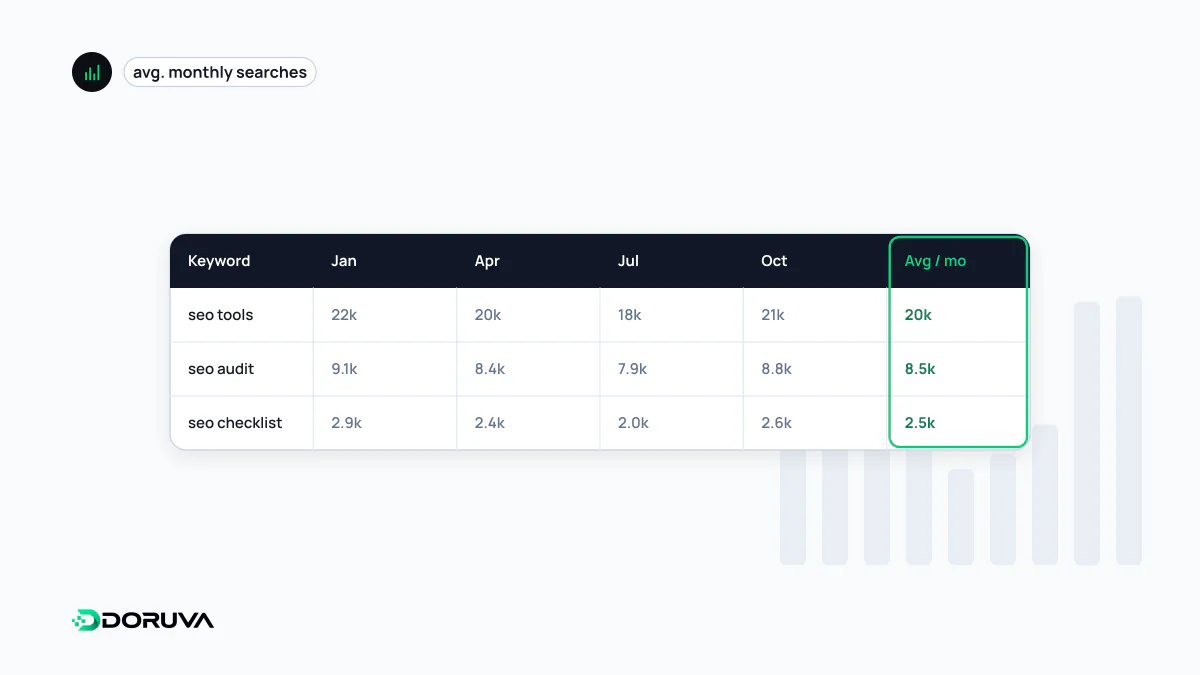
What the number actually summarises
In Google Ads Keyword Planner, "Avg. monthly searches" is the number of searches for a keyword and its close variants under the location and network settings you chose, averaged by default over 12 months. Three details in that definition shape how to read it:
- It is an average. "Air conditioner prices", which peaks in summer, and "accounting software", which is steady all year, can share the same annual average. For seasonal topics the average hides both the busiest and the quietest month.
- Variants are merged. Singular and plural forms and spelling variants are often rolled into one figure, so adding the volumes of two variants together can double count.
- It depends on location. The same keyword has very different volumes for a country, a city or the whole world. For a local business, a national figure can mislead.
Why tools disagree
Google offers Keyword Planner to advertisers and publishes no separate volume data for organic search. Third-party SEO tools estimate volume from their own data sources and models, which is why one may show 1,300 for a keyword and another 2,900. Read the figures as orders of magnitude: whether a term is searched tens, hundreds or thousands of times a month is usually enough to decide. Comparisons are more reliable within a single tool than across several.
Google Trends gives no absolute numbers at all. It works from a sample and scales results from 0 to 100 relative to the chosen region and time range, which makes it ideal for seasonality and trend direction, not for estimating volume.
Volume is not traffic
Ranking first for a keyword searched 5,000 times a month does not bring 5,000 visitors. Clicks depend on position, on click-through rate and on the layout of the results page. Where a query shows ads, a map pack, a featured snippet or an AI summary, many searchers never reach the organic links; searches that end on the results page are known as zero-click searches. Treat volume as a ceiling on potential and look at the actual results page before projecting traffic.
Keywords that show zero
A tool reporting "0" or "no data" does not mean nobody searches for the phrase. In 2019 Google said that 15 percent of the queries it sees every day are ones it has never seen before. Demand that fragmented largely escapes volume tools. In B2B and niche services especially, a phrase listed at "10" a month can be valuable if it brings the right person. Google Search Console shows the queries your site really appeared for: recorded impressions rather than estimates.
Reading demand sensibly
- Look at the combined demand of a keyword group with one intent, not at a single phrase.
- For seasonal topics, check the monthly pattern in Trends and publish ahead of the peak.
- Weigh volume together with intent and business value; never sort by it alone.
- Keep specific, low-volume long-tail phrases on the list.