

What is Long-Tail Keyword?
Definition
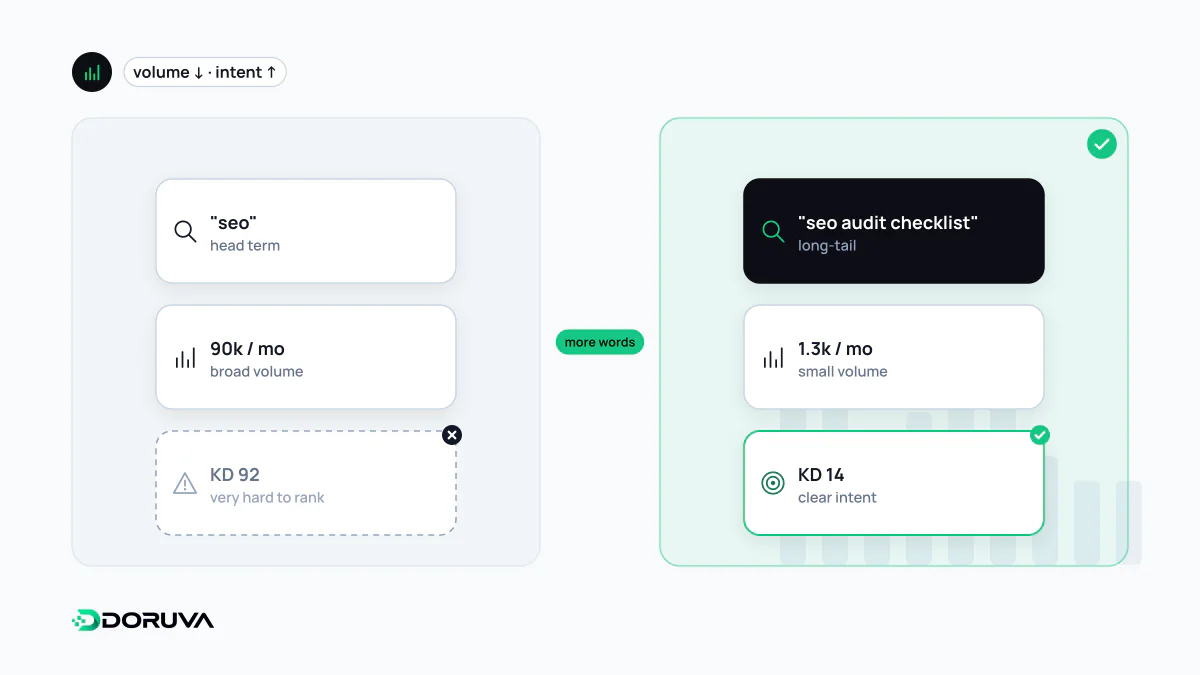
A long-tail keyword is a specific search phrase that few people search for individually but that carries a very clear intent, and is usually longer than generic terms. On the search demand curve it belongs to the long tail of countless low-volume queries stretching behind the few heavily searched head or short-tail keywords; each tail query is small, but together they account for a large share of all searches.
Also known as: long tail, head keyword, short-tail keyword, head term, long-tail query
The demand curve: head, middle and tail
Sort every search phrase in a market by volume and plot it, and you get a tall, narrow peak on the left and a very long, almost flat tail stretching to the right. That shape gives the "long tail" its name; Chris Anderson popularised the idea in his 2004 Wired article "The Long Tail".
| Zone | Example | Typical profile |
|---|---|---|
| Head (head / short-tail keyword) | "shoes" | Huge volume, vague intent, fierce competition |
| Middle (mid-tail) | "men's running shoes" | Moderate volume, intent taking shape |
| Long tail | "cushioned men's running shoes for flat feet" | Low individual volume, precise intent, less competition |
Each tail phrase is tiny, but there are so many of them that the tail's share of total demand is much larger than it looks query by query. In 2019 Google said that 15 percent of the queries it sees every day are ones it has never seen before, and those sit at the very end of the tail.
Specificity, not word count
The name can mislead. A phrase is long-tail because of low volume and specific intent, not because of how many words it has. "hreflang" is a single word, rarely searched and highly specialised; "pharmacy near me" is short and searched constantly. Tail queries do tend to be longer, since people add words as they narrow down what they want, but volume and intent define the category.
Why the tail is worth targeting
- Clear intent: someone typing "shoes" could want anything; someone typing a detailed phrase is usually close to a decision.
- Lower competition: large sites tend to fight over head terms, so a new or niche site can gain visibility in the tail much sooner.
- Invisible to tools: many tail phrases show zero search volume in keyword tools yet are searched by real people.
- A fit with AI search: Google documents that AI Overviews and AI Mode may run several searches across subtopics when building a response, a technique called query fan-out. Those sub-searches are, by nature, narrow and specific.
Targeting the tail without thin pages
The classic mistake is a separate page for every tail variant. Pages cloned per city or per modifier, identical apart from one word, give visitors nothing new, and Google's spam policies cover the pattern under doorway abuse and scaled content abuse. The better approach gathers tail phrases that share an intent into one thorough page: the main topic forms its backbone, and the specific tail questions become subheadings, examples and FAQs. One page can then appear for hundreds of distinct phrasings. Deciding which phrase belongs to which page is the job of keyword research.