

What is Domain Rating (DR)?
Definition
Domain Rating (DR) is a third-party metric from the SEO software company Ahrefs that expresses the strength of a domain's backlink profile on a 0–100 scale, relative to the other sites in Ahrefs' database. Its page-level counterpart is URL Rating (UR). DR is not a Google signal: Google does not use it, and the score is a relative estimate built solely from Ahrefs' own crawl and link data.
Also known as: DR, Ahrefs DR, Ahrefs Domain Rating, URL Rating, UR
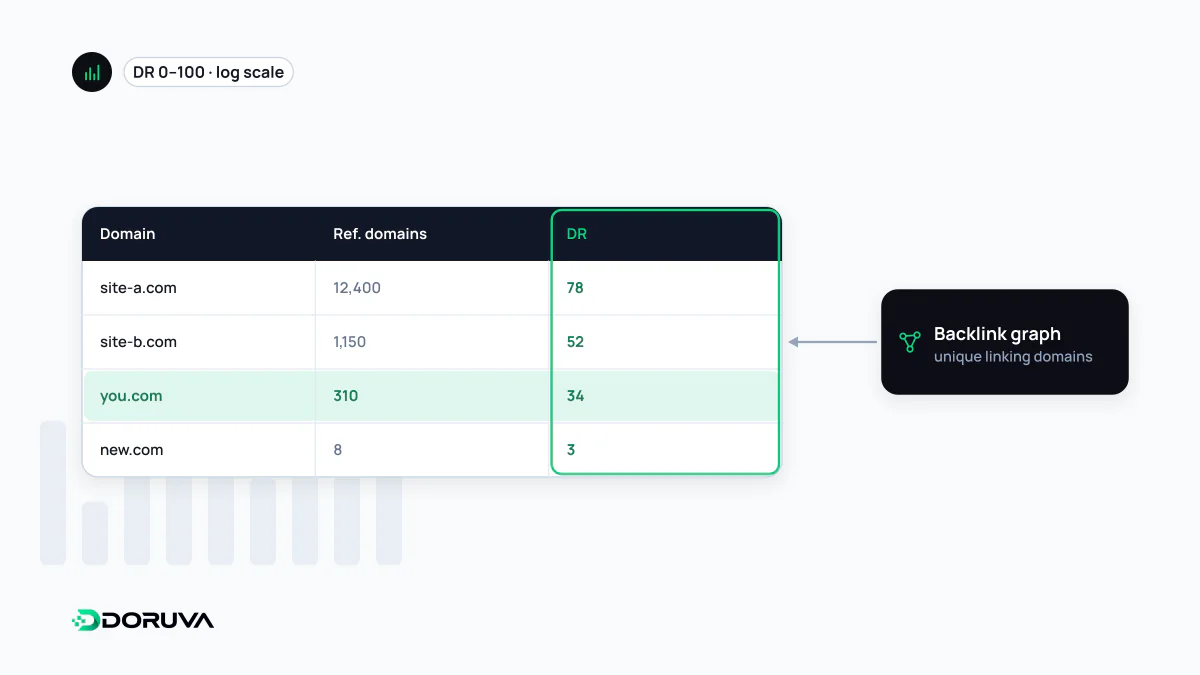
How Ahrefs calculates DR
According to Ahrefs' help documentation, DR shows the strength of a site's backlink profile compared with the other sites in its database, on a 100-point scale. The core of the calculation:
- The higher the linking domain's DR, the more it passes on.
- Each source domain splits its rating equally among the domains it links to. A DR 10 site linking to just three domains can therefore move your DR more than a DR 80 site that links to a million.
- The calculation is repeated across all domains, and the resulting absolute value is scaled into the 0–100 range.
DR is thus not about page count or traffic. It reflects only the strength of your referring domains and how many other sites each of them links to.
URL Rating (UR), the page-level twin
URL Rating asks the same question for an individual page. Ahrefs says UR uses a logarithmic scale, so moving from UR 20 to 30 is much easier than from 70 to 80. Both internal and external links count, rating loops between two sites are cut out, and nofollow links are respected. Ahrefs describes UR as built on basic PageRank principles, including counting links between pages and applying a damping factor. When you enter a domain into Site Explorer, the UR you see belongs to the homepage only.
| DR | UR | |
|---|---|---|
| Unit measured | The whole domain | A single URL |
| Links considered | Links from other domains | Internal and external links |
| Typical use | Rough comparison between sites | Link strength of a specific page |
Not a Google signal
This point is not up for debate: DR and UR are Ahrefs products. Google does not calculate them, cannot see them and does not use them for ranking, which happens at page and query level using many signals. Ahrefs itself notes that DR correlates with Google rankings less well than UR does. For Moz's comparable metric see Domain Authority; because the two tools use different data and methods, their scores cannot be compared with each other.
Why DR can fall without losing a link
DR is relative. Even if you lose no links, your score can drop when other sites gain links quickly: the top of the scale can't go past 100, so everyone else gets pushed down. Changes to Ahrefs' crawler and index can also shift scores across the board. Building strategy around a single day's DR movement makes little sense.
Using it well
- Compare within one tool: it is handy for benchmarking against competitors and tracking your own trend.
- Don't make it the only criterion: even Ahrefs advises against judging a site on DR alone, and suggests also weighing topical relevance, organic traffic, how many sites it links out to and content quality.
- Don't buy "high-DR links": paid links that pass ranking credit violate Google's spam policies. Sites that publish on any topic, attract no organic traffic and still show a high DR often exist precisely to serve that market.
- Aim for linkable content, not a number: DR rises as a side effect of earned backlinks.
The calculation details are in Ahrefs' DR documentation.