

What is Ranking Factor?
Definition
A ranking factor is a signal or input a search engine uses when ordering pages for a given query. Google says its systems look at many factors and signals across hundreds of billions of pages, but it does not publish a complete list or the weights. The broad areas Google describes are the meaning of the query, relevance, quality, usability and the searcher's context.
Also known as: ranking signal, Google ranking factors, search ranking factors, SEO ranking factors
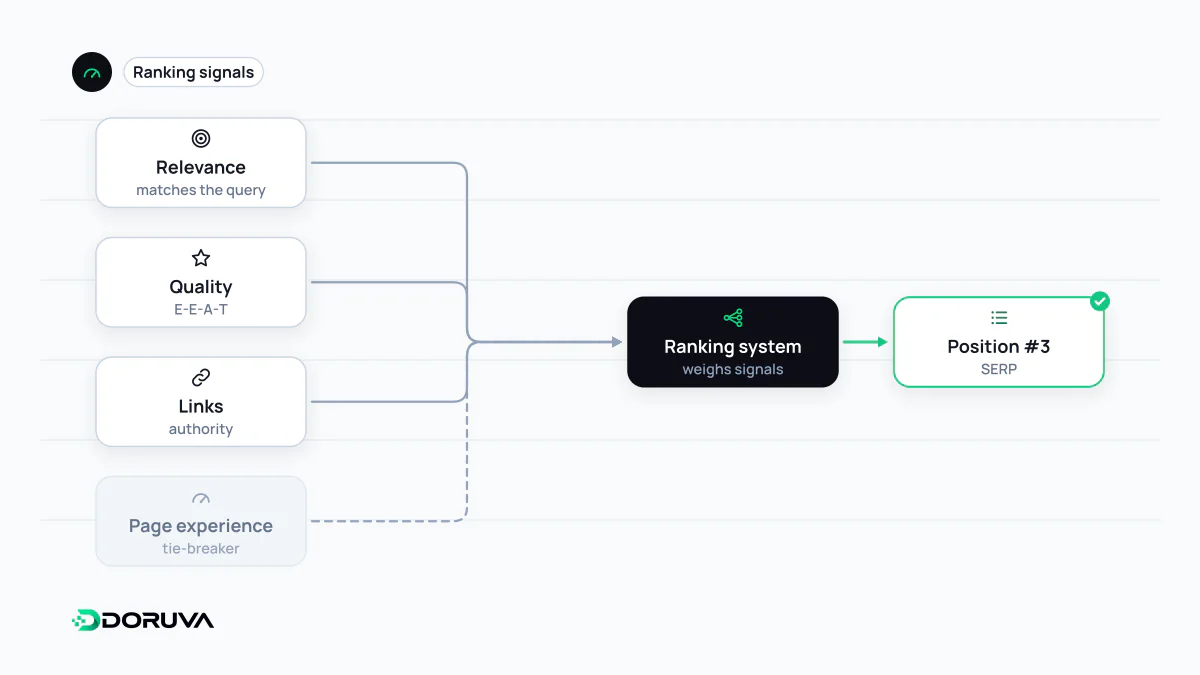
The framework Google itself describes
Google explains what determines results in five broad areas:
- Meaning of the query: language models that handle spelling, synonyms and the intent behind the words.
- Relevance: the most basic signal is whether content contains the query's keywords in headings or body text; beyond that, systems use aggregated and anonymised interaction data to assess whether results are actually relevant.
- Quality: signals that indicate expertise, authoritativeness and trustworthiness, such as other prominent websites linking to or referring to the content.
- Usability: when other signals are comparable, content that is more accessible, mobile-friendly and fast to load may perform better.
- Context and settings: location, search history and search settings.
Google's ranking systems guide also names concrete systems: link analysis and PageRank, freshness systems, original content and reviews systems, deduplication and spam detection with SpamBrain. The systems work primarily at page level, although Google acknowledges some site-wide signals too.
Confirmed, misunderstood and myth
| Claim | What Google's documentation says |
|---|---|
| Core Web Vitals affect rankings | They are used by ranking systems, but there is no single page experience signal and it does not override relevance |
| E-E-A-T is a ranking factor | E-E-A-T itself is not a specific ranking factor; a mix of factors that identify good E-E-A-T is used |
| Longer content ranks better | Google has no preferred word count |
| There is an ideal keyword density | No such ratio exists in the documentation; excessive repetition breaches spam policies |
The keywords meta tag matters | Google Search does not use it |
| Higher Domain Authority or Domain Rating means higher rankings | These are third-party estimates and do not correspond to any of Google's own signals |
Popular "200 Google ranking factors" lists are not Google documents; they mix confirmed items with speculation and long-debunked claims. Scores like Domain Authority can be handy for comparing competitors within one tool, but Google does not see or use them. Nor has Google ever said it uses Google Analytics data for ranking.
Why the weights are not fixed
How much a signal matters depends on the query. Freshness is decisive for an earthquake or election-result search and nearly irrelevant for "Pythagorean theorem". On health and finance topics, signals of reliability carry more weight. Page experience, in Google's words, can matter much more when several pages are similarly relevant. So "what is the most important ranking factor?" has no universal answer; the better question is why a particular page is the best answer to a particular query.
Reading ranking studies critically
Correlation studies published by SEO tool vendors describe what top-ranking pages have in common; they do not show cause. Top pages having many links could mean links drive rankings, or that well-ranked pages get seen and linked more often. A more reliable way to judge a change on your own site is to record the date and compare similar page groups in Search Console, while checking whether outside events such as a core update landed in the same window. Google's own summary is on its How Search Works pages.