

What is Core Update?
Definition
A core update is a significant, broad change Google makes to its search algorithms and systems several times a year. It does not target specific sites or pages; it recalibrates how content is assessed overall. Major core updates are announced on the Google Search Status Dashboard, and their rollout typically takes from several days to a few weeks.
Also known as: Google core update, broad core update, core algorithm update
Not the same as a spam update
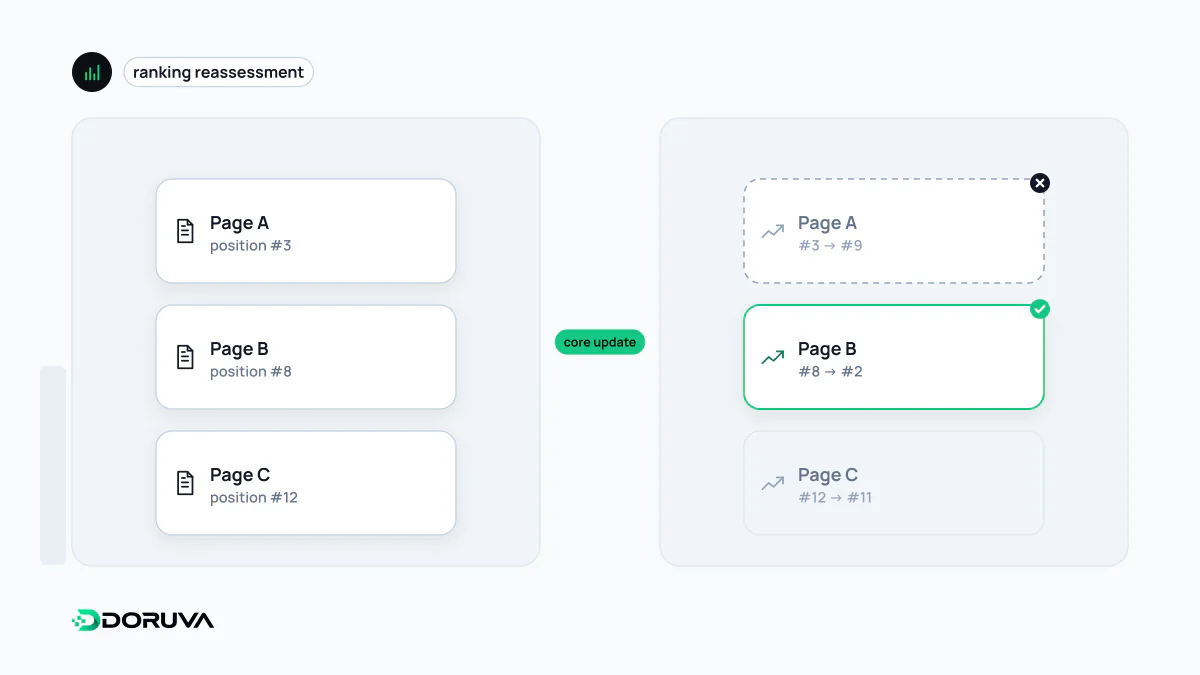
Google changes Search constantly, mostly through small improvements nobody announces. Core updates are what Google calls broad changes: they do not target a site, a niche or a violation, but recalibrate how its systems assess content in general. That makes them different from spam updates, which improve the detection of behaviour that breaks Google's spam policies. A site that drops after a core update may have done nothing wrong at all. More often than not, a drop means other pages are now judged more helpful for the same queries, not that yours got worse.
Tracking an update
Announcements appear in the ranking section of the Google Search Status Dashboard, which records each update's name, start and completion. Durations vary: going by the dashboard history, the March 2026 core update took about 12 days to roll out and the December 2025 one about 18 days. Google also says it ships smaller core updates that are not announced, so attaching every wobble to a named update is a poor habit.
A sensible way to analyse a drop
- Wait for the rollout to finish. Google recommends waiting at least a full week after completion before drawing conclusions; rankings can swing while the update is still rolling out.
- Compare the right windows. In the Google Search Console Performance report, compare a week after completion with a week before the rollout started, then break the change down by page and by query group.
- Size the loss. Google's own examples: going from position 2 to 4 calls for no drastic action, and it advises against changing content that already performs well; falling from 4 to 29 warrants a deeper assessment. Check web, image, video and news results separately.
- Rule out your own changes. A migration, a stray noindex or a template change in the same period can mimic an update hit.
- Assess the content honestly. Google points back to its helpful content questions: is the page original, is it clear who wrote it, does the reader have to search again to finish the job?
Realistic expectations about recovery
There is no specific technical setting to "fix" after a core update. Google advises focusing on changes that make sense for users and are sustainable over time. Some improvements can show within days, but it can take several months for its systems to learn and confirm that a site has improved, and if nothing changes after a few months, the next core update may be the point where it does. Improving pages also does not guarantee a return to old positions, because competitors and searcher behaviour keep moving in the meantime.
Another trap is reading each update as the arrival of one new ranking factor. A core update is a coordinated adjustment of many systems at once. That is also why volatility tends to be sharper in areas such as YMYL topics, where systems lean more heavily on signals of reliability. Google keeps its current advice in the core updates documentation.