

What is Helpful Content?
Definition
Helpful content is Google's term for content created primarily to benefit a specific audience rather than to attract search traffic. The idea began as a separate helpful content system in 2022 and became part of Google's core ranking systems in March 2024, so helpfulness is now assessed through a variety of signals rather than one dedicated classifier.
Also known as: helpful content update, helpful content system, people-first content, HCU
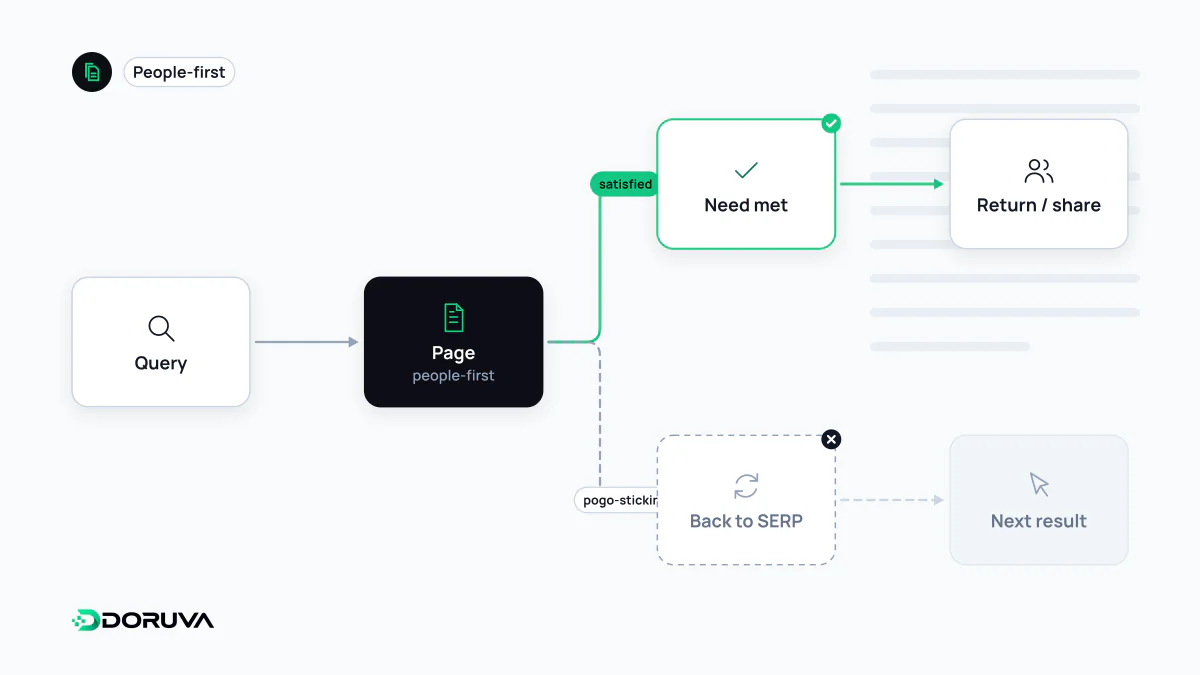
From a standalone classifier to the core systems
In August 2022 Google announced the "helpful content update". As described at launch, it was a machine-learning classifier that ran continuously, identified content with little value for searchers and produced a site-wide signal: if a site had a relatively high proportion of unhelpful content, other pages on that site could perform worse as well. Google stressed it was neither a manual action nor a spam action, just one signal among many. It initially applied to English-language searches, with expansion to other languages announced as a later step.
The March 2024 core update changed the picture. Google said there was no longer one signal or system used to identify helpfulness; instead, its core ranking systems use a variety of signals to do it. The ranking systems guide now lists the helpful content system among retired systems, noting that in March 2024 it became part of the core ranking systems. "Was there a helpful content update?" therefore no longer has a separate answer: the effects show up within core updates.
What "people-first" means in practice
Google frames the distinction around one question: would an existing or intended audience find this content useful if they came to your site directly, or was it made mainly to gain visits from search? Its guidance breaks that into who, how and why:
- Who created the content, and is that evident through bylines and author information?
- How was it made? If products were tested, how? If automation or AI was involved, is that explained to readers where they would reasonably expect it?
- Why does it exist? Google calls this the most important question: content should exist to help people, not primarily to attract search traffic.
Using AI is not prohibited in itself. Using automation to produce content primarily to manipulate rankings is, and that falls under Google's spam policies.
Signs that content was made for search engines first
Google publishes self-assessment questions for content teams. A "yes" to any of these suggests a search-engine-first approach:
- Did you enter a niche without real expertise mainly because you expected traffic?
- Are you producing lots of content on many different topics in the hope that some of it ranks?
- Are you mainly summarising what others say without adding much value?
- Do readers leave feeling they need to search again to get better information?
- Are you writing to a particular word count because you heard Google prefers one? (Google's answer: it does not.)
- Are you changing dates to make pages seem fresh when the content has not substantially changed?
Using the idea in a content review
When a site loses visibility, walking through its pages with these questions often reveals more than hunting for a technical fault. A practical audit sorts pages into three groups: pages that genuinely serve the audience and deserve improvement; overlapping thin pages that should be consolidated; and pages that answer no real visitor need and can be retired. The goal is not a smaller site for its own sake but a site where each page fully satisfies a specific search intent.
Helpfulness is never "done" by ticking a checklist either. Original data, first-hand use, clear authorship and coverage that leaves the reader with nothing left to look up are the most concrete expressions of what the systems try to measure. The current principles are maintained in Google's helpful content documentation.