

What is Backlink?
Definition
A backlink is a link from a page on another website to a page on your site. From the linking site's point of view, the same link is an outbound link. Search engines use backlinks to discover pages and to understand how widely other sites reference a piece of content. What matters is not the raw count but whether links are relevant and earned naturally.
Also known as: inbound link, incoming link, inlink, referring link
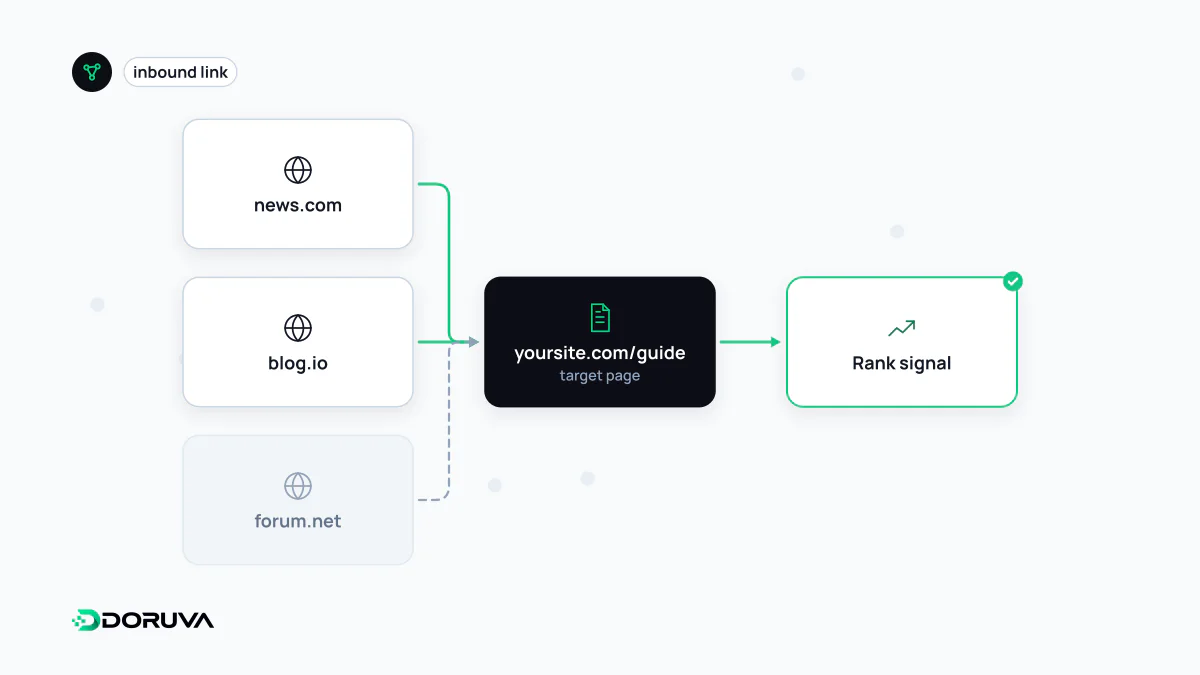
It depends which end you're on
A link's name depends on where you stand. When a news site links to your page, that link is a backlink for you and an outbound link for the news site. Links between your own pages are a separate category: internal links.
| Type | Direction | Who controls it |
|---|---|---|
| Backlink (inbound) | Another site → your site | The linking site |
| Outbound / external link | Your site → another site | You |
| Internal link | Your page → your page | You |
How search engines use them
Links are the web's basic fabric, and PageRank, one of Google's earliest algorithms, was built on analyzing them. Today Google describes, in general terms, that its ranking systems consider whether other prominent sites link to or refer to content when assessing how trustworthy it is. How much weight an individual backlink carries, when it counts and how it combines with other signals is not public. Any claim offering precise numbers is an estimate.
What is known: a contextual link from a relevant site means more than many links from unrelated ones, and the anchor text gives a hint about the target page's topic. Scores such as “Domain Authority” belong to third-party SEO tools, not Google, and Google does not use them; see Domain Authority for more.
Link spam: where the line is
Google's spam policies prohibit link schemes intended to manipulate rankings. Examples include buying or selling links that pass ranking credit, excessive link exchanges, links generated by automated programs, and keyword-rich anchor text in articles or press releases distributed to other sites.
Advertising and sponsorship links are not forbidden; they just need to be qualified with rel="sponsored" or nofollow:
<a href="https://www.example.com/" rel="sponsored">Example Sports</a>Google's disavow tool is meant for sites that have a manual action, or expect one, because of unnatural links they built or paid for. Google says most sites never need it.
Earning links sustainably
- Publish things others want to cite: original data, research, thorough guides, free tools
- Make real relationships visible: suppliers, partners, events and industry associations
- Contribute expert commentary to press and trade publications
- Find broken links and unlinked mentions of your brand, and point them out politely
All of this falls under off-page SEO.
Outbound links matter too
Linking out from your content is not a loss. Google encourages linking to relevant resources that help readers, and citing primary sources makes your claims verifiable. Simply qualify links you don't vouch for, or that were paid for, with the appropriate rel value.
How to monitor them
Search Console's Links report shows the sites linking to you most and your most-linked pages. Third-party tools add detail, but each only sees the part of the web it crawls, so treat their numbers as samples rather than totals. The complete rules are in Google's spam policies.