

What is Off-Page SEO?
Definition
Off-page SEO covers the activities that influence a website's search visibility but happen outside the site's own pages. Links from other websites (backlinks), brand mentions, digital PR, business profiles and customer reviews all belong here. The goal is for the site to be recognised as a trustworthy source that others genuinely reference.
Also known as: off-site SEO, offpage SEO, off-page optimization
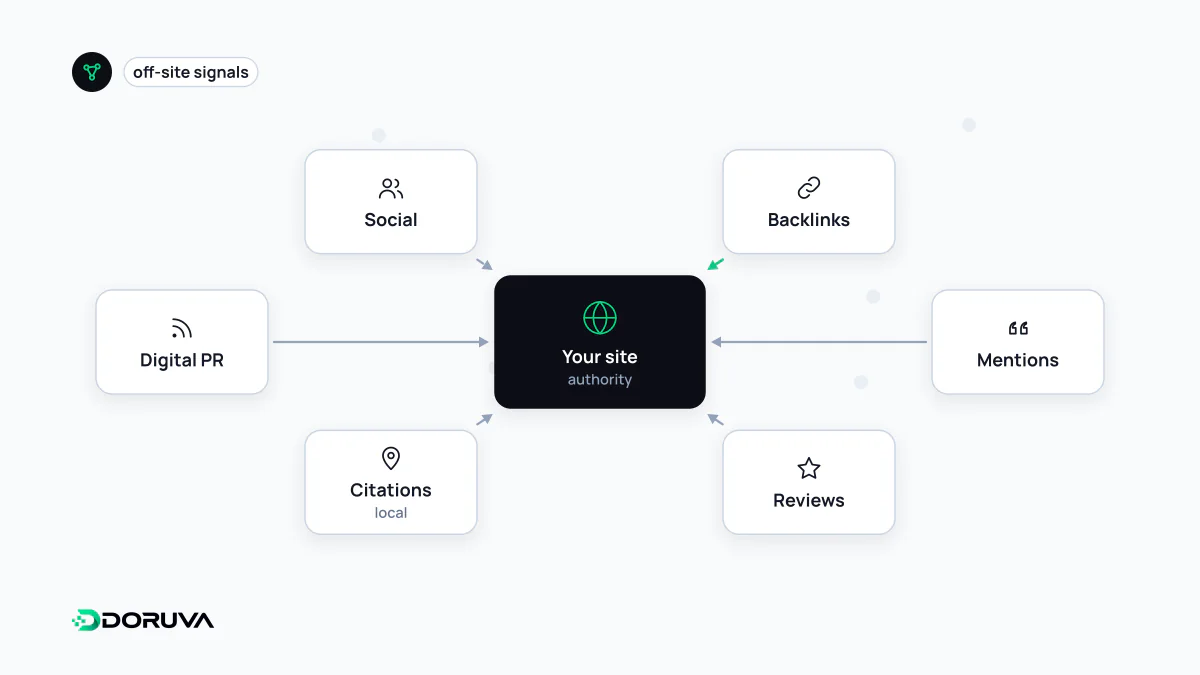
Reputation that forms outside your site
What a site says about itself is only part of the picture; what others say about it is a separate signal. Off-page SEO covers that second part. Google's documentation says it uses links both to find new pages and as a signal when judging how relevant pages are, which is why backlinks are the best-known piece of off-page SEO.
It is not only about link counts, though. Coverage in industry publications, an accurate business profile, real customer reviews and people searching for the brand by name all leave traces that a site is known and trusted. How much each of these affects rankings cannot be isolated, and Google does not publish the weights.
What makes a link worth having
- Context: the link sits on a relevant page, in the natural flow of the text.
- Source quality: the linking site offers real value to its own audience.
- Link text: anchor text that describes the target without being forced.
- Earned, not arranged: the link exists because the content is worth citing.
Scores such as Domain Authority are estimates produced by third-party SEO tools, and Google does not use them. They can help with comparisons but should not become the goal (see Domain Authority).
The line you should not cross: link spam
Under Google's spam policies, links created mainly to manipulate rankings count as link spam. That includes exchanging money, goods or services for links, excessive link swaps done purely for cross-linking, links generated by automated programs, and advertorials distributed with optimized anchor text.
Paid partnerships are allowed as long as the link carries a rel value that says so:
<a href="https://example.com/" rel="sponsored">Example Brand</a>rel="nofollow" is also acceptable in place of rel="sponsored". The differences between these values are covered under nofollow.
Off-page signals for local businesses
For businesses with a physical address or service area, much of off-page SEO runs through the Google Business Profile. Google explains that local results are based on relevance, distance and prominence, and that prominence takes into account information found about the business across the web, including links and articles, as well as review count and ratings. A complete, current profile, genuine customer reviews and consistent replies to them are therefore part of local visibility.
Monitoring off-page signals
- The Links report in Search Console shows a sample of the external links Google knows about and your most-linked pages.
- Tracking new articles that mention your brand reveals unlinked mentions as well as linked ones.
- Whether AI assistants cite your brand as a source is a separate and increasingly relevant signal, covered under AI citation.