

What is Referring Domain?
Definition
A referring domain is a unique domain that has at least one link pointing to your site. A hundred links from the same site count as one referring domain. Because it reflects the breadth of a link profile more realistically than the raw backlink total, it is a core metric in SEO tools; it is not a figure Google publishes, but a count each tool makes from its own crawl data.
Also known as: linking domain, referring root domain, linking root domain, ref domain
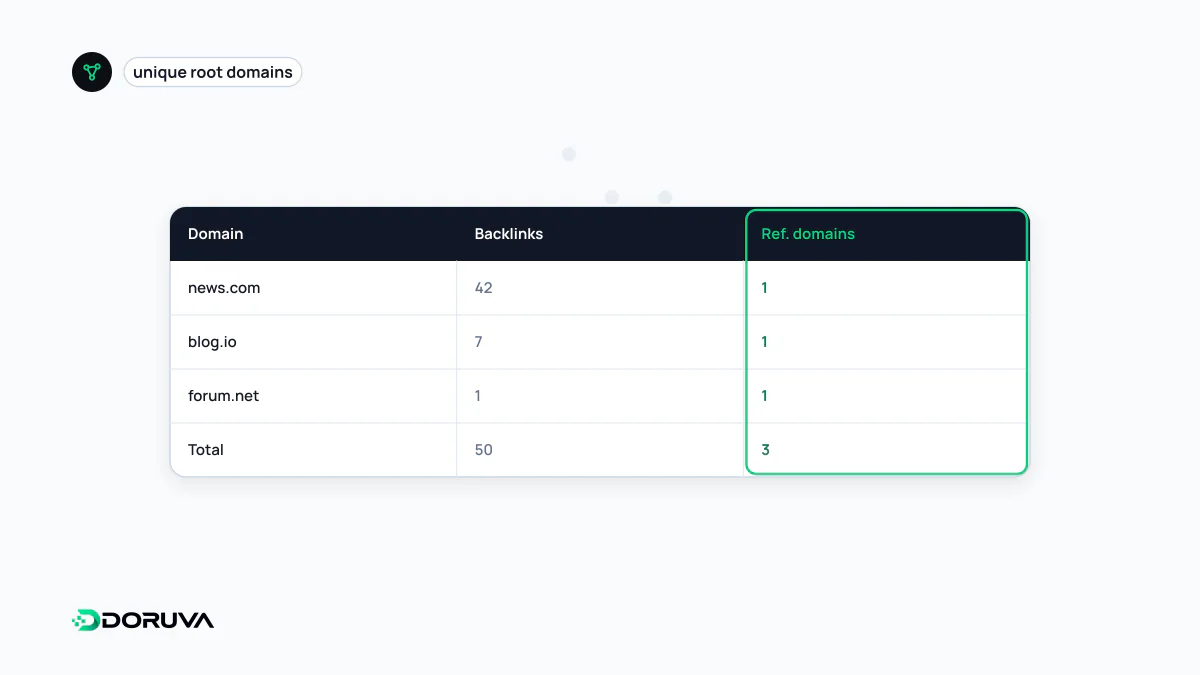
Why backlink totals mislead
Picture a web agency that puts "Site by Example Studio" in the footer of a client's 12,000-page site. A backlink tool may report that as 12,000 backlinks to the agency. In reality one site made one editorial decision. Counting referring domains removes that inflation:
| Source | Backlinks | Referring domains |
|---|---|---|
| Site-wide footer credit on a client site | 12,000 | 1 |
| One article each in three trade publications | 3 | 3 |
| A citation on a university page | 1 | 1 |
A glance at the backlink column suggests the first row matters most, but the breadth of the profile comes from the last two. That is why link analysis usually starts with the number of referring domains rather than the backlink total.
What counts as one domain?
Every tool has its own counting rules. Some treat blog.example.com and www.example.com as separate sources, others merge them, and some also report referring IPs or subnets. Google Search Console's Links report groups data by root domain: protocol, subdomains such as www and m., and subdirectories are all folded together. Top-level domains are not merged, so example.com and example.de appear as two different sites.
What the number tells you, and what it doesn't
Links from many independent sites suggest that your content is being referenced across different communities, which is what an earned link profile normally looks like. Google says in general terms that links feed into its ranking systems, but it has never published how it counts domains or how much a first link from a new domain weighs against a second link from a site that already links to you. Figures on that question come from correlation studies by tool vendors.
Nor does the count say anything about quality on its own. A hundred domains from unrelated, auto-generated sites are worth less than two respected publications in your industry.
Where to see it
In Google Search Console, the "Top linking sites" table in the Links report lists the root domains linking to you most. It is a sample: tables are capped at 1,000 rows, removed links can linger for a while, and the report doesn't say whether a link is nofollow. Third-party tools add history and competitor comparisons, but each sees only the part of the web it crawls, and two tools almost never agree on the number. Their most reliable use is tracking the trend inside one tool over time.
The inflation trap
Because the metric is popular, people try to inflate it: networks of sites owned by the same person, bulk directory submissions, paid blog posts. Google's spam policies explicitly classify such link schemes as link spam. If the report shows spammy domains you don't recognise, remember that Google usually ignores them already; the disavow tool is meant for cases where unnatural links you built or paid for put you at risk of a manual action.